


Listen to the article
Film photography is experiencing a notable revival, particularly among younger generations drawn to its distinctive aesthetic and analog experience. Gen-Z and younger Millennials are embracing film despite the learning curve compared to the digital cameras they grew up with.
George Walker IV, an Associated Press photojournalist based in Nashville, sees the value in film photography as a foundational learning tool. “It forces me to be patient and concentrate to make the pictures that matter,” says Walker, who joined AP in 2023 after three decades at The Tennessean. “You have a finite number of frames on a roll of 35 mm film, usually 24 or 36. And you should make those pictures count.”
Before digital cameras became mainstream in the early 2000s, photography relied entirely on physical film rather than electronic files stored on memory chips. Photographic film consists of light-sensitive cellulose material coated with silver-halide compounds that create a latent image when exposed through the camera lens.
This process results in photographs with a distinctive grainy quality that many find appealing compared to the sometimes too-perfect digital images. Film photography’s resurgence parallels other analog revivals like vinyl records and letter writing, suggesting a broader cultural response to digital fatigue and instant gratification.
Most consumer cameras use 35mm film, which comes in small canisters available at specialty shops, online retailers, and some drugstores. When purchasing film, the ISO rating (film speed) is a crucial consideration. Higher ISO numbers indicate greater light sensitivity – photographers might choose ISO 1600 or higher for low-light situations like indoor sports, while ISO 400 or lower works best in bright conditions.
For beginners, black and white film offers more forgiveness with exposure settings and encourages focusing on composition and lighting fundamentals rather than color.
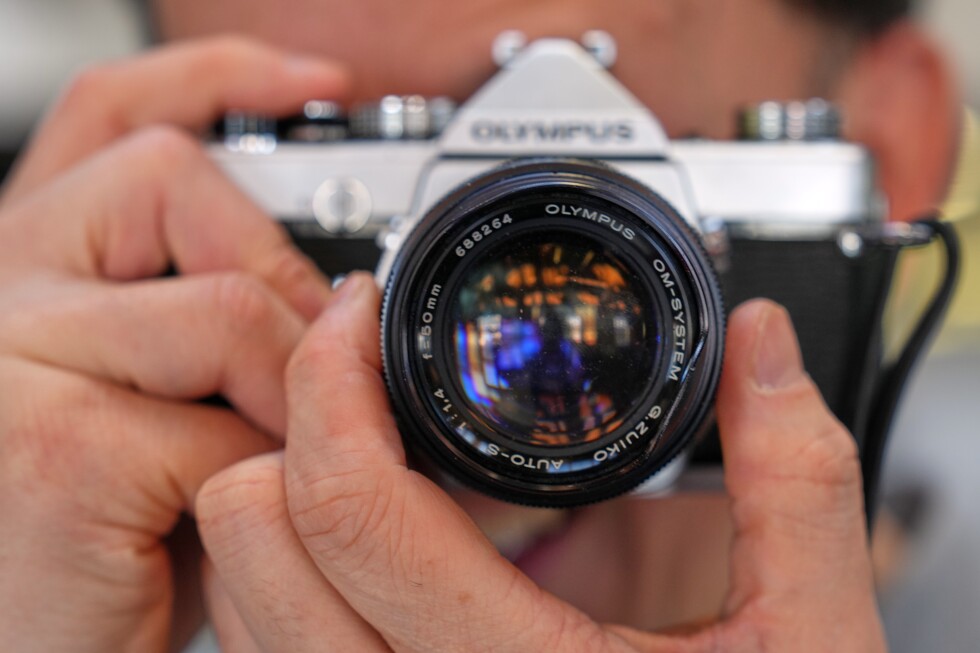
The market for new film cameras has contracted significantly, with only a handful of point-and-shoot, niche, or high-end models currently in production. However, secondhand vintage cameras remain plentiful on platforms like eBay and in specialty camera shops. Models from the “big five” manufacturers of the pre-digital era – Canon, Nikon, Pentax, Olympus, and Minolta – are particularly worth seeking out.
Camera options range from simple point-and-shoot models to more complex single-lens reflex (SLR) cameras. Point-and-shoot cameras are compact, affordable, and user-friendly, typically offering minimal controls beyond a flash button. SLR cameras provide full manual control with various adjustments and interchangeable lenses, making them ideal for learning photography principles, though their size and complexity can intimidate novices.
Loading film requires careful attention. With manual cameras, users must open the back, feed the film leader into the right-side spool, advance the film using the winding lever, and close the camera back. Proper loading is confirmed when the rewind knob rotates during film advancement. Point-and-shoot cameras typically feature automatic winding with interior guides for film placement.
Once loaded, it’s crucial to keep the camera back closed until the film is completely used and rewound to avoid ruining the entire roll.
Manual cameras require understanding exposure controls like shutter speed and aperture (f-stop). Aperture functions like a water faucet – smaller numbers (f/2.8) allow more light than larger numbers (f/16). It also controls depth of field, with smaller f-stop numbers producing less depth of field. Shutter speed determines exposure duration and helps freeze action, with faster speeds like 1/500 second better for capturing movement.
Most manual cameras feature viewfinder light meters to guide proper exposure settings. Manual focusing requires practice, with photographers typically prioritizing eye focus for portraits and determining key elements for landscapes.
After shooting, photographers can have film processed at drug stores, photo shops, community darkrooms, or mail-in labs. Processing costs vary based on turnaround time, film type, exposure count, and additional services. While negatives were once essential for making additional prints, many labs now provide digital files alongside physical prints, though experienced photographers still prefer retaining their negatives.
This analog renaissance represents more than mere nostalgia – it reflects a desire for intentional, tactile creative experiences in an increasingly digital world.
Fact Checker
Verify the accuracy of this article using The Disinformation Commission analysis and real-time sources.

8 Comments
Using an f-stop is a fundamental skill in film photography that helps control depth of field and exposure. It’s fascinating to see this analog technique resurfacing and being embraced by today’s digital-native photographers.
Yes, mastering f-stops and other manual camera controls is crucial for getting the most out of film photography. It’s a great way to build fundamental photographic skills.
Film photography’s resurgence is an intriguing trend. I wonder if it’s also driven by a desire for a more tactile, hands-on creative experience compared to the ubiquity of digital cameras and smartphones today.
That’s a good point. The physical, manual nature of film photography could offer a welcome respite from the digital world for many photographers.
Interesting to see film photography making a comeback, especially among younger generations. The analog process and unique aesthetic must be quite appealing. I wonder how the learning curve and limitations of film compare to the convenience of digital photography today.
You raise a good point. Film photography requires more patience and intentionality, which could be valuable learning experiences for new photographers.
As someone who grew up with digital photography, I’m curious to learn more about the technical aspects of using an f-stop and how it differs from modern digital camera settings. The article provides a helpful introduction to this foundational film photography concept.
The article highlights some interesting contrasts between film and digital photography. While digital may be more convenient, there’s something to be said for the discipline and creative process of working with a limited number of frames on film. I can see the appeal, especially for younger photographers.