


Listen to the article
Oil Prices Surge as Middle East Conflict Disrupts Global Supply
Oil prices have skyrocketed past $90 per barrel as the escalating conflict between the U.S., Israel, and Iran severely disrupts global energy supplies. American crude settled at $90.90 on Friday, representing a 36% increase in just one week, while Brent crude, the international benchmark, climbed 27% to $92.69.
The rapid price surge follows a week of intensifying hostilities that began with major U.S. and Israeli attacks on Iran, which have since expanded into a broader regional conflict. Nearly every country in the Middle East has now experienced damage from missiles or drone strikes.
The conflict has created a critical bottleneck at the Strait of Hormuz, a narrow waterway bordered by Iran that serves as a vital maritime passage for approximately 20 million barrels of oil daily. Ships are currently stranded in the Persian Gulf, unable to navigate safely through the strait.
“The more news we get, the more it seems like this is going to last a really long time,” said Al Salazar, head of macro oil and gas research at Enverus.
The situation worsened when Iran launched retaliatory strikes, including a drone attack on the U.S. Embassy in Saudi Arabia. Iranian forces also hit a major Saudi refinery and a liquefied natural gas facility in Qatar, halting refined product flows and taking roughly 20% of the world’s LNG supply offline.
Kuwait announced on Saturday it would reduce oil production as a “precautionary” measure, potentially creating even greater market disruption.
“Right now, with all of this shut in, we are in a situation of extreme deficit,” explained Claudio Galimberti, chief economist at Rystad Energy. According to his assessment, approximately 9 million barrels of oil per day have been removed from the market due to damaged facilities or precautionary production cuts.
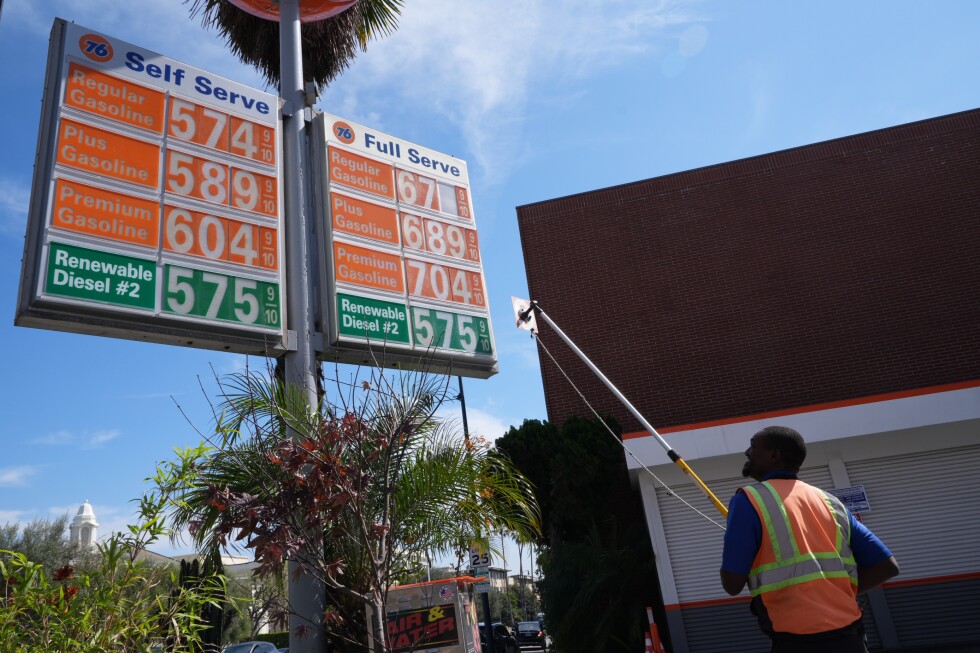
American consumers are already feeling the impact. The national average for a gallon of regular gasoline reached $3.41 on Saturday, jumping 43 cents in a week, according to AAA. Diesel prices have risen even more dramatically, climbing 75 cents to $4.51 per gallon.
The price shock has hit Europe and Asia even harder, as these regions depend more heavily on Middle Eastern energy supplies. Diesel prices doubled in Europe, while jet fuel costs in Asia surged by nearly 200%.
Despite being a net oil exporter, the United States remains vulnerable to global price fluctuations. American oil is traded on international markets, meaning domestic prices rise in response to Middle East disruptions regardless of local production capacity. Additionally, U.S. producers face significant time constraints in ramping up output.
“If you put more wells in the ground, there’s about a six-month lag before you get that production uplift,” Salazar noted.
The U.S. oil infrastructure presents another challenge. Most American crude is light and sweet, while refineries on the East and West coasts are designed to process heavier, sour crude, necessitating both exports of domestic crude and imports of refined products like gasoline.
President Donald Trump stated on Monday that U.S. military operations against Iran were expected to last four to five weeks but acknowledged “the capability to go far longer.” On Friday, he appeared to rule out negotiations with Iran unless it offers “unconditional surrender.”
In response to the crisis, Trump introduced a plan Friday to insure losses up to approximately $20 billion in the Gulf region, aiming to restore confidence in maritime trade and support American and allied businesses.
However, energy experts remain skeptical about the efficacy of insurance solutions. Amy Jaffe, director of the Energy, Climate Justice and Sustainability Lab at New York University, pointed out that traders and shippers are primarily concerned about counterterrorism threats, including automated drone speedboats, weapon-carrying drones, and mines.
For many Americans like Mark Doran from Middlebury, Vermont, the price spike comes at an already difficult economic time. “It’s crazy. It’s not needed, especially at a time when people are already struggling, but not unexpected from all this turmoil,” he said while filling his tank.
The long-term security implications remain a significant concern. As Salazar pointedly asked: “All it takes is one individual with a rocket-propelled grenade to stand on the shore and take out a tanker, right? And this is forever, do you know what I mean?”
Fact Checker
Verify the accuracy of this article using The Disinformation Commission analysis and real-time sources.

14 Comments
The ongoing tensions in the Middle East are certainly concerning. We rely heavily on oil and gas from that region, so any disruptions have major global implications. It will be important to monitor this situation closely and ensure energy security.
Agreed. This conflict has the potential to significantly impact energy markets and supply chains worldwide. Diplomacy and de-escalation should be priorities to mitigate the fallout.
As an energy industry analyst, I’m closely monitoring the situation. The disruption to supply is concerning, but the potential for further escalation is even more worrying. Maintaining a steady and secure energy supply is crucial for the global economy.
Well said. Energy security and price stability are vital national interests. Resolving this conflict through diplomatic channels should be the top priority.
This is a worrying development. The sharp rise in oil and gas prices is going to put a lot of strain on consumers and businesses. Let’s hope the situation can be resolved without further escalation.
Absolutely. High energy costs will ripple through the economy in many ways. Policymakers will need to balance energy security with affordability and sustainability.
This is a challenging situation with no easy solutions. The impact on oil and gas prices is just the tip of the iceberg. The broader geopolitical and economic ramifications could be far-reaching. Let’s hope cooler heads prevail and a peaceful resolution can be found.
Agreed. The stakes are high, and the implications extend well beyond the energy sector. Prudent policymaking and international cooperation will be essential to navigate this crisis.
The situation in the Middle East is deeply troubling. The disruption to global oil and gas supply is already having far-reaching consequences. I hope diplomacy can prevail to de-escalate the conflict and restore stability.
Me too. The world can ill afford further supply chain disruptions and price shocks at this time. Constructive dialogue between all parties involved is essential.
As an investor, I’m closely watching the impact of this conflict on energy equities. The surge in commodity prices could benefit some producers, but the broader geopolitical risks are concerning. Diversification and risk management will be key.
Good point. Energy stocks may see volatile trading as this situation unfolds. Prudent portfolio management will be crucial to navigate the uncertainty.
This is a complex geopolitical situation with major economic implications. While higher energy prices may benefit some producers, the broader impact on consumers and industries is a real concern. Policymakers will need to carefully balance competing interests.
Absolutely. The ramifications of this conflict could be far-reaching. Finding the right policy responses to mitigate the damage will be a delicate balancing act.