


Listen to the article
Nvidia’s Jensen Huang Projects $1 Trillion Order Backlog as AI Boom Accelerates
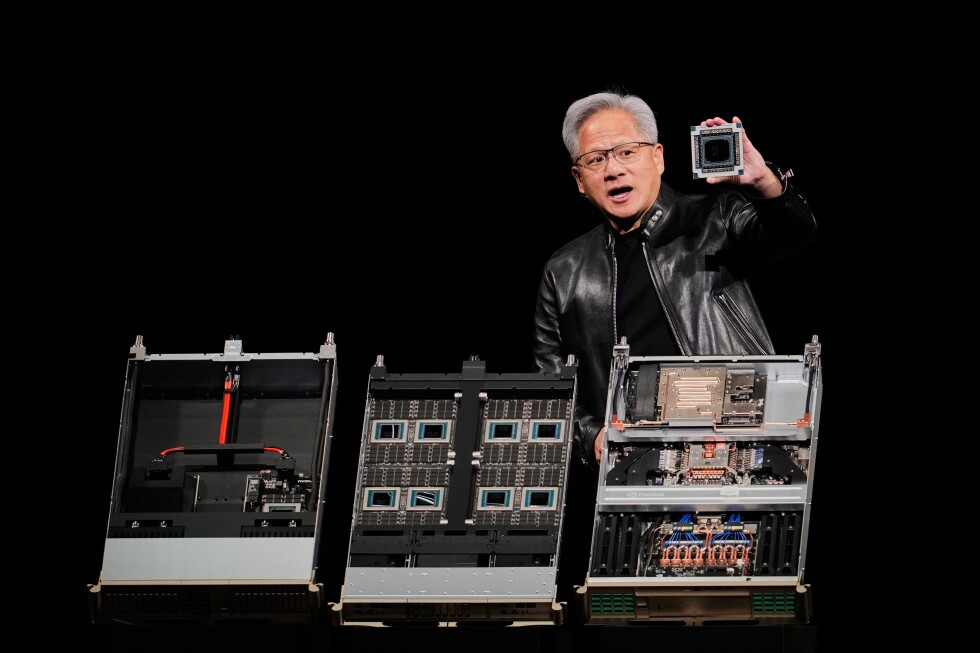
Nvidia CEO Jensen Huang delivered an ambitious forecast Monday, predicting his company will face a $1 trillion backlog in chip orders by year’s end—double his projection from just a year ago. The statement came during a two-hour presentation at a packed arena in San Jose, California, where Huang outlined his strategy for maintaining Nvidia’s dominance in the artificial intelligence market.
Clad in his trademark black leather jacket, the 63-year-old executive emphasized that despite Nvidia’s meteoric rise, the AI revolution remains in its earliest stages. “We reinvented computing, just like the PC revolution and the internet revolution,” Huang told the audience. “We are now at the beginning of a new platform change.”
Nvidia has leveraged its commanding position in AI processors to achieve extraordinary growth, with annual revenue surging from $27 billion in 2022 to $216 billion last year. This performance has propelled the Santa Clara-based company to a market capitalization of $4.5 trillion, making it one of the world’s most valuable corporations.
However, the company’s stock has retreated since briefly crossing the $5 trillion valuation threshold last October, reflecting growing concerns that AI expectations may be overinflated. “This is just a white-knuckle period for the technology industry,” noted Dan Ives, analyst at Wedbush Securities.
Even after releasing quarterly results in February that significantly exceeded analyst forecasts and providing optimistic guidance, Nvidia’s share price remains down approximately 6% from pre-earnings levels. Following Huang’s disclosure about projected order backlogs, the company’s stock edged up nearly 2% to close Monday at $183.22.
While analysts anticipate Nvidia’s revenue will exceed $330 billion in the coming fiscal year, the company faces emerging competitive pressures in the AI chip sector. Technology giants including Google and Meta Platforms are actively developing proprietary processors that could potentially challenge Nvidia’s market leadership.
Compounding these challenges, U.S.-imposed security and trade restrictions have limited Nvidia’s ability to sell its advanced chips in China, constraining potential growth in a significant market.
Huang’s strategy for maintaining Nvidia’s central role in AI development involves both meeting the soaring demand for chips powering popular AI applications like OpenAI’s ChatGPT and Google’s Gemini, while simultaneously expanding into the burgeoning market for inference processors.
Inference chips enable AI systems to apply their training to generate responses—whether writing documents or creating images—more efficiently than the processors used during the initial training phase. “The inference inflection has arrived,” Huang declared during his presentation.
To strengthen its position in this emerging field, Nvidia has entered a multi-billion dollar licensing agreement with inference specialist Groq, which included bringing on board that company’s top engineering talent.
Industry analysts remain bullish on Nvidia’s prospects despite the competitive landscape. “Nvidia isn’t going to cede any market share to Google or Meta,” Ives predicted, expressing confidence that the company’s market value will surpass $6 trillion within the next year.
The company’s trajectory highlights the extraordinary economic impact of artificial intelligence development, with Nvidia establishing itself as the primary beneficiary of the global AI infrastructure buildout. As organizations worldwide rush to implement AI capabilities, Nvidia’s specialized processors have become essential components, creating unprecedented demand that Huang believes will only accelerate.
As the AI sector continues evolving, Nvidia’s ability to maintain its technological edge while navigating competitive pressures, regulatory constraints, and sky-high market expectations will determine whether Huang’s trillion-dollar projection materializes in the coming months.
Fact Checker
Verify the accuracy of this article using The Disinformation Commission analysis and real-time sources.

6 Comments
Exciting times ahead for AI and the tech industry. Nvidia’s ambitious growth projections are a testament to the rapid advancement of AI capabilities and their strategic position in the market. I’m curious to see how this ‘inference inflection’ phase will unfold and impact various sectors.
The AI market appears to be on the cusp of a significant transformation, and Nvidia is well-positioned to lead the charge. Their CEO’s confident projections suggest the company is bullish on the continued growth and widespread adoption of AI technologies. I wonder how this will impact the broader tech landscape.
The AI revolution is clearly gaining momentum, and Nvidia’s impressive order backlog suggests a promising future for the sector. However, I wonder about the potential risks and challenges that may arise as the company scales its operations to meet this surging demand. Navigating the complexities of the AI landscape will be crucial for Nvidia’s continued success.
Nvidia’s $1 trillion order backlog is an impressive milestone, showcasing the surging demand for their AI-powered chips. This highlights the crucial role they play in enabling the next phase of the AI revolution across industries. It will be interesting to see how they manage such a massive order pipeline.
Nvidia’s remarkable financial performance and ambitious growth plans are a testament to the transformative power of AI. As the company further solidifies its position as a leader in this space, it will be interesting to see how the ‘inference inflection’ they describe unfolds and shapes the future of various industries.
While Nvidia’s dominance in the AI processor market is undeniable, I’m curious to see how they navigate the challenges of scaling their production and delivery to meet the $1 trillion order backlog. Effective supply chain management and innovation will be key to maintaining their competitive edge.