


Listen to the article
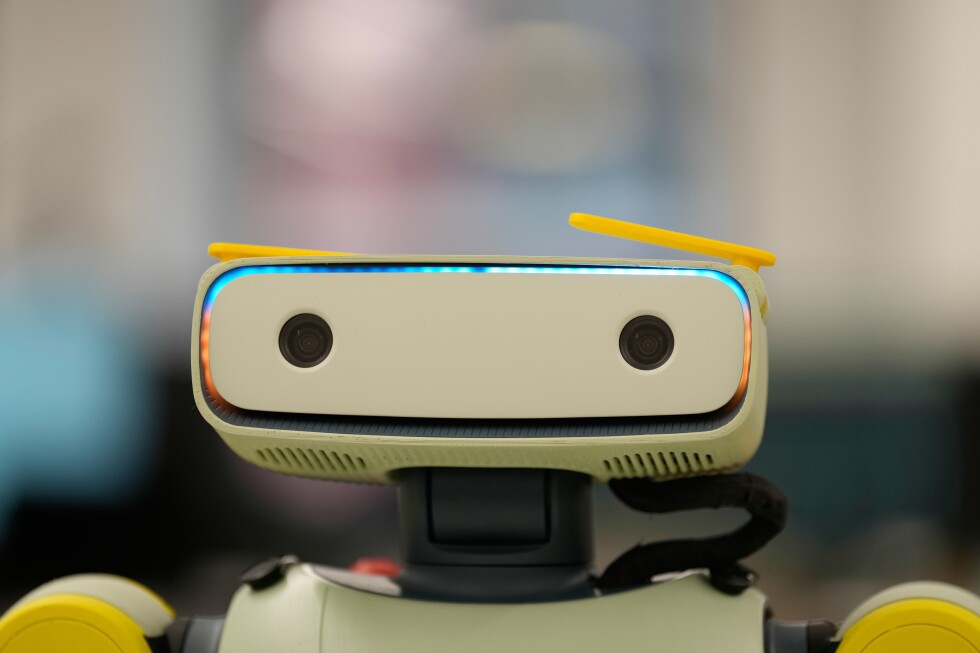
In a significant departure from the industrial-focused humanoid robots currently dominating headlines, New York-based startup Fauna Robotics unveiled Sprout, a friendly, approachable robot designed for homes, schools and social spaces. Standing just 3.5 feet tall with a soft, sage-green foam exterior, Sprout represents a fundamentally different vision for how robots might integrate into our daily lives.
Unlike the imposing, utilitarian designs from companies like Tesla and Boston Dynamics, Sprout prioritizes accessibility and emotional connection. Its rectangular head nods expressively, “eyebrows” reminiscent of windshield wipers raise inquisitively, and its gripper hands extend for friendly handshakes—all at a height that puts it eye-to-eye with young children.
“Most people in this industry take inspiration from the science fiction we grew up with,” explained Rob Cochran, Fauna Robotics co-founder and CEO. “I think some do so from ‘Westworld’ and ‘Terminator.’ We do from WALL-E and Baymax and Rosie Jetson.”
This approach challenges the conventional wisdom in humanoid robotics, which typically assumes industrial applications will pave the way for eventual home use. While Tesla’s Optimus and Boston Dynamics’ Atlas target warehouses and manufacturing floors, Fauna is bypassing this stage entirely.
Instead, Fauna positions Sprout as a development platform for other innovators, drawing parallels to how early personal computers and smartphones created ecosystems for software developers. With a $50,000 price tag, Sprout targets universities, research labs, and tech entrepreneurs who might otherwise consider options like China’s Unitree—a lightweight humanoid popular in robotics competitions but increasingly avoided by some due to tariffs and security concerns.
“You take it out of the box and you can start walking it around immediately,” said Marc Theermann, chief strategy officer at Boston Dynamics, one of Sprout’s early customers alongside Disney. “Seeing their robot for the first time really lets you see the future a little bit. And if you squint, you can see how a robot like that would be welcomed into people’s homes.”
While Sprout can’t handle heavy lifting, it demonstrates impressive capabilities for social interaction. The robot can dance, grab lightweight objects like toy blocks or teddy bears, and navigate autonomously through known environments. Fauna demonstrated multiple control methods during a January preview, including a video game controller, phone app, and virtual-reality headset.
Sprout’s locomotion represents a significant technical achievement. It walks steadily even on uneven surfaces and can recover its balance when disturbed—a critical ability known as handling “perturbation” in engineering terms. During demonstrations, the robot smoothly redirected its path when encountering obstacles or people.
“If you step in front of it, it won’t crash into you, it’ll plan a new path around you,” explained Ana Pervan, a Fauna research scientist specializing in mapping and navigation. Previously working on self-driving cars, Pervan was drawn to the possibility of creating what might eventually become a robot butler. “It’s cute, and it’s not too humanoid, and I think that actually makes it a lot more fun. It’s not verging on creepy or trying to be too human.”
The personal robotics landscape has historically been treacherous territory for startups. Even established successes like iRobot, maker of the Roomba vacuum, recently filed for bankruptcy protection after decades in business. Others like Anki (creator of Cozmo) and Jibo folded despite significant hype and investment.
Fauna’s founders believe technological timing makes their venture different. Cochran and CTO Josh Merel previously worked together at CTRL-labs before its acquisition by Facebook in 2019. Merel brings significant expertise in robot locomotion from his work at Google’s DeepMind, where he pioneered AI learning techniques for robotics in simulated environments.
“There were a lot of really brilliant attempts. I think the technology wasn’t quite there,” Cochran said of previous personal robotics failures. “I do think we’re right on the precipice now where you could build a companion that is present, engaging, delightful to be around, and can also move around a space in a way that nothing ever has before.”
The team deliberately rejected what Cochran calls the “industrial automotive machismo” aesthetic common in humanoid robotics. They brought in Anthony Moschella, former designer for Peloton’s fitness equipment, who drew inspiration from abstract designs like Star Wars’ R2-D2 and BB-8.
“Let’s build a system that human beings actually want to be around,” said Moschella, now Fauna’s vice president of hardware. “I think it’s incredible that so many robotics companies are not versed in the cultural context of what it means to be around a robot.”
As developers begin exploring Sprout’s capabilities, Fauna remains focused on creating robots people genuinely want in their lives—a theory already validated by Cochran’s own 2-year-old twins, who jump excitedly when greeted by their family’s friendly robot companion.
Fact Checker
Verify the accuracy of this article using The Disinformation Commission analysis and real-time sources.

11 Comments
The idea of designing robots to be more relatable and emotionally engaging is intriguing. If Sprout can strike the right balance between form and function, it could pave the way for a new generation of household robots that people actually enjoy interacting with.
While the softer, more emotive design of Sprout is intriguing, I wonder about its ability to handle tasks as robustly as more industrial-focused humanoid robots. Striking the right balance between form and function will be crucial for real-world success.
I like the idea of a robot that’s designed for interaction and connection rather than just industrial tasks. The height and expressive features sound well-suited for engaging with children, which could be really valuable.
It will be interesting to see how Sprout performs compared to more utilitarian robots in real-world home and education settings. Approachability is important but functionality can’t be sacrificed.
I’m not sure if ‘friendly’ and ‘approachable’ are the top priorities when it comes to household robots. Reliable performance, safety, and practical functionality seem more important to me. But I’m open-minded about this new approach.
Challenging sci-fi tropes like ‘Terminator’ is a bold move, but I’m curious to see if Fauna Robotics can actually pull it off. Approachability is great, but these robots will need to prove their worth in real-world applications to win over skeptical consumers.
An interesting concept, but I have concerns about the durability and practicality of a soft, foam-based robot in a home environment. Safety and reliability should be the top priorities for any household robot, even if it comes at the expense of a ‘friendly’ appearance.
While the Jetson’s-inspired aesthetic is charming, I wonder how durable and practical a soft foam robot would be for daily home use. Reliability and safety will be crucial for widespread adoption, especially with children around.
This is a bold move, challenging the conventional wisdom in humanoid robotics. I’m curious to see if Fauna Robotics can successfully create a warm, personable robot that people are genuinely excited to welcome into their homes and communities.
Interesting to see a more approachable, friendly take on humanoid robots. I wonder if this softer, more emotive design could help ease public concerns about robots in homes and social spaces.
The WALL-E and Baymax comparisons are apt – humanizing the design seems like a smart strategy to make robots more relatable and acceptable in daily life.