


Listen to the article
Olympic Gold Medalist Takes on Challenging Role as SafeSport CEO
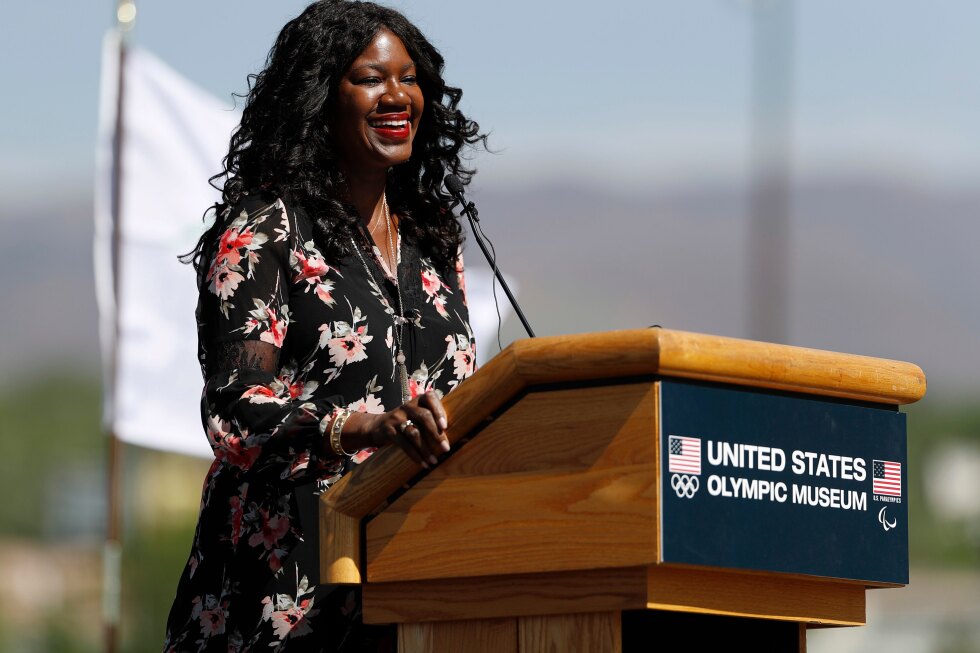
Benita Fitzgerald Mosley, an Olympic gold medalist and experienced sports executive, has stepped into what many consider the most challenging job in American sports. Starting Sunday, she becomes CEO of the U.S. Center for SafeSport, the organization tasked with combating sexual abuse in Olympic sports.
“It’s a hard job,” Fitzgerald Mosley told The Associated Press during a visit to the agency’s Denver headquarters. “On its surface, it probably would scare any normal human to death.” Despite the daunting nature of the role, she feels drawn to the position, describing it as “a calling” that aligns with her personal goals of helping others maximize their potential.
Fitzgerald Mosley brings a unique background to the role. She made history at the 1984 Los Angeles Olympics as the first Black woman to win gold in the 100-meter hurdles. However, her academic credentials may prove more relevant to her new position—she holds a degree in industrial engineering from the University of Tennessee, a discipline focused on optimizing complex systems and improving efficiency.
These skills will be crucial as she takes over an organization that has struggled since its inception nine years ago. SafeSport was created in the aftermath of sexual abuse scandals that the U.S. Olympic and Paralympic Committee (USOPC) and its affiliated sports organizations failed to adequately address. The center faces a monumental task, responsible for protecting approximately 11 million athletes across the country—from Olympic competitors headed to Italy next week to youth participants in local clubs.
The organization has faced persistent criticism regarding its hiring practices, investigation timelines, case management, and response to abuse reports. Fitzgerald Mosley has firsthand knowledge of these challenges, having served on a Congressionally appointed commission that evaluated the Olympic movement and directed some of its sharpest criticism at SafeSport.
“It’s the hardest job in sports,” said Edwin Moses, a fellow 1984 Olympian and hurdles legend who also served on the commission. Moses, who has an engineering background like Fitzgerald Mosley, believes her analytical approach will be valuable. “That background makes you look at a whole organism, and break it down into pieces and elements,” he said. “She’s going to break everything down and analyze it from scratch.”
One immediate challenge is the volume of cases—SafeSport received more than 8,000 reports in 2024 alone. Fitzgerald Mosley is considering implementing one of the commission’s recommendations: creating regional entities licensed by the center to handle grassroots-level cases.
“We may need to alter the structure of how we go about the work,” she explained. “If we’re really, truly trying to change the culture of American sports to focus on athlete well-being and safety, you have to start from the bottom and go to the top.”
Her approach begins with a comprehensive assessment. The center is employing a third-party agency to conduct surveys, focus groups, and individual conversations with staff and stakeholders. “Then we’re going to go back to them and say ‘Thank you for participating. This is what we found, and this is what we’re going to do about it,'” she said.
Fitzgerald Mosley’s track record includes impressive accomplishments in previous roles. At USA Track & Field, she helped increase the organization’s Olympic medal count from 23 at the 2008 Beijing Games to 29 at London 2012. She later worked as the USOPC’s chief of organizational excellence and has held leadership positions at the Laureus Sport for Good Foundation and Women In Cable Television.
She recognizes the structural challenges inherent in the center’s design. Congress created a system where SafeSport receives significant funding from the very organizations it oversees—the Olympic committee and its affiliates. Additionally, the center must balance sensitivity toward abuse victims with fairness to the accused, a fundamental tension that has complicated its mission from the beginning.
When asked about the timeline for implementing changes, Fitzgerald Mosley remained pragmatic but determined. “I’ll be able to tell you in six or nine months, how quickly are we able to turn this barge around,” she said. “Is it three months, is it six months, is it 18 months? I don’t know. But it can’t be 18 years. We’ve got to do this quickly.”
As the Winter Olympics approach and millions of young athletes continue participating in sports nationwide, Fitzgerald Mosley’s engineering mindset and leadership experience will be put to the test in an organization where both the stakes and scrutiny couldn’t be higher.
Fact Checker
Verify the accuracy of this article using The Disinformation Commission analysis and real-time sources.

14 Comments
This is an important position that requires someone with a strong moral compass and commitment to protecting athletes. Mosley’s credentials and determination seem well-suited for the task at hand.
Absolutely. Tackling abuse and misconduct in Olympic sports will take courage and vision. Hopefully Mosley can bring positive change and restore trust in the system.
This is a critical role that demands someone with empathy, integrity, and a commitment to athlete safety. Mosley’s personal and professional qualifications seem well-suited to the challenge.
Agreed. Restoring faith in the organization after past failures will require strong leadership. Mosley’s passion for helping others reach their potential could be a real asset in this endeavor.
While the SafeSport job is daunting, Mosley’s background as an Olympic champion and industrial engineer could bring a fresh perspective. Her drive to make a difference is admirable.
Absolutely. Solving complex organizational issues requires a multi-faceted approach. Mosley’s combination of athletic, academic, and executive experience may prove invaluable in this high-stakes role.
Mosley’s willingness to take on this challenge is impressive. Restoring trust and accountability in Olympic sports after past scandals will be no easy feat, but her passion and qualifications suggest she’s up for it.
Agreed. This is a pivotal moment for SafeSport, and having a leader like Mosley who is both an accomplished athlete and a trained problem-solver could make all the difference.
Fixing the issues at SafeSport won’t be easy, but Mosley’s background as an athlete and engineer could give her a unique perspective. I’m curious to see the specific strategies she plans to implement.
Good point. Her combination of sports experience and analytical skills may allow her to identify and address systemic problems in ways previous leaders couldn’t. It will be interesting to follow her progress.
Interesting that an Olympic gold medalist would take on this challenging role. Combating abuse in sports is critical but also complex. Mosley’s engineering background could bring a fresh, analytical approach to the problems.
Yes, her technical expertise may be very valuable in optimizing the organization’s processes and systems. It’s a tough job, but her passion for helping others reach their potential is admirable.
It’s encouraging to see an experienced professional like Mosley take the helm at SafeSport. Her background in industrial engineering and sports could provide valuable insights for addressing the organization’s complex issues.
Absolutely. Mosley’s dual expertise in high-performance athletics and process optimization may give her a unique advantage in tackling the deep-rooted problems at SafeSport. I’m hopeful she can bring positive change.