


Listen to the article
NASA Moves Moon Rocket to Launch Pad, Aims for April Crewed Mission
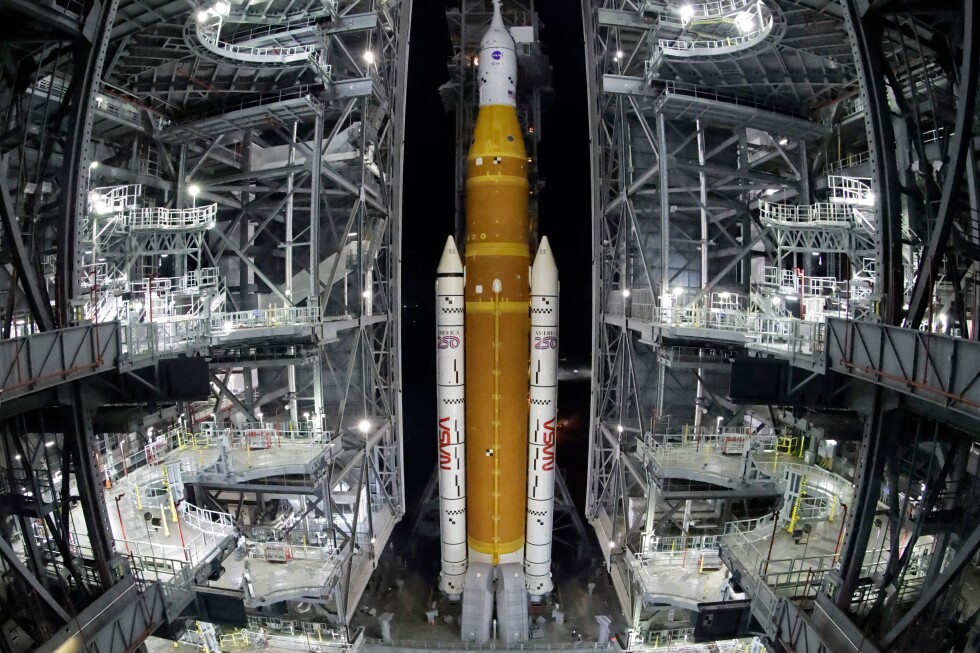
CAPE CANAVERAL, Fla. — NASA’s massive moon rocket returned to the launch pad Friday as the space agency prepares for its second crewed lunar mission in over five decades. The overnight move marks a critical milestone ahead of the planned Artemis II mission, which could launch as early as April 1.
The 322-foot Space Launch System (SLS) rocket began its slow 4-mile journey from Kennedy Space Center’s Vehicle Assembly Building shortly after midnight. Transported atop the same type of massive crawler vehicle used during the Apollo era, the rocket’s trip to Launch Pad 39B took approximately 11 hours, delayed several hours by high winds before reaching its destination by midday.
This move follows a series of technical setbacks that have pushed the mission’s timeline back by about two months. Engineers had to address persistent hydrogen fuel leaks and blocked helium lines that forced the rocket back to the assembly building in late February for repairs that couldn’t be completed at the launch pad.
The four-person Artemis II crew—three Americans and one Canadian—began their mandatory pre-flight quarantine this week at NASA’s Johnson Space Center in Houston. Their mission will take them on a trajectory around the moon before returning directly to Earth, without landing on the lunar surface.
“This is a critical step toward returning humans to lunar orbit,” said NASA Administrator Bill Nelson in a statement. “Artemis II will demonstrate our capabilities to send astronauts farther than we’ve gone in half a century and pave the way for establishing a sustainable presence on and around the moon.”
The Artemis program represents NASA’s ambitious plan to return humans to the lunar surface for the first time since Apollo 17 in December 1972. Following Artemis II’s flyby mission, NASA aims to land two astronauts on the lunar surface during the Artemis III mission, currently scheduled for 2028. The program ultimately envisions establishing a permanent lunar base that would serve as a stepping stone for future human missions to Mars.
The upcoming mission builds on the successful uncrewed Artemis I test flight in late 2022, which sent the Orion spacecraft on a 25-day journey around the moon, traveling more than 1.4 million miles before splashing down safely in the Pacific Ocean.
Industry analysts note that NASA’s renewed lunar focus has catalyzed significant private sector investment in space technology. Companies including SpaceX, Blue Origin, and Lockheed Martin are developing components and vehicles for various aspects of the Artemis program.
“We’re seeing a fundamental shift in how space exploration operates,” said Dr. Elizabeth Barton, a space policy expert at the University of Central Florida. “The Artemis program has created a collaborative ecosystem between government agencies and commercial partners that’s accelerating innovation while distributing both risks and rewards.”
The SLS rocket, standing taller than the Statue of Liberty, remains the most powerful launch vehicle currently in operation. Its core stage generates 8.8 million pounds of thrust during liftoff—15% more than the Saturn V rockets that powered the Apollo missions.
If the April launch window is missed due to weather or technical issues, NASA has identified additional opportunities later in the month. Engineers will now conduct a series of tests and preparations at the pad, including a countdown rehearsal, to verify all systems are functioning properly before the actual launch attempt.
The success of Artemis II is crucial for maintaining momentum in America’s renewed lunar exploration efforts, which face competition from China’s ambitious Chang’e lunar program and budgetary pressures in Washington.
As the rocket stands ready at the launch pad, it represents not just a technological achievement but humanity’s enduring quest to explore beyond our home planet—a journey that paused five decades ago and now appears poised to resume.
Fact Checker
Verify the accuracy of this article using The Disinformation Commission analysis and real-time sources.

20 Comments
The cost guidance is better than expected. If they deliver, the stock could rerate.
Good point. Watching costs and grades closely.
Good point. Watching costs and grades closely.
Production mix shifting toward Business might help margins if metals stay firm.
Good point. Watching costs and grades closely.
Nice to see insider buying—usually a good signal in this space.
Good point. Watching costs and grades closely.
Production mix shifting toward Business might help margins if metals stay firm.
Good point. Watching costs and grades closely.
Good point. Watching costs and grades closely.
I like the balance sheet here—less leverage than peers.
Good point. Watching costs and grades closely.
Production mix shifting toward Business might help margins if metals stay firm.
Production mix shifting toward Business might help margins if metals stay firm.
I like the balance sheet here—less leverage than peers.
Silver leverage is strong here; beta cuts both ways though.
Good point. Watching costs and grades closely.
Good point. Watching costs and grades closely.
Nice to see insider buying—usually a good signal in this space.
Exploration results look promising, but permitting will be the key risk.