


Listen to the article
NASA’s Second Attempt at Moon Rocket Fueling Proceeds Without Issues
NASA engineers made significant progress Thursday during their second attempt to fuel the agency’s massive moon rocket, a crucial test that could determine whether astronauts return to lunar orbit as early as March.
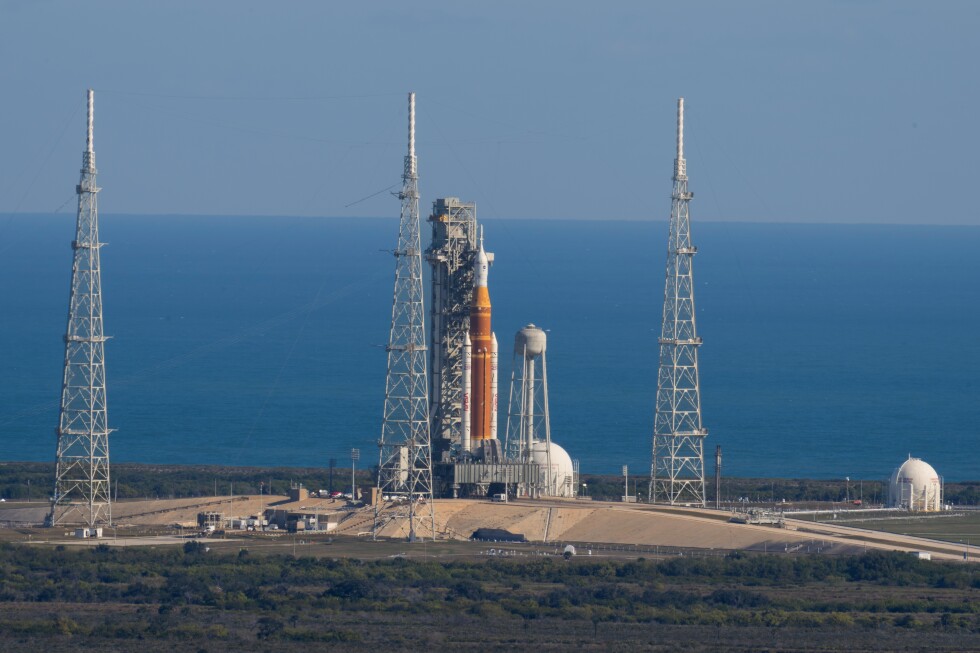
Launch teams at Kennedy Space Center successfully pumped more than 700,000 gallons of supercold fuel into the 322-foot Space Launch System (SLS) rocket positioned on the launch pad. By midway through the procedure, no notable leaks had been reported, marking a substantial improvement over the previous attempt.
The fueling operation represents the most challenging part of a two-day practice countdown necessary before NASA can set a launch date for the Artemis II mission, which will carry four astronauts on humanity’s first journey to the moon since Apollo 17 in 1972.
Two weeks ago, dangerous amounts of supercold liquid hydrogen escaped from connections between the pad and the rocket during the initial rehearsal, forcing engineers to abort the test. In response, the team replaced a pair of seals and a clogged filter before Thursday’s second attempt.
Three of the mission’s U.S.-Canadian crew members joined the launch team later in the day to monitor progress. If successful, the earliest possible launch date for Artemis II would be March 6, 2025. Unlike the Apollo missions, this crew won’t orbit or land on the lunar surface but will instead complete a 10-day out-and-back journey, paving the way for future lunar exploration.
NASA has long struggled with hydrogen fuel leaks, dating back to the space shuttle era, which provided many of the engines now used in the SLS rocket. The first uncrewed Artemis test flight faced similar issues, being grounded for months before finally launching in November 2022.
Jared Isaacman, NASA’s new administrator and a tech entrepreneur who previously financed his own orbital trips through SpaceX, has identified the infrequency of launches as a key factor exacerbating these technical challenges.
“We will not launch unless we are ready and the safety of our astronauts will remain the highest priority,” Isaacman stated last week on social media platform X.
Despite being just two months into his role, Isaacman has already committed to redesigning the fuel connections between the rocket and launch pad before the Artemis III mission, which aims to land two astronauts near the moon’s south pole in the coming years.
During Thursday’s fueling test, Isaacman also addressed another critical safety issue facing NASA’s human spaceflight program. He released a scathing report on Boeing’s Starliner capsule program, which left two astronauts stranded aboard the International Space Station for months earlier this year. Isaacman stated the situation could have resulted in loss of crew and placed responsibility on both Boeing and NASA leadership for the problems.
The successful completion of this fueling test would mark a significant milestone for NASA’s Artemis program, which aims to establish a sustainable human presence on and around the moon. This broader initiative represents the most ambitious human spaceflight endeavor since the Apollo era and serves as a stepping stone for eventual human missions to Mars.
The upcoming Artemis II mission will be closely watched by international partners and commercial space companies, as NASA’s lunar return strategy involves unprecedented collaboration across government agencies, private industry, and international space programs.
If the current test proceeds without further complications, NASA will analyze the data before officially announcing a target launch date for the Artemis II mission, potentially setting the stage for the first humans to venture beyond low Earth orbit in over half a century.
Fact Checker
Verify the accuracy of this article using The Disinformation Commission analysis and real-time sources.

9 Comments
Overcoming technical challenges like the hydrogen leak is par for the course with complex rocket systems. Kudos to the NASA team for their persistence and quick troubleshooting to get the fueling test back on track.
Absolutely. Reliability and safety are paramount when sending humans to the moon. Glad they were able to identify and fix the issues from the previous attempt.
The Artemis program represents a new chapter in human space exploration. I’m curious to see what scientific and technological advancements may come from this mission that can benefit life on Earth.
Interesting that this is the first crewed lunar mission since Apollo 17 in 1972. It will be exciting to see what advancements in rocketry and space travel have been made in the intervening decades.
Yes, the 50-year gap since the last crewed lunar mission is quite remarkable. I’m eager to see how the Artemis program builds on the legacy of Apollo.
The Artemis program holds a lot of promise for advancing space exploration and lunar science. Curious to see what new discoveries and technologies may come out of this mission.
Successful fueling tests are a critical milestone, but there’s still a long road ahead before the Artemis astronauts can head to the moon. I hope the rest of the launch preparations go smoothly.
Agreed. With complex missions like this, it’s important not to overlook any details. Kudos to NASA for their diligence in testing and preparing every aspect.
Exciting to see NASA making progress on the Artemis mission. Proper fueling tests are crucial for a safe and successful moon landing. I’m curious to see what the final launch date will be and which astronauts will be chosen for this historic journey.