


Listen to the article
NASA Begins Critical Test for First Crewed Moon Mission Since Apollo Era
NASA has commenced a pivotal two-day practice countdown that will determine the launch timeline for humanity’s return to lunar exploration after more than five decades. The test, which began Saturday at Kennedy Space Center in Florida, will culminate in the fueling of the massive Space Launch System (SLS) rocket—a crucial milestone that will influence when the first crewed lunar mission since 1972 can lift off.
Commander Reid Wiseman and his three-person crew are already in medical quarantine to prevent illness before their historic journey. The quartet, comprising American and Canadian astronauts, will monitor the dress rehearsal remotely from their Houston base. Once the rocket passes this critical test, they will transfer to Kennedy Space Center for final launch preparations.
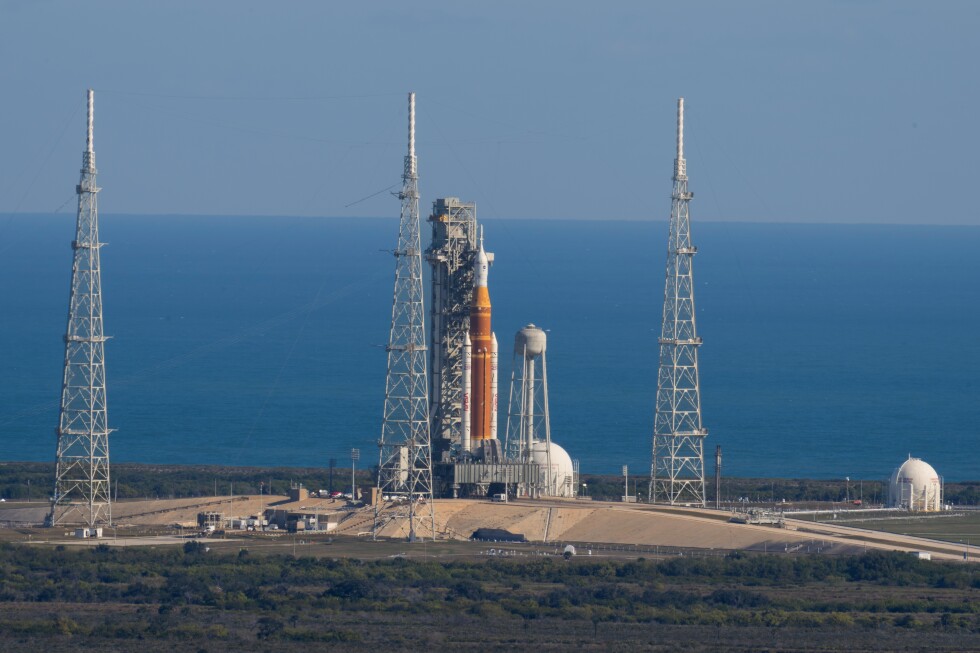
The imposing 322-foot SLS rocket was rolled out to Launch Pad 39B two weeks ago. Engineers will conduct the high-stakes fueling demonstration on Monday, filling the rocket’s tanks with more than 700,000 gallons of cryogenic propellants. The test will proceed through the entire pre-launch sequence, stopping just 30 seconds before the engines would normally ignite.
“This is essentially a full launch countdown without actually launching,” explained a NASA spokesperson. “We need to verify all systems operate as expected with the extreme cold of the propellants loaded.”
A recent cold snap at Cape Canaveral forced a two-day postponement of both the fueling test and potential launch date. If Monday’s test proceeds without significant issues, NASA could attempt a launch as soon as February 8, though officials caution that date remains tentative.
The mission, designated Artemis II, represents the first crewed flight of NASA’s Artemis program, which aims to establish a sustainable human presence on and around the moon later this decade. Artemis I successfully completed an uncrewed test flight around the moon in late 2022, validating the spacecraft systems before human occupancy.
During their approximately 10-day mission, the four astronauts will travel farther from Earth than any humans since Apollo 17 in December 1972. They will ride in the Orion spacecraft atop the SLS rocket, reaching lunar orbit before making a direct return to Earth without landing on the lunar surface. The mission will conclude with a splashdown in the Pacific Ocean.
The flight profile mirrors Apollo 8’s historic Christmas 1968 mission, when astronauts Frank Borman, Jim Lovell, and Bill Anders became the first humans to orbit the moon. This time, however, the spacecraft features modern technology and safety systems that far exceed Apollo-era capabilities.
The Artemis program represents NASA’s renewed focus on deep space exploration after decades of concentrating on low Earth orbit operations with the Space Shuttle and International Space Station. It also marks significant international cooperation, with Canada providing a crew member and the European Space Agency supplying the service module that powers the Orion spacecraft.
Artemis II serves as the final dress rehearsal before Artemis III, which aims to land the first woman and first person of color on the lunar surface as early as 2026. That mission will utilize SpaceX’s Starship vehicle as a lunar lander under NASA contract.
The Apollo program sent 24 astronauts to lunar space between 1968 and 1972, with 12 of them walking on the moon’s surface. Eugene Cernan, commander of Apollo 17, remains the last person to leave footprints on lunar soil—a distinction that will stand until Artemis III astronauts step onto the lunar surface in the coming years.
The current mission comes amid renewed global interest in lunar exploration, with China, India, Japan, and private companies all advancing their own moon programs, signaling a new international space race focused on establishing a permanent lunar presence.
Fact Checker
Verify the accuracy of this article using The Disinformation Commission analysis and real-time sources.

14 Comments
A bit skeptical about the timeline and whether they’ll be able to stick to it, but NASA has a proven track record of overcoming technical challenges. Curious to see if they can pull this off on schedule.
Fair point. Space missions are always full of unexpected hurdles. As long as they maintain a thorough, methodical approach, I’m confident NASA can make this happen.
Exciting to see NASA gearing up for their first crewed moon mission in over 50 years. The SLS rocket test will be a crucial milestone – glad they’re taking the time to do a full dress rehearsal to ensure everything goes smoothly for the actual launch.
With the latest advances in space technology, I’m excited to see what new discoveries and innovations come out of this mission. The possibilities for scientific breakthroughs are endless.
I wonder if this mission will help revive public interest and funding for space exploration. The Apollo era sparked so much excitement – hopefully this can do the same and pave the way for even more ambitious goals.
The SLS rocket sounds like a true engineering marvel. I wonder how its capabilities compare to the rockets used in the Apollo era. Hopefully this mission paves the way for even more ambitious lunar and deep space exploration.
Over 700,000 gallons of cryogenic propellants – that’s an enormous amount of fuel needed to get the SLS rocket off the ground and to the moon. Glad NASA is taking the time to thoroughly test the fueling process.
The scale of this mission is truly impressive. I’m glad NASA is being so thorough in their testing to ensure a safe and successful launch.
Astronauts in medical quarantine – smart move to minimize the risk of illness before the big mission. Curious to see the final crew composition and how the Canadian astronaut will contribute to this historic flight.
Agreed, having a diverse international crew is important for the future of space exploration. I wonder what unique skills and perspectives the Canadian astronaut will bring to the team.
Fantastic to see the international collaboration on this mission. Space exploration should bring the world together, not divide it. I’m hopeful this will be the start of a new era of global cooperation in space.
Kudos to the NASA team for their hard work and dedication. Returning humans to the moon is no easy feat, but their expertise and perseverance will surely shine through.
Glad to see the US and Canada collaborating on this historic mission. International cooperation is key for the future of space travel. Can’t wait to see the crew in action!
Curious to see if this will reignite public interest in space exploration the way the Apollo missions did. This could be a turning point in getting people excited about the possibilities of returning to the moon.