


Listen to the article
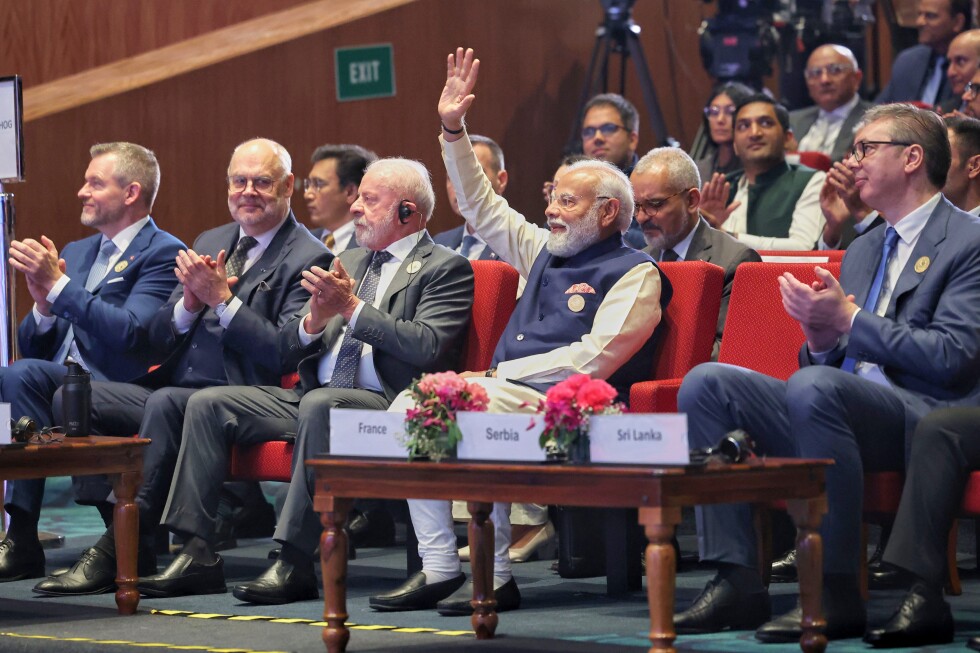
Indian Prime Minister Narendra Modi positioned India as a pivotal player in the global artificial intelligence landscape on Thursday, unveiling his vision for the country to develop homegrown technology with worldwide impact.
“Design and develop in India. Deliver to the world. Deliver to humanity,” Modi told attendees at the India AI Impact Summit in New Delhi, which drew world leaders, technology executives, and policymakers.
Modi’s ambitious statements come as India—one of the world’s fastest-growing digital markets—seeks to capitalize on its experience in building large-scale digital infrastructure. The government aims to establish the nation as a cost-effective hub for AI innovation while bridging advanced economies and developing nations.
The high-profile summit featured addresses from French President Emmanuel Macron, Google CEO Sundar Pichai, and UN Secretary-General António Guterres. In his remarks, Guterres called for a $3 billion fund to help developing countries build essential AI capacity, including skills, data access, and affordable computing resources.
“The future of AI cannot be decided by a handful of countries, or left to the whims of a few billionaires,” Guterres emphasized, advocating for AI as a resource that must “belong to everyone.”
Indian officials are promoting their country’s digital identification system and online payment networks as models for low-cost AI deployment, especially in emerging economies. With a population of 1.4 billion and nearly a billion internet users, India represents an enormous market and potential talent pool for AI development.
“We must democratize AI. It must become a tool for inclusion and empowerment, particularly for the Global South,” Modi said, highlighting India’s potential role as a technological bridge between developed and developing nations.
The country has recently attracted significant foreign investment in its AI ecosystem. Microsoft announced a $17.5 billion investment over four years to expand cloud and AI infrastructure in India. This followed Google’s $15 billion commitment over five years, which includes plans for its first AI hub in the country. Amazon has pledged $35 billion by 2030, focusing on AI-driven digitization efforts.
India is also aiming to secure up to $200 billion in data center investments in the coming years, addressing a critical infrastructure need for AI development.
Despite these advances, India faces substantial challenges in competing with established AI powerhouses. The country has yet to develop large-scale AI models comparable to those from U.S.-based OpenAI or China’s DeepSeek. This gap reflects several obstacles, including limited access to advanced semiconductor chips, insufficient data center capacity, and the complexity of incorporating hundreds of local languages into AI systems.
The summit itself has not been without controversy. The event opened on Monday with organizational difficulties as attendees and exhibitors reported lengthy delays and stolen personal belongings and display items, though organizers later announced the recovery of these items.
Further complications arose on Wednesday when a private Indian university was expelled from the summit after a staff member presented a commercially available Chinese-made robotic dog as the institution’s own innovation, damaging the credibility of India’s indigenous technology narrative.
The challenges continued Thursday when Microsoft co-founder Bill Gates withdrew from a scheduled keynote address without explanation. The Gates Foundation later stated the decision was made “to ensure the focus remains on the AI Summit’s key priorities.” Gates has recently faced renewed scrutiny regarding his past connections to Jeffrey Epstein.
Despite these setbacks, the summit represents India’s determination to establish itself as a significant player in the global AI ecosystem. The government’s focus on developing AI solutions that can address the unique challenges of emerging economies could potentially position India as an important counterbalance to Western and Chinese dominance in this critical technology sector.
Fact Checker
Verify the accuracy of this article using The Disinformation Commission analysis and real-time sources.

8 Comments
India’s focus on ‘design and develop in India, deliver to the world’ is an intriguing model. Leveraging local expertise while aiming for global impact could make India a unique player in the AI landscape.
Guterres’ call for a $3 billion fund to support AI capacity in developing nations is a welcome initiative. Equitable access to AI tools and skills is key to inclusive growth. India’s hosting of this summit signals its desire to shape the global AI landscape.
India’s AI ambitions are bold, but practical challenges around data access, computing resources, and talent development will need to be addressed. Striking the right balance between innovation and ethical AI principles will be critical.
The participation of global leaders like Macron and Guterres highlights the far-reaching implications of India’s AI aspirations. Aligning these ambitions with broader sustainable development goals will be a key test.
Interesting to see India positioning itself as a cost-effective hub for AI development. This could open up new opportunities for collaboration between advanced and developing economies. Bridging the digital divide will be crucial to making AI accessible worldwide.
The India AI Impact Summit brings together an impressive array of stakeholders. Translating high-level political rhetoric into tangible outcomes for citizens in India and beyond will be the real test of success.
India’s ambition to become a global AI hub is an exciting development. Leveraging its tech talent and large digital market could make it a formidable player in this space. The challenge will be ensuring AI innovation benefits all segments of society.
India’s large digital user base and growing tech talent pool make it well-positioned to become an AI powerhouse. But inclusive development and ethical considerations must be at the forefront of its strategy.