


Listen to the article
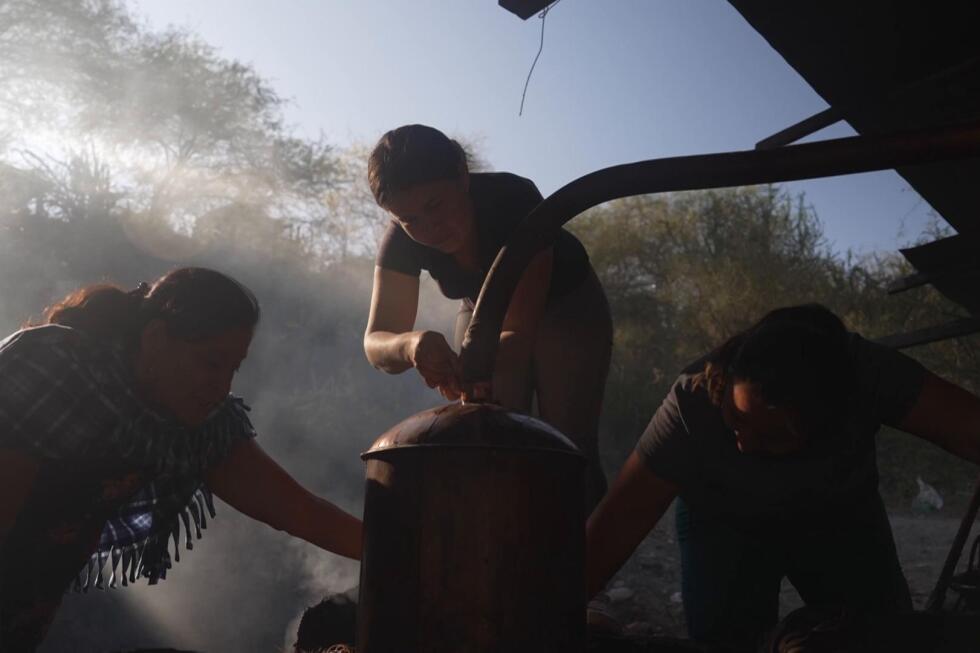
Thirty years ago in rural Oaxaca, Gladys Sánchez Garnica’s family mezcal distillery operated by the light of a single bulb. As the smoky agave spirit dripped from clay ovens, her parents passed down generations of knowledge about sustainable harvesting practices while neighbors arrived on horseback for a taste of their craft.
“We were taught when to harvest agave, how to care for the soil, and how much we could ask of the forest,” said Garnica, 33, from the women-owned distillery in San Pedro Totolapam, a small town of 3,000 residents in Oaxaca’s Central Valleys where mezcal forms the backbone of the local economy.
Today, this modest tradition exists alongside an unprecedented global boom that has transformed mezcal from a locally cherished spirit into a major international industry. The rapid expansion has brought both economic opportunities and mounting environmental challenges to Mexico’s mezcal heartland.
Along roads leading to communities like San Luis del Rio, where celebrity brands such as Dos Hombres—created by “Breaking Bad” actors Bryan Cranston and Aaron Paul—source their product, vast agave plantations now blanket hillsides that were once covered in forest.
The numbers tell a dramatic story of growth. Mexican mezcal production has surged from approximately 1 million liters in 2010 to more than 11 million liters in 2024, according to COMERCAM, Mexico’s regulatory body for the spirit. Nearly all production occurs in Oaxaca, with roughly 75% of exports destined for the United States market.
This expansion has left an indelible mark on the landscape. A study led by Rufino Sandoval-García, professor at the Technological University of the Central Valleys of Oaxaca, found that in just two major mezcal-producing regions, over 34,953 hectares of tropical dry and pine oak forests—an area roughly the size of Detroit—have been cleared for agave cultivation over the past 27 years.
The research revealed that agave plantations in these regions have expanded by more than 400% over three decades. Increasingly, these monoculture plantations are replacing both forests and traditional farmland with espadin agave, the variety used in most commercial mezcal production.
“It will take a long time for the ecosystem to recover the resilience it once had,” Sandoval-García warned, noting that this transformation is accelerating soil erosion, reducing carbon capture by approximately 4 million tons annually, limiting groundwater recharge, and creating localized heat islands in heavily planted areas.
The environmental footprint of mezcal production has always been significant. Producing a single liter requires at least 10 liters of water for fermentation and distillation, and generates waste products like bagazo (fibrous residue) and vinazas (wastewater) that are often dumped untreated into local rivers. The process also demands substantial quantities of firewood to roast agave and fuel distillation, much of which comes from illegal logging operations.
Félix Monterrosa, a third-generation producer from Santiago Matatlan who owns the Oaxacan brand CUISH, laments how industrial-scale production has displaced the traditional milpa system he learned from his ancestors, where corn, beans and pumpkin were grown alongside agave in a balanced ecosystem.
“Now everything is monoculture, and that is the real problem,” Monterrosa said. In his hometown, decades of dumping mezcal waste into the local river have left it so polluted that residents nicknamed it the “Nilo,” short for “ni lo huelas”—”don’t even smell it.”
Water scarcity compounds these challenges. Oaxaca experienced its worst drought in more than a decade in 2024, according to Mexico’s National Water Commission. In response, some producers like Armando Martínez Ruiz from Soledad Salinas have installed systems to cool and reuse water during distillation. “We never had enough water here, so I try not to waste it,” he explained.
Despite growing environmental concerns, the economic benefits of the mezcal boom are undeniable in a region with some of Mexico’s highest poverty rates. Luis Cruz Velasco, a producer from San Luis del Rio who works with Mexican brands like Bruxo, noted that the industry now employs nearly every family in his town of 300 residents. Where previous generations lived in thatched houses, mezcal income has enabled his siblings to attend university.
“There are many people who criticize us and ask what we do to reforest,” Velasco said. “But we have to look for a livelihood and food.”
Major companies are beginning to address sustainability issues. Del Maguey, one of the world’s top-selling mezcal brands, reports reusing more than 5,000 tons of bagazo and 2 million liters of vinaza over five years to build flood prevention infrastructure at one of their distilleries.
In Oaxaca, where much land is communally owned, converting forest to agave plantations legally requires federal approval from Mexico’s Secretary of Environment and Natural Resources. However, the permitting process is so cumbersome that some communities bypass it entirely, according to Helena Iturribarria from Tierra de Agaves, a conservation initiative promoting sustainable agave production.
Amid these challenges, local producers are finding ways to preserve both tradition and environment. In 2018, Garnica founded “Guardians of Mezcal,” a women’s collective promoting sustainable production methods, including using only fallen trees for firewood and planting agave alongside other crops to maintain biodiversity.
“Mezcal is a way of life, like a form of work that our parents taught us,” Garnica said. “If there is a funeral, a wedding, a party, mezcal is a drink you are going to share with others, and above all many families depend on it.”
Fact Checker
Verify the accuracy of this article using The Disinformation Commission analysis and real-time sources.

19 Comments
This article highlights the delicate balance required to support economic development while also protecting the environment and cultural heritage. It will be interesting to see how the mezcal industry evolves to address these challenges.
This is an important issue that deserves more attention. The environmental impact of rapid expansion in the mezcal industry could have serious long-term consequences if not properly addressed.
The growth of celebrity-backed mezcal brands is an interesting development. I wonder how those producers are addressing sustainability and supporting the local communities compared to traditional distilleries.
That’s a good point. The influence of larger commercial interests could pose risks to the existing local mezcal culture and practices if not managed properly.
The shift from small family distilleries to large-scale agave plantations is concerning. Preserving the traditional craftsmanship and sustainable methods should be a priority as mezcal popularity spreads.
Agreed. Maintaining the cultural heritage and artisanal approach will be crucial as the industry evolves to meet global demand.
The growth of celebrity-backed mezcal brands is an intriguing development, but the article rightly points out the environmental risks. Maintaining the traditional craftsmanship and sustainable practices should be a priority.
Agreed. The influence of larger commercial interests could disrupt the existing local mezcal culture if not managed carefully. Preserving that heritage should be a key consideration.
The environmental cost of the mezcal boom in Mexico is an important issue that deserves more attention. Preserving the local ecosystems and communities should be a top priority as the industry continues to grow.
Absolutely. Responsible and sustainable practices need to be at the forefront as mezcal producers, both large and small, navigate this period of rapid expansion.
The shift from small family distilleries to large-scale agave plantations is concerning. I hope the industry can find ways to preserve the traditional methods and cultural heritage as it continues to grow globally.
Me too. Balancing economic opportunities with environmental and cultural preservation will be critical for the long-term sustainability of the mezcal industry in Mexico.
This is an interesting look at the environmental impact of the booming mezcal industry in Mexico. Sustainability and responsible harvesting practices will be critical as demand continues to grow globally.
You’re right, the article highlights how the rapid expansion has brought both economic opportunities and environmental challenges. Balancing those will be a key issue going forward.
This is a complex issue with no easy solutions. Maintaining the artisanal quality and traditional practices of mezcal production while meeting surging global demand is a major challenge.
The article provides a nuanced look at the challenges facing the mezcal industry in Mexico. Maintaining the traditional craftsmanship while meeting global demand is no easy task.
Agreed. It will require thoughtful policymaking and collaboration between producers, communities, and regulators to chart a sustainable path forward.
This article highlights an important issue at the intersection of economic development, cultural preservation, and environmental protection. Finding the right balance will be crucial for the long-term future of mezcal production in Mexico.
It’s good to see the article acknowledging the environmental costs associated with the mezcal boom. Careful management of the agave supply and forests will be essential to ensure the industry’s long-term viability.