


Listen to the article
Italian Prime Minister Condemns Anti-Olympics Protests and Railway Sabotage
Italian Premier Giorgia Meloni has strongly condemned recent anti-Olympics protests in Milan and alleged sabotage of railway infrastructure, describing those responsible as “enemies of Italy and Italians” in a statement released early Sunday.
Meloni expressed frustration that protesters demonstrating against the Winter Olympics created negative images that were broadcast internationally. She referenced incidents where railway cables were cut, preventing trains from departing, while thousands of Italians, including many volunteers, were working diligently to ensure the Games ran smoothly.
“Solidarity, once again, with the police, the city of Milan, and all those who will see their work undermined by these gangs of criminals,” Meloni stated on Facebook.
Italy’s transport ministry has launched a terrorism investigation into what appears to be coordinated sabotage of railway lines across northern Italy on Saturday, coinciding with the first day of the Winter Olympics. According to Italian news agency ANSA, no group has claimed responsibility for the attacks.
The sabotage first targeted the central Bologna hub—a critical junction connecting northern and southern Italy—around 6 a.m. Saturday while it was still dark. Additional incidents were reported near Pesaro along the Adriatic coast. In both locations, infrastructure was reportedly burned or cut to cause disruption.
The transport ministry has vowed to seek millions of euros in compensation from the perpetrators. The attacks resulted in hours-long delays affecting thousands of passengers during a high-profile international event.
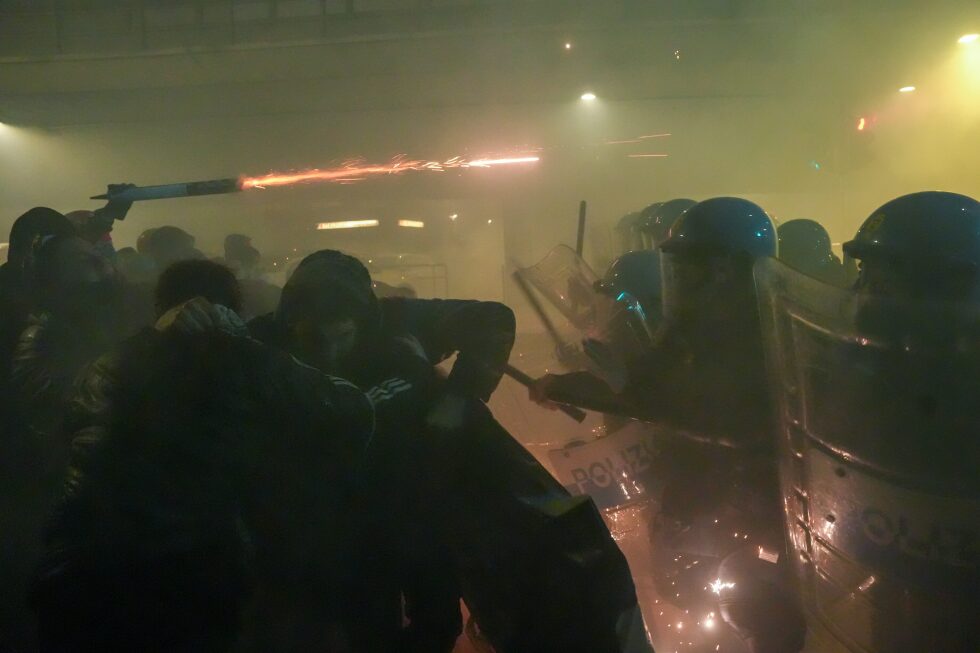
In Milan, tensions escalated Saturday evening when Italian police deployed tear gas and water cannons against dozens of protesters who threw firecrackers and attempted to access a highway near an Olympic venue. This confrontation followed a largely peaceful demonstration by thousands who had marched earlier to protest the environmental impact of the Games and the presence of U.S. law enforcement agents in Italy.
The skirmish comes just days after Meloni’s government approved a controversial security decree that allows police to detain individuals for up to 12 hours when there are reasonable grounds to believe they might disrupt peaceful protests. Opposition lawmakers have criticized the measure as an attack on freedom of expression.
International Olympic Committee spokesperson Mark Adams addressed the incidents during the IOC’s daily media briefing, stating that while peaceful protest is legitimate, “we draw a line at violence. That has no place at the Olympic Games.”
Police managed to contain the violent demonstrators, who appeared to be attempting to reach the Santagiulia Olympic ice hockey rink. By that point, the larger peaceful protest—which police estimated included 10,000 participants, including families with small children and students—had already dispersed.
During the main demonstration, protesters carried cardboard cutouts representing trees felled to construct the new bobsled run in Cortina. The event featured dancers performing to drum beats and music blasting from trucks leading the march, including songs criticizing U.S. Immigration and Customs Enforcement (ICE).
Before the main march, a group of masked protesters had set off smoke bombs and firecrackers on a bridge overlooking a construction site approximately 800 meters from the Olympic Village, which is housing around 1,500 athletes.
The protests coincided with U.S. Vice President JD Vance’s visit to Milan as head of the American delegation. Vance and his family visited Leonardo da Vinci’s “The Last Supper” in the city center, far from the demonstration, which partially focused on opposing the deployment of ICE agents providing security for the U.S. delegation.
U.S. officials have clarified that Homeland Security Investigations, an ICE unit focusing on cross-border crimes, routinely sends officers to international events like the Olympics to assist with security. They emphasized that the ICE division responsible for immigration enforcement in the U.S. is not being deployed to Italy, and that any agents present would operate only within U.S. diplomatic territory, not on Italian streets.
The protests on Saturday followed a similar demonstration the previous week when hundreds gathered to oppose the presence of ICE agents despite official clarifications about their limited role and jurisdiction.
Fact Checker
Verify the accuracy of this article using The Disinformation Commission analysis and real-time sources.

12 Comments
Meloni is right to condemn these disruptive actions. Protests are one thing, but sabotaging critical infrastructure to undermine the Olympics is unacceptable. These demonstrators are harming Italy’s reputation and the hard work of volunteers.
This is really unfortunate. The Olympics are supposed to be a unifying, celebratory event for Italy. These disruptive actions only serve to divide the country and distract from the hard work of hosting the Games. Meloni is right to condemn them.
It’s disappointing to see this kind of anti-Italy sentiment. The Olympics are a chance to showcase the country and bring people together. While peaceful protest is fine, attacking the railways goes too far and won’t win over public support.
Curious to know more about the alleged sabotage and who is behind it. Cutting railway cables seems like a serious crime that could have put people in danger. I hope the authorities can get to the bottom of this and hold the culprits accountable.
Meloni is right to express solidarity with the police and all the hard-working Italians making the Olympics happen. These protesters are undermining national pride and Italy’s global reputation. Not a good look at all.
Glad to see the transport ministry is investigating this as potential terrorism. Disrupting critical infrastructure like that is extremely concerning and can’t be tolerated. Curious to learn more about the motives behind these attacks.
Agreed, this is a serious situation that requires a thorough investigation. Sabotaging railways is not a legitimate form of protest – it puts people at risk and damages Italy’s image.
I don’t agree with Meloni’s characterization of the protesters as ‘enemies of Italy.’ While their actions may be misguided, they likely have legitimate grievances that deserve to be heard. Dismissing them outright is not productive.
I understand your perspective, but I have to disagree. Sabotaging critical infrastructure crosses a line and goes beyond peaceful protest. The government needs to respond firmly to protect public safety and Italy’s international standing.
Meloni is right to call out these actions as unacceptable. Peaceful protest is one thing, but deliberately sabotaging railways to undermine the Olympics is crossing a line. These protesters are hurting Italy’s image and the hard work of so many people.
Curious to know more about the specific grievances of these protesters. While I don’t condone the sabotage, there may be legitimate concerns about the Olympics that deserve attention. A more nuanced approach from the government could help de-escalate the situation.
I see your point, but the government has to take a firm stance against attacks on critical infrastructure, regardless of the protesters’ motivations. The Olympics are a major international event – Italy can’t afford this kind of disruption and damage to its reputation.