


Listen to the article
Congressional scrutiny intensifies over suspicious trading on prediction markets after a series of well-timed bets preceded major geopolitical announcements, raising concerns about potential insider trading and national security risks.
The Associated Press reported Wednesday that approximately 50 newly created accounts on Polymarket placed significant wagers on a U.S.-Iran ceasefire just moments before former President Donald Trump announced the agreement on social media. These accounts had never made any other transactions on the platform.
This incident follows a pattern of suspiciously timed bets that have yielded substantial profits. In January, an anonymous Polymarket user earned $400,000 by wagering that Venezuelan leader Nicolas Maduro would leave office shortly before his capture. In another case, a trader made approximately $550,000 by betting on a U.S. strike against Iran and the removal of Ayatollah Ali Khamenei from office, just before hostilities began.
The scope of potential insider trading extends beyond geopolitical events. Researchers at Harvard University recently published a study estimating that $143 million in profits have been generated on Polymarket by individuals who may have possessed insider information about events ranging from celebrity engagements to Nobel Prize announcements.
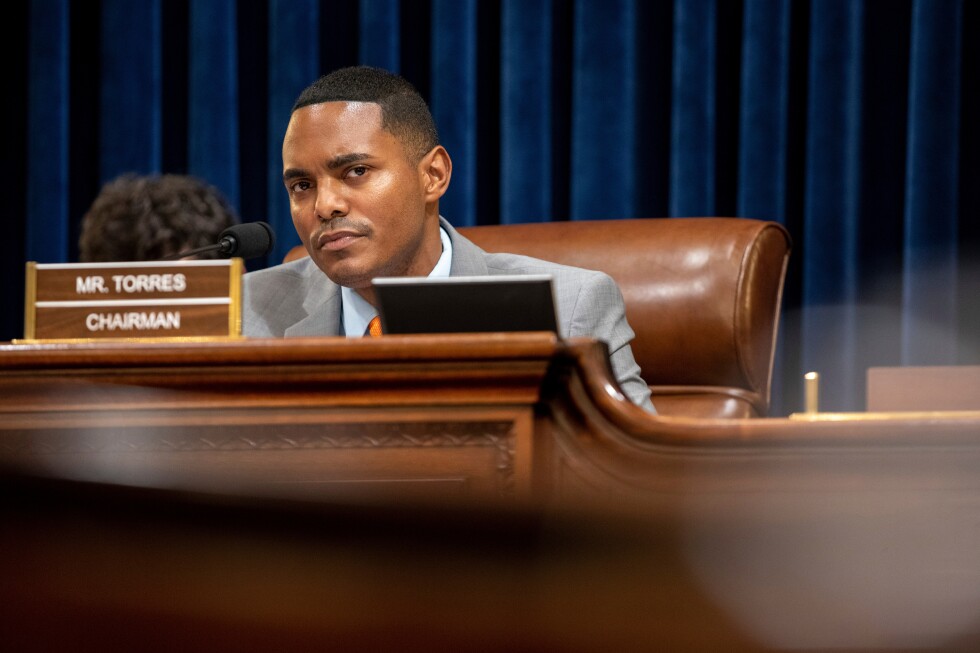
Rep. Ritchie Torres (D-N.Y.), who serves on both the House Financial Services Committee and the subcommittee on digital assets and financial technology, sent a letter Thursday to the Commodity Futures Trading Commission (CFTC) demanding an investigation into these suspiciously timed trades.
“This pattern raises serious concerns that certain market participants may have had access to material nonpublic information regarding a market-moving geopolitical event,” Torres wrote in the letter, which was shared exclusively with the AP.
In an interview, Torres questioned the statistical probability of such accurate predictions. “What is the statistical likelihood that of anyone other than an insider trader placing a winning bet 12 minutes before a market-moving presidential announcement,” he said. “There are two answers: God, or an insider trader. And something tells me that God is not placing bets around Donald Trump’s posts on Truth Social.”
Sen. Richard Blumenthal (D-Connecticut) also sent a letter to Polymarket on Thursday, demanding explanations about why the company continues to permit wagers on war and violence, and what measures it’s taking to prevent insider trading.
“Polymarket has become an illicit market to sell and exploit national security secrets unlike any in history, and by extension a potential honeypot for foreign intelligence services watching for those same suspicious bets and wagers,” Blumenthal wrote.
The concern spans both sides of the political aisle. Rep. Blake Moore (R-Utah) expressed alarm following the AP’s report on the ceasefire wagers. “We don’t want to imagine a world where America’s adversaries use prediction markets to anticipate our next move,” Moore said.
Currently, U.S. residents have limited access to Polymarket, which was banned from operating in the United States in 2022. The company is attempting to reenter the U.S. market by acquiring a CFTC-licensed exchange and clearinghouse, which would provide a legal pathway to offer contracts domestically. Polymarket has begun a limited rollout in the U.S., though most of its activity still occurs on a separate, crypto-based offshore platform outside U.S. jurisdiction.
The stakes are particularly high as both Polymarket and its competitor Kalshi seek regulatory approval to operate nationwide in the U.S., especially in the lucrative sports betting market. Kalshi, which already operates under U.S. regulation, aims to become the country’s dominant prediction market.
The competition also carries political connections. Donald Trump Jr. has invested in Polymarket through his venture capital firm, 1789 Capital, and separately serves as a paid strategic adviser to Kalshi.
Prediction markets allow users to place bets on a wide range of outcomes, from weather forecasts to Federal Reserve interest rate decisions. At least two bipartisan bills are currently pending in Congress that would restrict these types of betting activities.
Polymarket did not immediately respond to requests for comment.
Fact Checker
Verify the accuracy of this article using The Disinformation Commission analysis and real-time sources.

7 Comments
Fascinating story. Polymarket seems to be a hot topic these days, with allegations of well-timed trades around major geopolitical events. I’m curious to see how this investigation unfolds and whether any concrete evidence of insider trading emerges.
Agreed, the potential for abuse in these prediction markets is concerning. Regulators will need to strike a balance between allowing innovation and ensuring proper oversight to prevent misuse of sensitive information.
The potential for insider trading in these prediction markets is really alarming. I hope the investigations are thorough and that any wrongdoing is swiftly addressed. Maintaining the integrity of these platforms is crucial.
Wow, these allegations of suspicious trading patterns on Polymarket are quite troubling. If true, it could undermine public trust in these prediction platforms and even have broader national security implications. I’ll be following this story closely.
Agreed, the national security risks are especially concerning. Regulators will need to carefully examine these trades and ensure proper safeguards are in place to prevent abuse of sensitive information.
This is a complex issue with a lot of nuance. On one hand, prediction markets can provide valuable insights, but the potential for insider trading is worrying. I hope lawmakers can find a way to harness the benefits while mitigating the risks.
This is quite concerning if true. Insider trading in prediction markets could pose serious national security risks. I hope investigators get to the bottom of these suspicious trading patterns and hold anyone accountable who may have exploited sensitive information for personal gain.