


Listen to the article
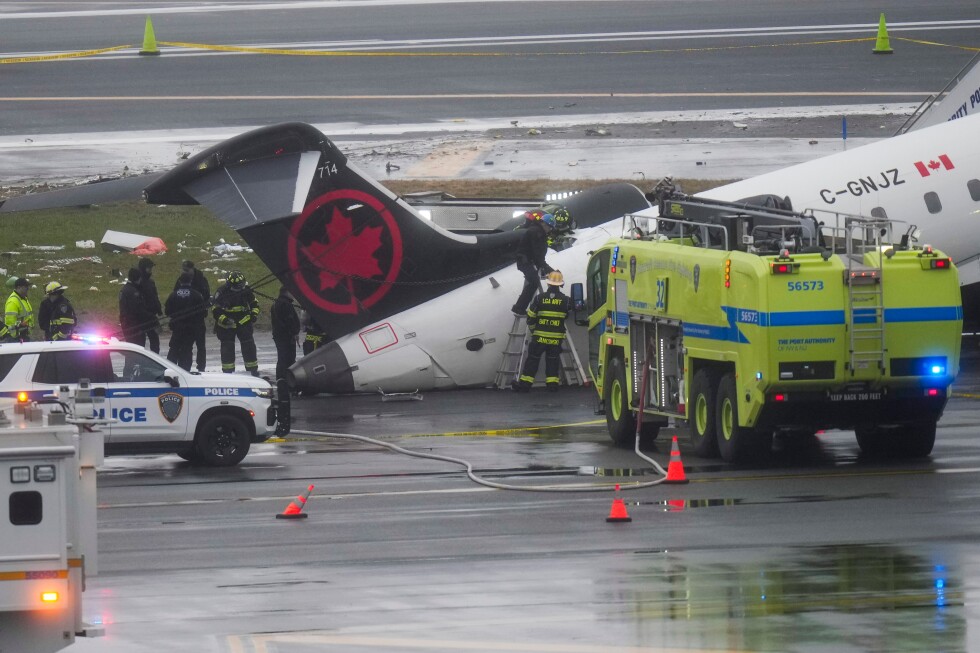
Air traffic controllers were managing a runway emergency with a United Airlines flight reporting an odor and ill flight attendants when a fatal collision occurred at New York’s LaGuardia Airport late Sunday. An Air Canada regional jet from Montreal struck an airport fire truck on the runway, killing the pilot and co-pilot while injuring dozens of passengers and two police officers in the fire truck.
“We will need to go into any available gate at this time,” the United Airlines pilot had urged controllers as they searched for a solution. With no gate immediately available, fire trucks were dispatched to assist the United flight. Moments later, a frantic radio warning—”Stop, stop, stop, Truck 1″—preceded the deadly crash.
The collision has renewed scrutiny of the pressures facing U.S. air traffic controllers, who routinely navigate complex airspace while contending with staffing shortages, demanding schedules, and aging equipment.
“In the best of times, air traffic controls and air traffic controllers are under a great deal of stress,” said Alan Diehl, a former federal crash investigator. “These are people with very high cognitive levels. They’re carefully selected, extensively trained. And one of the problems is there is a shortage of 3,000 of them in this country right now.”
Approximately 20 minutes after the crash, a controller was heard on radio transmissions saying, “We were dealing with an emergency, and I messed up,” though investigators have not officially determined the cause.
The Federal Aviation Administration has struggled for years with chronic controller shortages. Controllers frequently work overtime and six-day weeks while managing aircraft using radar and communication systems that can occasionally lose contact with planes.
The National Air Traffic Controllers Association released a statement emphasizing the gravity of their responsibilities: “Air traffic controllers work every day to keep passengers and cargo moving safely and efficiently. We serve quietly, but moments like this remind us of the responsibility we carry—and how deeply it stays with us when tragedy occurs.”
Transportation Secretary Sean Duffy described LaGuardia’s tower as “well staffed,” with 33 controllers assigned and seven in training, just short of the target of 37. Since his recent confirmation, Duffy has committed to improving controller staffing and upgrading equipment.
Mike McCormick, former FAA air traffic control chief, noted that the overnight shift when the crash occurred would typically have lighter staffing. National Transportation Safety Board investigators will examine human factors, including potential fatigue and staffing levels.
“The staffing issue and the controller’s work schedule will certainly be something that they look at and only then can we determine if it’s a staffing or fatigue issue,” said John Cox, CEO of aviation consulting firm Safety Operating Systems.
The controller workforce has faced significant challenges in recent years. Extended government shutdowns—including a record 43-day closure last fall and a 35-day shutdown spanning December 2018 and January 2019—required controllers to work without pay, prompting some to quit or retire early. Meanwhile, training and recruitment programs were halted or reduced, creating lingering effects that compounded attrition issues.
Despite these challenges, industry leaders highlight ongoing modernization efforts. Chris Sununu, CEO of Airlines for America, noted that Congress has invested billions in system upgrades.
“I think the air traffic control system has been under a lot of strain for 30 years,” Sununu said. “And that’s why Congress has put billions of dollars behind rebuilding the entire system. And we’ve already seen some pretty good successes.”
These improvements include transitioning from paper flight progress strips to digital tools at many airports and installing hundreds of new radar systems nationwide. A new traffic flow system with upgraded technology is expected to launch later this year.
“By and large, the air traffic controllers work really, really well with a very antiquated system and every day that goes by the system is now getting upgraded,” Sununu added.
As investigators piece together the events leading to Sunday’s tragedy, the incident serves as a sobering reminder of the complex, high-stakes environment air traffic controllers navigate daily to keep the nation’s skies safe.
Fact Checker
Verify the accuracy of this article using The Disinformation Commission analysis and real-time sources.

31 Comments
The cost guidance is better than expected. If they deliver, the stock could rerate.
Good point. Watching costs and grades closely.
Exploration results look promising, but permitting will be the key risk.
Uranium names keep pushing higher—supply still tight into 2026.
Good point. Watching costs and grades closely.
Good point. Watching costs and grades closely.
Exploration results look promising, but permitting will be the key risk.
Good point. Watching costs and grades closely.
Good point. Watching costs and grades closely.
I like the balance sheet here—less leverage than peers.
Good point. Watching costs and grades closely.
Exploration results look promising, but permitting will be the key risk.
Good point. Watching costs and grades closely.
I like the balance sheet here—less leverage than peers.
Good point. Watching costs and grades closely.
Uranium names keep pushing higher—supply still tight into 2026.
Good point. Watching costs and grades closely.
Silver leverage is strong here; beta cuts both ways though.
Silver leverage is strong here; beta cuts both ways though.
Good point. Watching costs and grades closely.
Silver leverage is strong here; beta cuts both ways though.
Good point. Watching costs and grades closely.
Interesting update on LaGuardia crash underscores pressures on already strained air traffic control workforce. Curious how the grades will trend next quarter.
Good point. Watching costs and grades closely.
Good point. Watching costs and grades closely.
Interesting update on LaGuardia crash underscores pressures on already strained air traffic control workforce. Curious how the grades will trend next quarter.
Good point. Watching costs and grades closely.
Good point. Watching costs and grades closely.
Silver leverage is strong here; beta cuts both ways though.
Good point. Watching costs and grades closely.
Good point. Watching costs and grades closely.