


Listen to the article
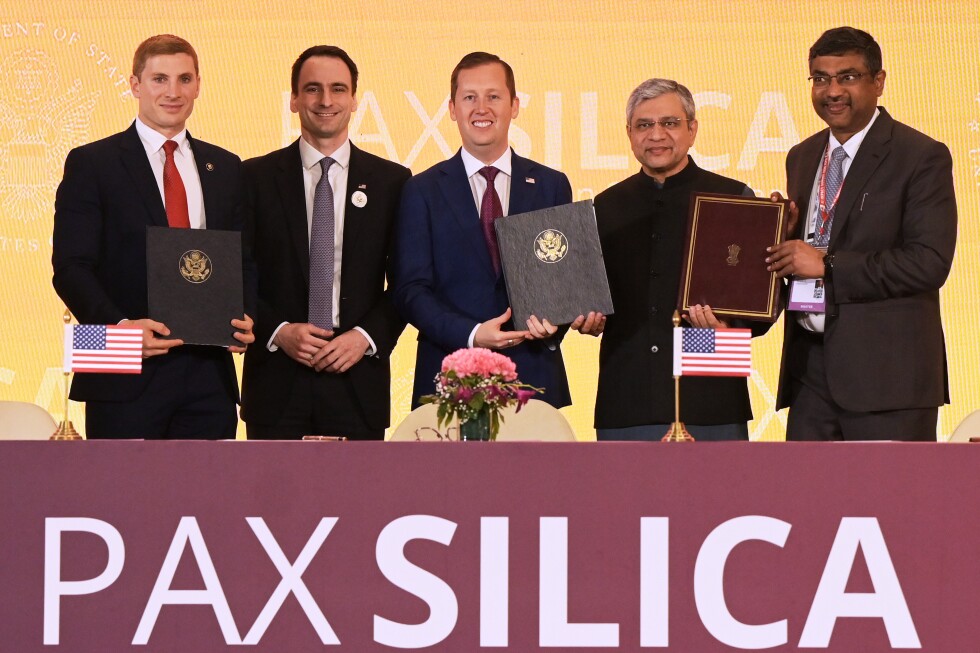
India has joined Pax Silica, a U.S.-led technology cooperation initiative, marking a significant shift in bilateral relations after recent tensions over India’s Russian oil purchases. The agreement, finalized Friday in New Delhi, integrates India into a growing alliance of nations focused on semiconductor development and technological advancement.
The move represents a strategic realignment that brings India closer to Washington’s efforts to establish secure supply chains for semiconductors and critical technologies amid intensifying geopolitical competition with China. Other nations already participating in the Pax Silica framework include Japan, South Korea, the United Kingdom, and Israel.
“Pax Silica will be a group of nations that believe technology should empower free people and free markets. India’s entry into Pax Silica isn’t just symbolic. It’s strategic, it’s essential,” U.S. Ambassador Sergio Gor stated during the signing ceremony.
At its core, the initiative aims to strengthen cooperation among partner countries on semiconductor design, fabrication, research, and supply chain resilience. The framework seeks to reduce dependence on Chinese manufacturing while fostering trusted production networks among democracies and strategic allies.
The agreement was reached during an artificial intelligence summit in New Delhi and follows weeks after India and the United States established an interim trade framework. This recent trade deal has helped ease tensions that threatened to impede growing bilateral momentum between the world’s largest and oldest democracies.
Earlier this month, President Donald Trump announced that the U.S. would lower reciprocal import tariffs on India from 25% to 18%. Additionally, the U.S. agreed to remove the extra 25% levy previously imposed on India for its Russian crude oil purchases. These concessions came after Prime Minister Narendra Modi agreed to halt India’s purchases of Russian oil.
India had substantially increased its Russian oil imports following Moscow’s invasion of Ukraine in 2022. This policy had drawn criticism from Western partners, though New Delhi consistently defended the purchases as necessary measures to manage domestic inflation and protect Indian consumers during a period of global energy market volatility.
The rapprochement comes at a critical juncture for both nations. For India, membership in Pax Silica represents an opportunity to accelerate its ambitions in semiconductor manufacturing and advanced technologies. The Indian government has already committed approximately $10 billion to develop a domestic semiconductor ecosystem, viewing the sector as essential for technological sovereignty and economic growth.
For the United States, bringing India into the fold strengthens its strategy of building resilient supply chains with trusted partners, particularly as technology increasingly becomes a cornerstone of national security and economic competitiveness.
“From the trade deal to Pax Silica to defense cooperation, the potential for our two nations to work together is truly limitless,” Ambassador Gor emphasized, highlighting the comprehensive nature of the evolving partnership.
The development also reflects broader geopolitical shifts in the Indo-Pacific region, where India has emerged as a crucial counterbalance to China’s growing influence. By joining Pax Silica, India further cements its position within the framework of Western-aligned technological partnerships while maintaining its strategic autonomy.
Analysts suggest that India’s entry into Pax Silica, combined with recent trade concessions, signals a strategic convergence that extends beyond mere commercial interests into long-term technology and security cooperation. This reinforces India’s evolving role as a key U.S. partner in the Indo-Pacific at a time when technological leadership is increasingly defining global power dynamics.
The agreement is expected to facilitate greater technology transfer, joint research initiatives, and investment in advanced manufacturing between the participating nations, potentially accelerating India’s technological advancement while strengthening the collective capabilities of democratic nations in critical technology sectors.
Fact Checker
Verify the accuracy of this article using The Disinformation Commission analysis and real-time sources.

15 Comments
The Pax Silica framework aims to foster technological cooperation and innovation among partner countries. India’s entry, with its strong capabilities in semiconductor design and manufacturing, could significantly bolster the initiative’s goals of building more secure supply chains.
The Pax Silica framework aims to foster technological cooperation and innovation among partner countries. India’s entry, with its strong capabilities in semiconductor design and manufacturing, could significantly bolster the initiative’s goals of building more secure supply chains.
India’s decision to join Pax Silica is a significant shift in its foreign policy, as the country moves to strengthen its technology partnerships with the US and its allies. This could have far-reaching implications for the geopolitical dynamics in the region.
The Pax Silica initiative is an important step towards building more secure and resilient technology supply chains. India’s participation adds a major player to the alliance, and could lead to greater technological cooperation and innovation among the partner countries.
This is an interesting strategic move by India to join the US-led Pax Silica initiative. It signals a shift in India’s foreign policy and a desire to build more secure supply chains for critical technologies. The participation of major allies like Japan, South Korea, and Israel underscores the importance of this alliance.
India’s decision to join the Pax Silica initiative is a strategic move that reflects the country’s desire to diversify its technology partnerships and reduce reliance on China. This aligns with the broader geopolitical shifts we’re seeing in the region.
This is a noteworthy development, as it brings India closer to the US-led efforts to counter China’s technological dominance. The participation of key allies like Japan, South Korea, and Israel underscores the importance of this initiative for global technological security.
The Pax Silica initiative represents an important step towards building more secure and resilient technology supply chains. India’s participation, with its strong capabilities in semiconductor design and manufacturing, could be a valuable contribution to this effort.
The Pax Silica initiative aims to build a coalition of nations that can jointly develop and produce critical technologies. India’s participation, with its strong semiconductor design and manufacturing capabilities, will be a valuable addition to this effort.
Yes, India’s entry into Pax Silica is a smart move. It allows India to leverage its technological expertise while also strengthening its ties with the US and other key allies in this strategic area.
This is an interesting development that reflects the changing geopolitical landscape. India’s decision to join the Pax Silica initiative signals a strategic realignment and a desire to diversify its technology partnerships beyond its traditional ties with Russia.
India’s entry into Pax Silica is significant, as it brings a major economy and technology powerhouse into the fold. Reducing dependence on Chinese manufacturing and fostering trusted technology partnerships is crucial for ensuring supply chain resilience in the face of geopolitical tensions.
Absolutely, this move by India demonstrates its commitment to diversifying its technology and semiconductor supply chains. It’s a wise strategic decision given the growing competition between the US and China.
India’s decision to join the Pax Silica initiative is a noteworthy shift in its foreign policy. It demonstrates the country’s desire to strengthen its ties with the US and its allies, while also diversifying its technology partnerships in the face of growing geopolitical competition.
This agreement represents a significant shift in India’s foreign policy, moving closer to the US-led efforts to counter China’s growing technological influence. It will be interesting to see how this partnership evolves and what concrete outcomes emerge from the Pax Silica framework.