


Listen to the article
India and EU Finalize Landmark Trade Agreement After 20 Years of Talks
India and the European Union announced a groundbreaking free trade agreement on Tuesday, culminating nearly two decades of complex negotiations. The accord, which leaders have dubbed the “mother of all deals,” is set to impact nearly 2 billion people across both regions.
“This agreement will bring major opportunities for the people of India and Europe,” India’s Prime Minister Narendra Modi said in a virtual address to an energy conference. “It represents 25% of the global GDP and one-third of global trade.”
The timing is particularly significant as both India and the EU face increasing pressure from Washington’s aggressive tariff policies. The deal represents one of the most substantial bilateral commercial engagements in recent years, providing both parties with alternative trade channels amid global economic uncertainty.
Beyond trade, the partnership extends into security cooperation through a framework agreement for deeper defense ties and a separate pact aimed at easing mobility for skilled workers and students, underscoring the comprehensive nature of the relationship.
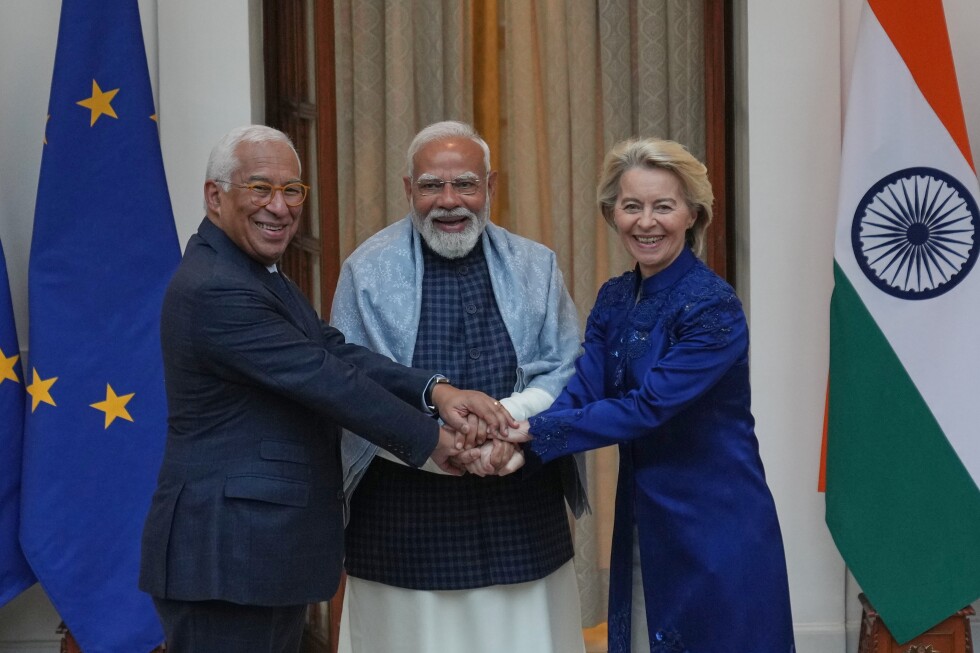
Speaking at a joint news conference in New Delhi alongside European Commission President Ursula von der Leyen and European Council President António Costa, Modi emphasized that the partnership “will strengthen stability in the international system” during a period of “turmoil in the global order.”
The negotiations gained fresh momentum in response to U.S. President Donald Trump’s approach to international trade relations. “Europe and India are making history today. We have concluded the mother of all deals,” von der Leyen stated on social media platform X.
In her subsequent speech, she characterized the accord as a story of “two giants” — the world’s second and fourth largest economies — “who chose partnership, in a true win-win fashion.” She added that it sends “a strong message that cooperation is the best answer to global challenges.”
The agreement is expected to cut up to €4 billion ($4.7 billion) in annual tariffs for exporters while creating millions of jobs across both regions. It will further integrate supply chains and strengthen joint manufacturing capabilities.
After a legal review of the text, formal signing could take place later this year, with implementation anticipated in early 2025 following ratification by the EU Parliament.
The terms include India reducing or eliminating tariffs for 96.6% of EU exports, while Brussels will offer similar reductions covering nearly 99% of India’s shipments by trade value, implemented in phases.
Key Indian sectors poised to benefit include textiles, apparel, engineering goods, leather products, handicrafts, footwear, and marine exports. The EU stands to gain in wine, automobiles, chemicals, and pharmaceuticals.
A negotiated quota system for automobiles, wines, and whisky will significantly reduce steep duties. According to the European Commission, India’s current 110% tariffs on cars will gradually decrease to as low as 10%, while car parts will become duty-free after 5-10 years. Tariffs of up to 44% on machinery, 22% on chemicals, and 11% on pharmaceuticals will be mostly eliminated.
Premium European wines will see Indian tariffs drop dramatically from 150% to 20%.
Some sectors remain protected due to domestic sensitivities. India has excluded dairy products such as milk and cheese along with cereals from the deal, while the EU has maintained restrictions on concessional tariffs for Indian sugar, meat, poultry, and beef products.
For India, the agreement represents a strategic diversification of export destinations, helping offset the impact of higher U.S. tariffs, including an additional 25% levy on Indian goods related to its continued purchases of discounted Russian oil.
From the European perspective, the deal secures expanded access to one of the world’s fastest-growing major economies while helping reduce reliance on more volatile markets during a period of global trade fragmentation.
Bilateral trade between India and the EU stood at $136.5 billion in 2024-25, with officials hoping to increase that figure to approximately $200 billion by 2030.
“Ultimately, the agreement is about creating a stable commercial corridor between two major markets at a time the global trading system is fragmenting,” noted Indian trade analyst Ajay Srivastava.
The EU has accelerated its global outreach strategy following strained relations with the United States. Over the past year, von der Leyen has signed deals with Japan, Indonesia, Mexico, and South America under the concept of “strategic autonomy” – effectively pursuing economic independence from an increasingly unpredictable U.S. administration.
Fact Checker
Verify the accuracy of this article using The Disinformation Commission analysis and real-time sources.

14 Comments
The scale and scope of this deal are quite impressive. Covering 25% of global GDP and one-third of worldwide trade, it will have a substantial impact on the global economy.
Agreed. The complementary strengths of India and the EU make this a truly game-changing partnership with far-reaching implications.
It will be fascinating to see how this landmark agreement impacts the dynamics of the global trading system, particularly in light of the ongoing tensions between major powers.
Exciting to see India and the EU clinching this historic trade deal. Deepening economic ties between these two economic powerhouses will create significant opportunities for businesses and consumers across both regions.
Absolutely, this agreement represents a major strategic shift as both parties look to diversify trade channels and reduce reliance on the US amid rising global tensions.
The sheer scale of this agreement, impacting nearly 2 billion people, underscores the ambition and vision of the Indian and EU leaders who have worked tirelessly to bring it to fruition.
Indeed, this is a true testament to their diplomatic skills and ability to navigate the complexities of international trade negotiations.
While the details of the agreement will need to be closely examined, the overall significance of this deal cannot be overstated. It represents a major shift in the global economic landscape.
The timing of this agreement is particularly noteworthy, coming amid rising global economic uncertainty. It provides both India and the EU with crucial alternatives to existing trade channels.
Absolutely, this deal gives them more strategic flexibility and leverage in the face of increasing pressure from major powers like the US.
This free trade agreement is a major win for both sides, providing alternatives to Washington’s aggressive tariff policies. It demonstrates the ability of nations to forge their own economic paths.
Beyond just trade, the comprehensive nature of this deal – encompassing defense, mobility of skilled workers, and more – highlights the deepening strategic relationship between India and the EU.
Absolutely. This underscores how economic ties are increasingly intertwined with broader geopolitical considerations in today’s complex global landscape.
This deal represents a significant shift in the global balance of economic power, with India and the EU flexing their muscles as they seek to shape the future of international commerce.