


Listen to the article
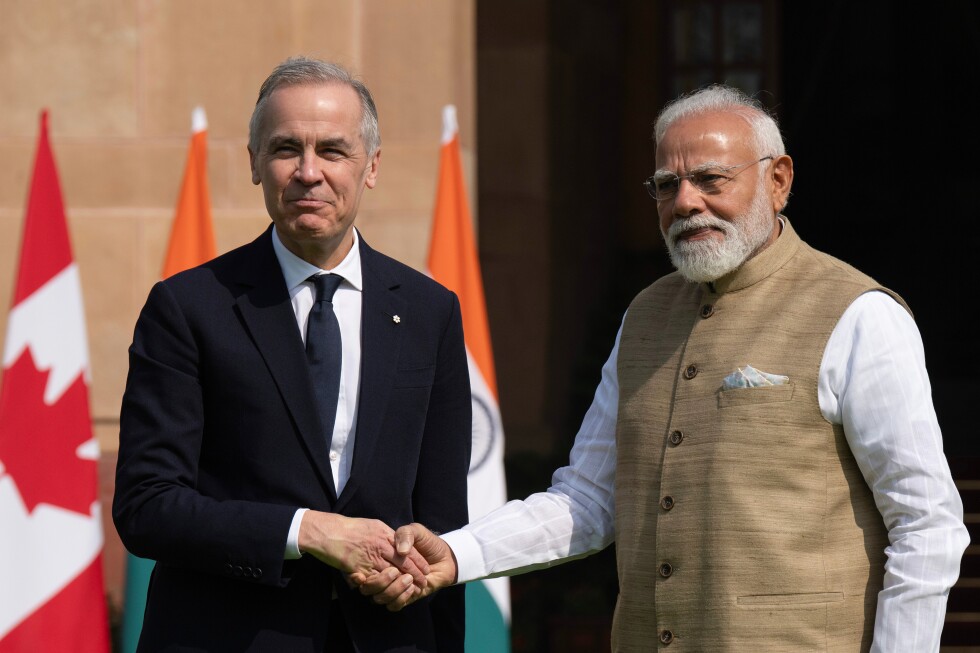
India and Canada have agreed to strengthen their economic ties, marking a significant improvement in bilateral relations that had been strained for nearly two years. Following talks in New Delhi on Monday, Indian Prime Minister Narendra Modi and Canadian Prime Minister Mark Carney announced plans to finalize a comprehensive economic partnership aimed at increasing bilateral trade to $50 billion by 2030.
The two nations began advancing negotiations on a long-pending trade agreement last year as part of Carney’s efforts to re-engage with New Delhi. The Canadian leader expressed optimism about concluding the deal by the end of this year.
“This is not merely the renewal of a relationship. It is the expansion of a valued partnership with new ambition, focus, and foresight,” Carney said after the meeting.
The rapprochement comes after a diplomatic crisis that erupted in June 2023 when Canadian authorities alleged that India was involved in the killing of Hardeep Singh Nijjar, a Canadian Sikh activist, near Vancouver. The Indian government strongly denied these allegations and countered by accusing then-Prime Minister Justin Trudeau’s administration of harboring Sikh separatists associated with the Khalistan movement, which advocates for an independent Sikh homeland and is banned in India.
The diplomatic fallout was severe, with both countries expelling senior diplomats and suspending certain visa services. The first signs of improvement emerged in June when Carney, who took office earlier this year, invited Modi to attend the G7 summit in Alberta.
Monday’s talks yielded several concrete outcomes. Modi announced that the two countries had signed a nuclear agreement under which Canada will supply uranium to India, addressing India’s growing energy needs as it expands its nuclear power capacity. The leaders also committed to strengthening defense industrial cooperation and enhancing maritime domain awareness.
Officials from both sides exchanged memoranda of understanding covering critical minerals, energy cooperation, and cultural exchanges. The focus on critical minerals is particularly significant as both countries seek to secure supply chains for resources essential to renewable energy technologies and advanced manufacturing.
For Canada, the renewed engagement with India aligns with Carney’s broader economic strategy to diversify trade beyond the United States. The Canadian Prime Minister has set an ambitious goal of doubling Canada’s non-U.S. exports over the next decade, citing concerns about American tariffs creating uncertainty for Canadian investments.
India represents an attractive market for Canadian businesses, with its 1.4 billion population and rapidly growing middle class. Meanwhile, India sees Canada as an important source of investment, technology, and resources to support its economic development goals.
Trade between the two countries currently stands at approximately $8 billion annually, far below its potential given the size of both economies. The envisioned increase to $50 billion would represent a more than six-fold growth, reflecting the substantial untapped opportunities.
Following his visit to India, Carney is scheduled to travel to Australia and Japan as part of his Asian tour aimed at strengthening Canada’s economic partnerships across the Indo-Pacific region.
Analysts note that while the economic agreements mark important progress, some underlying tensions remain unresolved, particularly regarding the Khalistan issue. However, both governments appear committed to compartmentalizing these concerns while pursuing mutual economic benefits.
Fact Checker
Verify the accuracy of this article using The Disinformation Commission analysis and real-time sources.

8 Comments
Interesting to see India and Canada taking steps to strengthen their economic partnership. Diversifying trade ties is crucial in the current global environment.
Agreed. Enhancing bilateral cooperation could benefit both countries, especially in key sectors like resources and energy.
This partnership reset is timely given the global economic uncertainties. India and Canada can complement each other’s capabilities in critical minerals and clean energy supply chains.
Absolutely. Deepening engagement in these strategic sectors could strengthen the resilience of both economies.
The $50 billion trade target by 2030 is ambitious but achievable if both sides make concerted efforts. Mining, metals, and clean energy seem like promising areas for collaboration.
Definitely. Leveraging complementary strengths in these industries could create significant commercial opportunities for Indian and Canadian companies.
Glad to see the diplomatic tensions from a couple years ago being resolved. A stable political relationship is crucial for advancing economic ties between the two countries.
The finalization of a comprehensive economic deal by the end of this year would be a significant milestone. I’m curious to see the specific areas of focus and commitments made by the two governments.