


Listen to the article
Anti-Tax Movement Gains Momentum as States Consider Eliminating Homeowner Property Taxes
It is a goal spreading among anti-tax crusaders across America — eliminate all property taxes on homeowners. With rising property values inflating tax bills in many states, the movement is gaining traction among Republican lawmakers and grassroots activists alike.
However, ending all homeowner taxes would cost billions or even tens of billions of dollars in most states. Critics question whether lawmakers can achieve this goal without harming schools and local governments that rely heavily on these taxes to provide essential services.
North Dakota appears to be leading the charge, using state oil money to gradually eliminate homeowner property taxes. In Georgia, Republicans in the House recently unveiled a complex effort to phase out homeowner property taxes by 2032. Meanwhile, in Florida, GOP Gov. Ron DeSantis has made eliminating property taxes his goal, with lawmakers currently considering phasing out nonschool property taxes on homeowners over 10 years. And in Texas, Republican Gov. Greg Abbott has stated he wants to eliminate property taxes for schools.
Republican lawmakers are increasingly echoing the sentiment that taxes, especially when nonpayment can result in home seizure, mean no one truly owns their property.
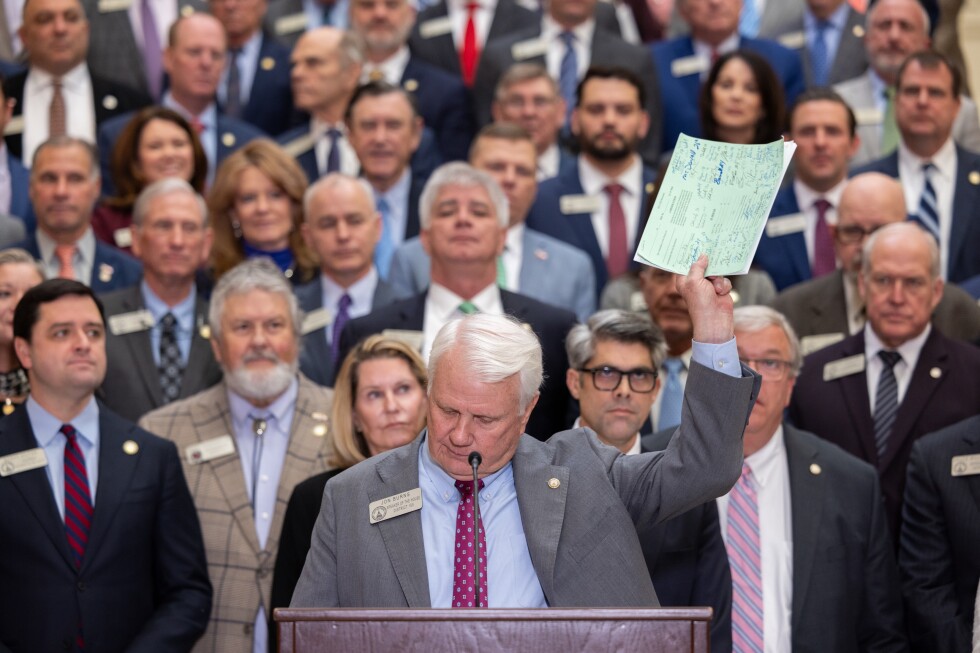
“No one should ever face the loss of their home because they can’t pay rent to the government,” Georgia Republican House Speaker Jon Burns of Newington said when unveiling his proposal.
An Election-Year Tax Revolt
These ambitious election-year efforts could be joined by ballot initiatives in Oklahoma and Ohio to eliminate all property taxes. Similar initiatives were defeated in North Dakota in 2024 and failed to make the ballot in Nebraska that year, although organizers there are trying again. Another initiative in Michigan may also struggle to reach the ballot.
“We’re very much in this property tax revolt era, which is not unique, it’s not new. We’ve seen these revolts in the past,” said Manish Bhatt, vice president of state tax policy at the Tax Foundation, a Washington D.C. group that is generally skeptical of new taxes.
Previous backlashes led to laws like California’s Proposition 13, a 1978 initiative that limited property tax rates and how much local governments could increase property valuations for tax purposes.
The efforts are aimed at voters like Tim Hodnett, a 65-year-old retiree in suburban Atlanta’s Lawrenceville. Hodnett’s annual property tax bill rose from $2,000 to $3,000 between 2018 and 2024. The increase is particularly noticeable to him because he paid off his mortgage years ago and pays his taxes in a lump sum rather than making monthly payments.
Hodnett, who is disabled and living on $30,000 a year, is about to get significant property tax relief as seniors in Gwinnett County are exempt from school property taxes, which account for about two-thirds of his bill. Still, he’d appreciate not paying the remaining $1,000 either.
“It would be nice to be exempt from property taxes,” Hodnett said.
Will There Be Replacement Revenue?
The critical question is whether local governments and K-12 schools should be expected to cut spending, or if they will be allowed to make up revenue from some other source.
“I think the complete elimination of the property tax for homeowners is really going to be very difficult in most states and localities around the country, and undesirable in most places,” said Adam Langley of Lincoln Institute of Land Policy, a Massachusetts nonprofit that studies land use and taxation.
In Florida, Republican Chief Financial Officer Blaise Ingoglia has been touring the state arguing that local governments are overspending, suggesting they don’t need the $19 billion in property taxes they collect from homeowners. Local governments have disputed these claims.
North Dakota, by contrast, is using earnings from the state’s $13.4 billion oil tax savings account to gradually eliminate homeowner property taxes. Last year, North Dakota’s Republican-controlled Legislature expanded its primary residence tax credit from $500 to $1,600 a year. Officials in December said the tax credit eliminated property taxes for 50,000 households and reduced bills for nearly 100,000 more, costing $400 million in state subsidies for the 2025 and 2026 tax years.
“It works, and we know we can build on it to provide even more relief and get property taxes to zero for the vast majority of North Dakota homeowners,” Republican Gov. Kelly Armstrong said.
The situation is less clear in Texas, which has been using state surplus funds to finance property tax reductions, and in Georgia, where the proposal calls for shifting tax burdens.
A Shift from Property to Sales Taxes
In Georgia, Speaker Burns wants to eliminate $5.2 billion in homeowner property taxes — more than a quarter of the $19.9 billion in property taxes collected in 2024 — by directing cities, counties, and school districts to rely on current or new sales taxes.
Burns’ plan faces significant hurdles. It will need approval from the Republican-led Senate and require Democratic support to meet the two-thirds threshold needed for a state constitutional amendment before going to voters in November.
While most property taxes fund schools, the majority of sales taxes don’t in some communities. It remains unclear if localities would redistribute sales taxes. Additionally, local governments and schools would remain limited to a combined 5% sales tax rate, on top of the state’s 4% rate. Some schools and governments might not be able to raise sales taxes enough to offset lost revenue.
Georgia would gradually increase the homestead exemption from the current $5,000 to $150,000 by 2031 before abolishing most homeowner property taxes in 2032. The plan would limit yearly property tax revenue growth to 3% on other types of property.
Local governments would be able to bill homeowners yearly for specific services such as garbage collection, street lighting, stormwater control, and fire protection, though lawmakers are avoiding calling these charges “taxes.” Voters could also approve assessments for government or school improvements. The bill’s authors haven’t yet decided if property owners could lose homes for unpaid assessments.
Burns also wants to allocate about $1 billion to reduce property tax bills in 2026, but it’s uncertain whether Republican Gov. Brian Kemp will support this measure. A spokesperson for the governor declined to comment.
Georgia previously attempted to limit how much home values could rise for tax purposes, a common approach nationwide. However, a majority of school districts and many other local governments have opted out of these limits. Georgia’s senators are still pursuing this approach, with a Senate committee recently voting to make such limits mandatory.
Fact Checker
Verify the accuracy of this article using The Disinformation Commission analysis and real-time sources.

10 Comments
Ending all property taxes for homeowners could have far-reaching consequences, both positive and negative. I’m curious to see if states can find creative ways to provide relief without severely disrupting local budgets and services.
That’s an important point. Any major tax reform requires thoughtful analysis of the potential unintended impacts.
Eliminating property taxes could benefit homeowners, but the impact on funding for schools, infrastructure, and other public services is concerning. I wonder if some form of tax relief or rebates could be a middle ground approach.
That’s a thoughtful suggestion. Targeted tax relief may be more feasible than a complete elimination of property taxes.
This push to end homeowner property taxes seems driven by anti-tax sentiment, but the fiscal implications could be significant. I hope lawmakers carefully weigh the tradeoffs and find a balanced solution that works for both taxpayers and local communities.
Well said. Maintaining essential public services while providing tax relief for homeowners will require nuanced policymaking.
The push to end homeowner property taxes is likely driven by rising real estate values inflating tax bills. However, these taxes are a critical revenue source for many states and localities. It will be interesting to see how lawmakers address this tricky balance.
Agreed. Finding alternative revenue sources to replace that lost income will be crucial if property taxes are eliminated.
Eliminating all property taxes for homeowners sounds like a major tax cut, but it could create challenges for funding essential services like schools and local infrastructure. I’m curious to see how states balance this goal with maintaining vital community resources.
That’s a good point. Phasing out property taxes gradually may be a more prudent approach to avoid disrupting public services.