


Listen to the article
In a dispute that has rocked the classical music world, the entire production team behind the Metropolitan Opera’s contemporary staging of Bizet’s “Carmen” has demanded their names be removed from programs following controversial changes to their original artistic vision.
The production, which opened on December 31, 2023, was directed by Carrie Cracknell in her Met debut. Her reimagining transposed the classic opera from 19th-century Seville to a modern American industrial town, with the character Escamillo reimagined as a rodeo star rather than a traditional bullfighter.
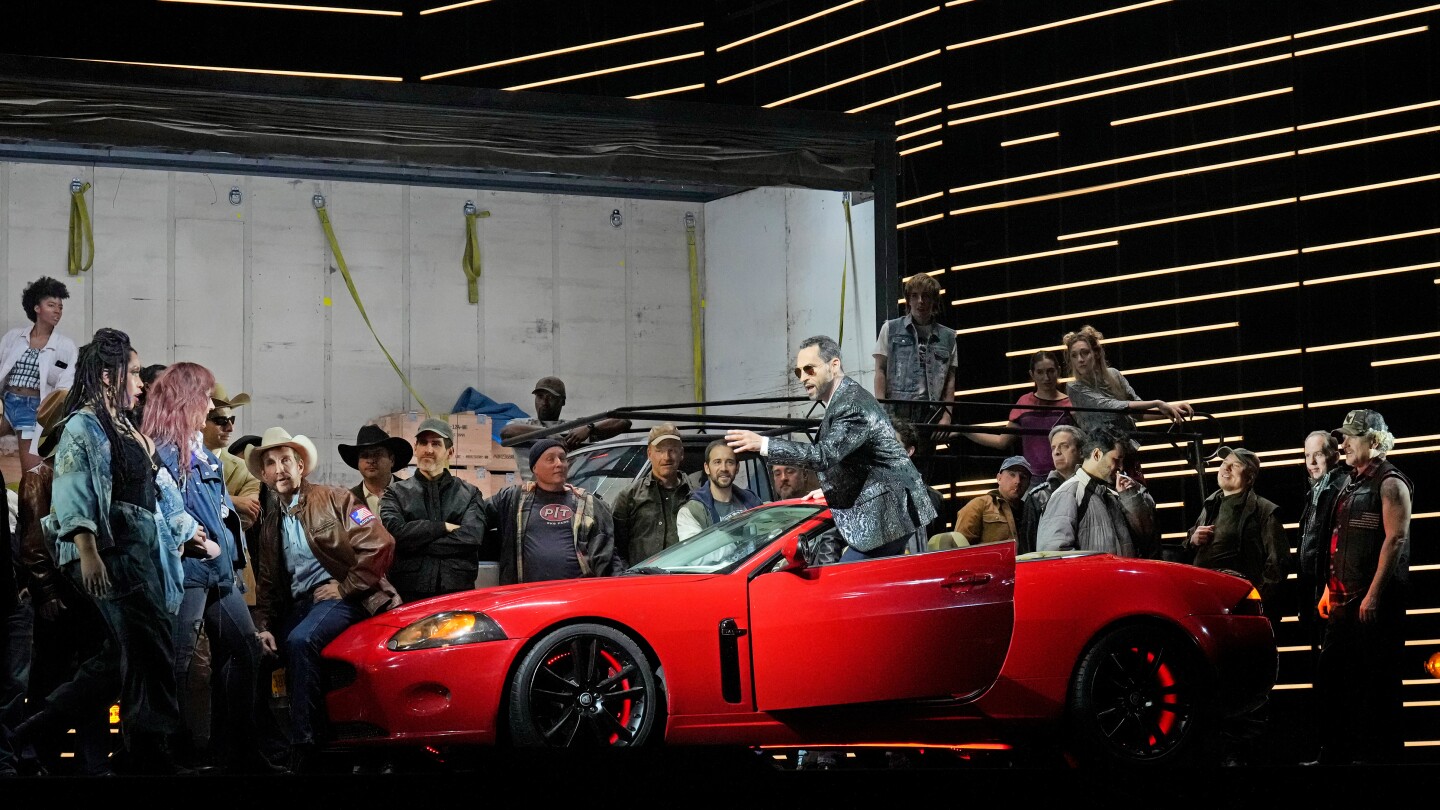
A central element of the original staging featured Escamillo’s dramatic entrance in a red Jaguar convertible, accompanied by his entourage in three pickup trucks that crossed the stage during the famous Toreador’s Song. These vehicles, operated on wires and guided by computer, served as a contemporary reimagining of the traditional bullfighter’s entrance.
However, in what the Met describes as a cost-cutting measure, the company drastically altered this key scene for the production’s current run. The Jaguar and two trucks were eliminated entirely. Instead, Escamillo now walks in with his followers, some pushing a motorcycle, while one stationary pickup truck remains on stage throughout the act.
“We were furious,” set designer Michael Levine told the Associated Press. “I didn’t want my name attached to the production because it’s not a representation of the original artistic intent. I’ve never come across anything on this level where they literally change the basic concept.”
Levine said he was notified of the changes last fall by John Sellars, the Met’s assistant general manager for production, just before the October 28 opening. “I get a phone call from John Sellars saying: We’re in terrible financial straits and we have to make cuts to the opera. We are going to cut the automation of the trucks,” Levine recounted.
The designer claims that he and Cracknell attempted to find alternative solutions, such as placing the vehicles on the stage turntable, but said the Met was unwilling to negotiate. Levine also noted that his contract specified changes could not be made after opening night, which led to his decision to remove his name from the production.
Following Levine’s stance, the rest of the production team — including director Cracknell, costume designer Tom Scutt, lighting designer Guy Hoare, projection designers rocafilm/Roland Horvath, and choreographer Ann Yee — also requested their names be removed. Current programs list only the conductor, chorus master, and revival stage director Melanie Bacaling, who previously served as an assistant stage director during the production’s premiere.
Met general manager Peter Gelb defended the changes as a necessary economic decision. “We decided it was incredibly expensive to run, and it was not particularly effective. We decided to cut it,” Gelb said, noting the alterations saved more than $300,000.
The dispute comes amid broader financial challenges at the Met. On Tuesday, Gelb announced 22 layoffs to the company’s administrative staff, temporary salary cuts ranging from 4-15%, and a reduction of next season’s schedule by one opera to 17. These measures are projected to save $15 million this fiscal year and $25 million in 2026-27.
In a surprising development, a person familiar with the Met’s planning revealed that the company intends to revive Richard Eyre’s 2009 production of “Carmen” in a future season. Eyre’s staging, which premiered on December 31, 2009, ran for 79 performances over six seasons until 2019. The Met could not recall a previous instance of a retired production returning under similar circumstances.
Cracknell’s production continues through Friday, concluding after 30 performances over two seasons. The 45-year-old director, who received a Tony nomination for “Seawall/A Life” and an Olivier nomination for Berg’s “Wozzeck” at the English National Opera, referred questions to Levine through her management agency.
Despite the controversy, Levine is scheduled to return to the Met next season for Claus Guth’s direction of Leoš Janáček’s “Jenůfa,” a staging previously presented at London’s Royal Opera and the Lyric Opera of Chicago. However, the designer expressed reservations: “Now, of course, I don’t trust the Met.”
For his part, Gelb expressed hope of repairing the relationship with the acclaimed designer. “I consider Michael to be one of the greatest designers in the world,” Gelb said. “We’re very proud to have had many of his great designs on our stage.”
Fact Checker
Verify the accuracy of this article using The Disinformation Commission analysis and real-time sources.

9 Comments
It’s a shame to see the creative team’s names stripped from the ‘Carmen’ program. Opera productions are the result of so much collaboration, and the director and designers’ visions are integral to the final product. I hope this situation can be resolved amicably.
The Met’s decision to alter the ‘Carmen’ staging and remove the production team’s names is certainly a bold move. I wonder what the audience reaction has been and whether it has impacted the critical reception of the production.
The controversy over the Met’s ‘Carmen’ staging is a fascinating window into the complex dynamics of opera production. It will be interesting to see how this dispute is ultimately resolved and what impact it has on the final artistic product.
Fascinating behind-the-scenes drama at the Met Opera. I’m curious to learn more about the artistic vision for this ‘Carmen’ production and why the key staging changes were made. Cost-cutting is understandable, but I wonder if it compromised the director’s original creative intent.
Removing the director and designers’ names from the ‘Carmen’ program is a rather drastic step. I wonder what the specific reasoning is behind this decision. It seems like it could undermine the artistic integrity of the production.
This ‘Carmen’ debacle highlights the delicate balance between artistic integrity and financial practicality that opera companies must navigate. It’s a complex issue without easy answers, but I’m curious to see how it plays out.
This ‘Carmen’ drama highlights the challenges opera companies face in balancing creative vision, financial constraints, and audience expectations. It’s an intricate balancing act, and it’s not surprising that tensions can flare up.
This dispute over the ‘Carmen’ production highlights the creative tensions and financial realities that opera companies must navigate. It will be interesting to see if the original creative team’s names are ultimately reinstated or if the Met sticks with the revised staging.
The Met’s decision to strip the names of the production team from ‘Carmen’ programs is an unusual move. I imagine this has caused significant upset among the creative collaborators. Opera is a highly collaborative art form, so this seems like an unfortunate situation.