


Listen to the article
In China, consumerism appears to be trumping nationalism despite diplomatic tensions with countries like Japan and the United States. While the ruling Communist Party has historically mobilized nationalist sentiment against nations that challenge China’s territorial claims over regions like Taiwan and Tibet, today’s Chinese consumers seem increasingly driven by personal preferences rather than political considerations.
“Chinese consumers, especially urban middle-class and younger demographics, are not making everyday purchasing decisions based on nationalism,” explains Jacob Cooke, CEO of Beijing-based consultancy WPIC Marketing + Technologies.
This trend is particularly evident in Chinese attitudes toward Japanese products. After Japanese Prime Minister Sanae Takaichi suggested in October that Tokyo might militarily intervene if China attacked Taiwan, Beijing responded with diplomatic outrage and trade restrictions. The Chinese government also issued travel advisories against visiting Japan, significantly impacting the country’s tourism sector.
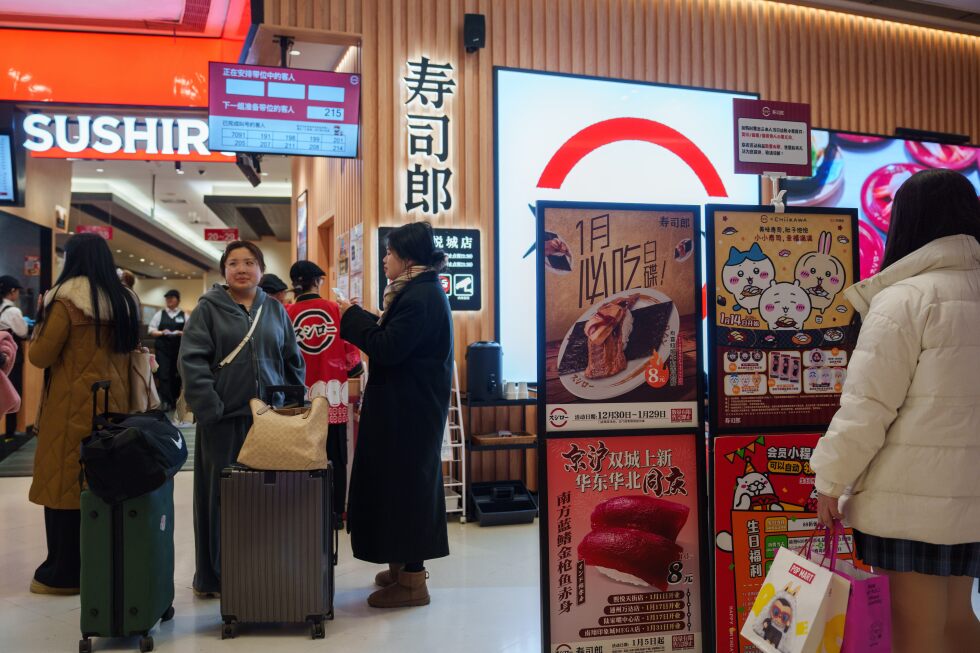
Yet at the street level, the picture looks quite different. When Japanese conveyor-belt sushi chain Sushiro opened a new outlet in Shanghai last December, crowds lined up enthusiastically despite the diplomatic chill. Since entering mainland China in 2021, Sushiro has become wildly popular.
“It tastes good,” said Edith Xiao, a 23-year-old university student who waited over 30 minutes to dine at a Beijing Sushiro location. “The quality of the ingredients is guaranteed.”
Xiao, who also enjoys Japanese manga and anime, views government tensions as separate from her consumer choices. “It’s just statements made by leaders. It doesn’t represent a change in the attitude of people of the country,” she explained.
A similar pattern emerges with American products. Despite ongoing U.S.-China tensions over tariffs and Taiwan, Disney’s “Zootopia 2” has become the highest-grossing Hollywood film in Chinese history, generating more than 4.4 billion yuan ($634 million) according to data provider Beacon Pro. This success comes despite Beijing’s push to promote domestically produced films as part of its strategy to make China a “strong film power” by 2035.
“It was so hilarious,” said Beijing resident Ruan Wenlin after watching the animated blockbuster.
Shaun Rein, managing director at China Market Research Group, attributes this embrace of escapist entertainment to broader social conditions. “Many Chinese consumers are tired, exhausted and anxious from COVID and from the weak economy,” he noted. “People are watching Hollywood movies, especially cartoons like Zootopia, because they’re stressed out and just want something to relax themselves.”
American fashion brands are also finding success. Ralph Lauren has seen faster sales growth in China than in Europe or North America, capitalizing on its “old money” aesthetic that appeals to China’s urban middle class.
“What attracts me most is its stable brand image and design,” said Zhang Tianyu while shopping at a Beijing Ralph Lauren store.
This evolving consumer behavior marks a shift from the “guochao” (national tide) movement that previously drove patriotic purchasing of Chinese brands. “Chinese have stopped buying just for the sake of buying Chinese brands,” Rein observed. “Consumers are scared about the economy, they’re anxious about their job prospects. So they’ll just buy whatever brand, domestic, Chinese or foreign, fits their definition of value and lifestyle.”
The contrast with earlier nationalist boycotts is striking. In 2012, anti-Japan protests over territorial disputes led to vandalism of Japanese restaurants and destruction of Japanese-brand cars. Similarly, Western brands including Nike faced boycotts in 2021 over concerns about Beijing’s treatment of Muslim minorities in Xinjiang.
More recent controversies, such as a planned Pokémon card game event at a shrine honoring Japan’s war dead, still generate angry social media comments but rarely translate into broader commercial impacts.
“We may believe that all Chinese consumers should follow Beijing’s direction of discarding foreign influence, which is misleading,” said Yaling Jiang, an independent Chinese consumer analyst. “Geopolitics does not dictate business flows on the local level.”
There are limits to this consumer independence, however. State employees and government agencies generally comply with official directives, such as avoiding travel to Japan. Chinese visitors to Japan fell 45% in December compared to the previous year, though many individuals still travel there while maintaining a low social media profile.
Meanwhile, the rise of competitive domestic brands presents perhaps a greater challenge to foreign companies than nationalist sentiment. From electric vehicles to smartphones and athletic wear, Chinese brands are rapidly gaining market share both domestically and internationally.
“Chinese will choose Chinese brands because they’re better, better value, better quality, better pricing,” Rein concluded, suggesting that market forces rather than nationalism increasingly drive consumer behavior in today’s China.
Fact Checker
Verify the accuracy of this article using The Disinformation Commission analysis and real-time sources.

9 Comments
This article highlights an interesting paradox in China – the disconnect between the government’s nationalist rhetoric and the pragmatic, apolitical purchasing decisions of the country’s consumers. Speaks to the nuances of a rapidly evolving market.
The rise of consumerism in China is a complex dynamic, as it appears to be at odds with the government’s nationalist agenda. Curious to see how this tension plays out as the country continues to develop economically.
This article highlights an intriguing paradox – how China’s consumers seem to prioritize their personal preferences over nationalist sentiments when it comes to everyday purchasing decisions. A sign of a maturing market economy?
Interesting to see how consumerism is trumping nationalism in China, despite the political tensions. It speaks to the growing power of the middle class and their personal preferences over ideological considerations.
The rise of Chinese consumerism is a fascinating trend, especially with the country’s history of state-driven nationalism. Curious to see how this balance evolves as China’s economy and middle class continue to grow.
The disconnect between China’s official nationalist rhetoric and its consumers’ pragmatic shopping habits is noteworthy. It underscores how economic forces can sometimes outweigh political agendas, at least at the individual level.
This article highlights an interesting paradox in China – the apparent disconnect between the government’s nationalist messaging and the pragmatic, apolitical purchasing decisions of the country’s consumers. Speaks to the nuances of a rapidly evolving market.
The apparent triumph of consumerism over nationalism in China is a fascinating trend. It speaks to the evolving priorities of the country’s middle class and the power of personal preferences in the marketplace, even amid political tensions.
The rise of Chinese consumerism and its apparent detachment from nationalist sentiments is a fascinating dynamic. Speaks to the complexities of navigating economic and political forces in a rapidly changing market.