


Listen to the article
Refillable Packaging Makes Comeback as Consumers Seek Sustainable Alternatives
Refilling a bottle instead of throwing it away has become a popular way for people to reduce waste—a small, tangible action in response to larger environmental problems. In recent years, a growing number of refill stores have opened across the United States, offering consumers the chance to reduce their environmental footprint through reusable packaging.
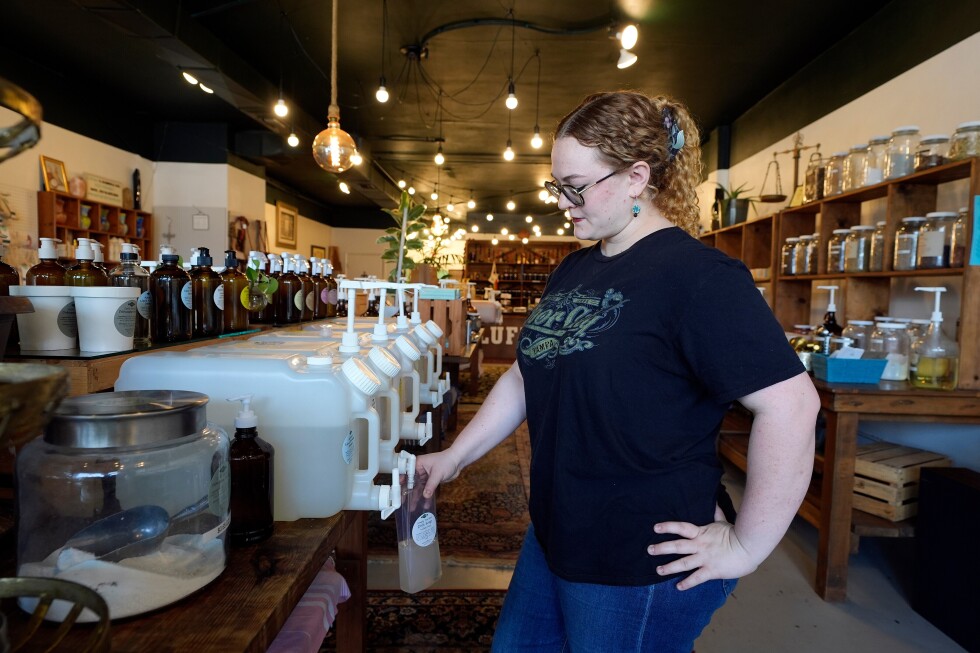
At Lufka Refillable Zero Waste store in Tampa, Florida, customers bring in reusable containers to fill with soap, shampoo, and cleaning supplies instead of buying products in single-use packaging. The store first weighs customers’ containers, then fills them with the desired product, charging by weight.
“When you do something positive, you get a little bit of a dopamine hit and you feel good,” said Julie Hughes, a Lufka customer who discovered the store two years ago while shopping for skincare products. “There are so many big problems in the world, but we can’t solve all of the big problems, but we do have control over our choices.”
For many customers, refilling provides a sense of environmental accomplishment and personal agency. Some shoppers have been refilling the same containers for six years, according to Lufka founder Kelly Hawaii. “Just imagine how much waste they’ve personally stopped consuming because they have that one container for that one product,” Hawaii said.
Return to traditional distribution models
Refillable packaging isn’t a new concept but rather a return to earlier distribution systems. Many industries historically relied on refillable or returnable containers, with familiar examples in the U.S. including soda, beer, and dairy products.
According to a 2020 study published in Resources, Conservation & Recycling: X, the shift to single-use packaging occurred mainly because disposable systems simplified logistics and reduced handling costs for producers and retailers. This transition contributed to a steady increase in packaging production and waste over time as reuse infrastructure declined.
The Public Interest Research Group estimates there are hundreds of refillable stores across the country, representing a “generation of new businesses” aimed at reducing packaging waste. Major retailers have also entered the space—Lush Cosmetics sells certain products without packaging and offers discounts to customers who return containers, while the reusable packaging platform Loop partners with major brands like Nestle and Coca-Cola in France to distribute products in durable, refillable containers.
Despite this resurgence, refillable packaging remains a small segment of the overall market. Barriers to wider adoption include hygiene requirements, the need for container collection and processing systems, and potentially higher costs associated with these additional processes.
Environmental benefits depend on usage patterns
The environmental advantage of reusable containers emerges only after repeated use, according to experts. Shelie Miller, a University of Michigan professor who studies sustainability, explains that consumers should think of “reduce, reuse, recycle” as a priority order, meaning reuse should generally come before recycling.
However, reusable containers don’t automatically guarantee environmental benefits. Durable containers typically require more energy and materials to produce, so they need to be used multiple times to offset their initial environmental impact—what Miller calls a “payback period.”
A 2021 study by Miller and a colleague examined various reusable products and found different payback periods based on material type. For example, a ceramic coffee mug must be reused between 4 and 32 times before outperforming disposable cups on measures like greenhouse gas emissions, water use, and energy demand—representing faster paybacks than reusable coffee cups made from metal or plastic.
Convenience also factors into the environmental equation. If refilling requires special trips, the added transportation emissions can cancel out the benefits. “If you are making dedicated trips just to reduce packaging, it actually can be worse for the environment than if you use the single-use product,” Miller explained.
Specialized solutions for hard-to-recycle items
For products with packaging that’s difficult to recycle through standard municipal systems, some companies offer specialized alternatives. Major beauty retailers like Ulta Beauty and Sephora have partnered with Pact Collective, a nonprofit that collects hard-to-recycle beauty packaging through in-store bins.
Carly Snider, executive director of Pact Collective, explained that the program targets items that conventional recycling programs can’t process—like packaging made of mixed materials or small pieces under 2 inches that fall through sorting machinery at recycling facilities.
“There’s specific things with beauty packaging that makes it really difficult,” said Snider. The organization routes these materials through specialized processing, diverting significant volumes from landfills.
Experts emphasize that while refilling and specialized recycling programs aren’t perfect solutions, they can make a meaningful difference when they replace single-use packaging and integrate into consumers’ everyday routines.
“Small things do add up,” Miller said. “And so when you have millions of people who are all doing small things, that really can make a difference, make a change.”
Fact Checker
Verify the accuracy of this article using The Disinformation Commission analysis and real-time sources.

12 Comments
It’s great that these stores are providing an easy way for consumers to make more sustainable choices. The sense of personal agency is an important psychological benefit.
Agreed. Giving people that feeling of making a positive impact, even in a small way, can be very motivating.
The dopamine hit from making a positive environmental choice is an interesting psychological aspect. Refill stores seem to be tapping into that sense of personal agency and accomplishment.
Definitely. Giving people a tangible way to contribute to sustainability goals is valuable, even if the individual impact is small.
Reusable packaging is a smart solution, especially for common household products. I’m curious to see if these refill stores continue to gain traction and how the model might evolve.
Me too. Convenience and cost will be key factors in driving wider adoption of refill stores.
Refill stores are an interesting approach to reducing waste. It’s great to see consumers taking tangible steps to lessen their environmental impact, even if they can’t solve all the big problems.
Absolutely. The small actions can add up and create meaningful change over time.
Reducing single-use packaging waste is a critical environmental issue. Refill stores offer a practical solution, though the overall impact will depend on how widely the model is adopted.
That’s a good point. Widespread adoption will be key to seeing significant reductions in waste.
I’m curious to see how these refill stores might expand their product offerings over time. Expanding into other household goods could make the model even more appealing to consumers.
Agreed. Diversifying the product selection could help drive more traffic and make refill stores a one-stop shop for sustainable living.