


Listen to the article
Democrats Pivot to Tax Cuts in Bid to Win Back Economically Anxious Voters
As voter concerns about affordability continue to dominate political discourse, Democratic lawmakers are embracing a strategy long associated with Republicans: cutting taxes for middle and working-class Americans.
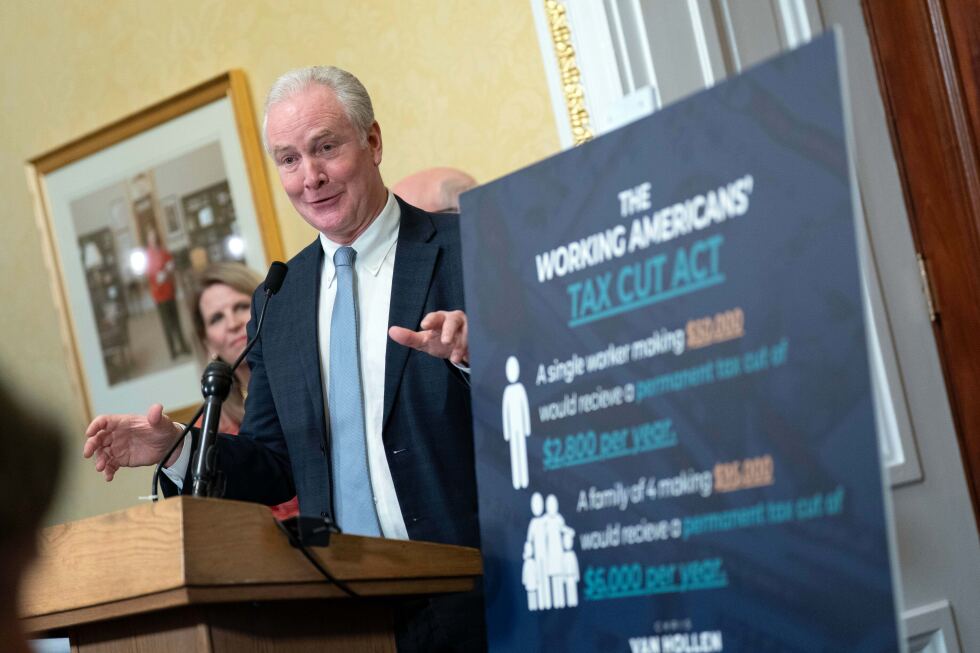
Several prominent Democrats have recently unveiled proposals that would significantly reduce federal income tax burdens for millions. Maryland Senator Chris Van Hollen has proposed effectively eliminating federal income tax for individuals earning $46,000 or less annually, while reducing it for those making up to about $106,000. Meanwhile, New Jersey Senator Cory Booker is advocating for no income tax on the first $75,000 of household earnings.
These proposals represent a strategic shift as Democrats seek to counter former President Donald Trump, who successfully campaigned on popular tax-cutting messages like “no tax on tips” and “no tax on overtime.” Trump’s soundbite-friendly proposals resonated with voters despite criticism from tax experts who called them inefficient and potentially wasteful.
“What our bill does is make sure all those people benefit,” said Van Hollen, referencing how hairdressers at his local barbershop had enthusiastically discussed potential savings under Trump’s tip tax exemption, which was incorporated into last year’s Republican budget bill.
The tax-cutting trend extends beyond federal lawmakers. Former Atlanta Mayor Keisha Lance Bottoms, now running for Georgia governor, has pledged to exempt public school teachers from state income taxes. Representative Katie Porter, campaigning for California governor, wants families earning under $100,000 to be exempt from state income tax.
Porter argues Democrats have historically taken an overly complicated approach to economic policy. “I don’t even know what 150% the median income is in my area,” she said, referring to qualification criteria in President Biden’s Inflation Reduction Act. “I like this proposal more than a complex web of reductions because it’s more straightforward. This is a conversation that I think Democrats should have been owning for the last decade.”
Despite embracing tax cuts, Democrats aren’t abandoning their core progressive tax principles. Van Hollen’s plan would fund tax relief for lower incomes by imposing a surtax on every dollar earned above $1 million. Booker proposes raising corporate tax rates nationally, while Porter supports similar increases in California.
However, economic analysts note these proposals face significant challenges. Booker’s plan would create a substantial deficit of approximately $7 trillion, according to the Yale Budget Lab, though Booker contends the study underestimates potential savings from closing “tax avoidance schemes” used by the wealthy.
Critics also point out that tax cuts aimed at lower-income groups often provide greater benefits to those higher on the income scale. “The breaks that middle-income people are getting out of these proposals is not impressive,” said Vanessa Williamson of the Tax Policy Center.
Alan Cole, an economist at the conservative Tax Foundation, observed that Democrats are attempting a delicate balancing act: “The Democratic approach is different than anything in the past, in that it’s trying to splice away the very wealthiest from people who are also wealthy. Democratic priorities mirror what their coalition looks like.”
This reflects the party’s changing demographics, as Democrats increasingly draw support from educated urbanites who earn more than the national average but still fall well below the ultra-wealthy threshold.
Chuck Marr, vice president of the liberal Center on Budget Priorities and Policies, expressed concern about revenue implications. “Reversing [Trump’s tax cuts] costs a lot of money,” he noted, highlighting that growing deficits—which have accelerated during Trump’s second term—help keep interest rates high, exacerbating voters’ affordability concerns.
Despite expert skepticism, Democratic politicians have embraced Van Hollen’s legislation, with 19 Democratic senators and two independent senators who caucus with the party signing on as cosponsors. Labor organizations like the AFL-CIO have also endorsed the bill, with president Liz Shuler stating, “We need ideas that are as clear and simple as the demands workers have given us. That’s how we restore faith—give people real relief.”
Porter summed up the evolving Democratic perspective: “Democrats need to recognize that taxes are a tool, yes, for funding programs to help people, but they are also a driver of unaffordability.” For a party seeking to reconnect with economically anxious voters, this shift toward simpler, more direct tax relief may represent their best chance to compete in the current political landscape.
Fact Checker
Verify the accuracy of this article using The Disinformation Commission analysis and real-time sources.

13 Comments
Tax cuts are always a politically charged topic. I’m curious to see if these proposals from Democrats will resonate with voters or if they’ll be seen as a cynical election-year ploy.
Tax cuts can be a double-edged sword. While they may help boost disposable income, they can also lead to reduced government revenues and services. Careful analysis will be crucial.
It’s always interesting to see political parties adopt positions that were previously associated with their opponents. I wonder what the long-term implications of this shift will be.
This is a fascinating development in the political landscape. It will be intriguing to see how Republican lawmakers respond to Democrats embracing a traditionally conservative policy stance.
Interesting to see Democrats embracing tax cuts, which have traditionally been a Republican policy. It will be fascinating to see if this helps them win back economically anxious voters.
Reducing taxes for middle and lower-income Americans could definitely help boost affordability, which seems to be a major concern for voters. I wonder how this will impact government revenue and spending priorities.
That’s a good point. The key will be balancing tax relief with maintaining essential government services and programs. It’s a tricky balance to strike.
Reducing the tax burden on middle and working-class Americans is a noble goal, but the devil will be in the details. I hope these proposals are well-crafted and fiscally responsible.
This is a significant strategic shift for the Democrats. I wonder if it signals a broader recognition that economic concerns are top of mind for many voters right now.
While tax cuts can be popular, I hope Democrats don’t lose sight of other important issues like climate change, healthcare, and education. Striking the right balance will be crucial.
Absolutely. Voters will be looking for comprehensive policy platforms, not just single-issue proposals. It will be interesting to see how Democrats integrate tax cuts with their broader agenda.
It’s encouraging to see Democrats try to address voter concerns around affordability and cost of living. Tax cuts could provide some relief, but I hope they’re coupled with other measures too.
Tax cuts can be a powerful tool to boost economic growth and help struggling families. However, they need to be carefully designed to ensure fairness and fiscal sustainability.