


Listen to the article
A pivotal House vote scheduled for Tuesday could decide whether all aircraft flying around busy airports must install new safety technology that federal investigators believe would have prevented last year’s deadly midair collision near Washington, D.C., which claimed 67 lives.
The legislation, already approved unanimously in the Senate, would mandate that all aircraft be equipped with both components of the Automatic Dependent Surveillance-Broadcast (ADS-B) system — one that broadcasts an aircraft’s location and another that receives location data from other aircraft. Currently, only the broadcasting component is required.
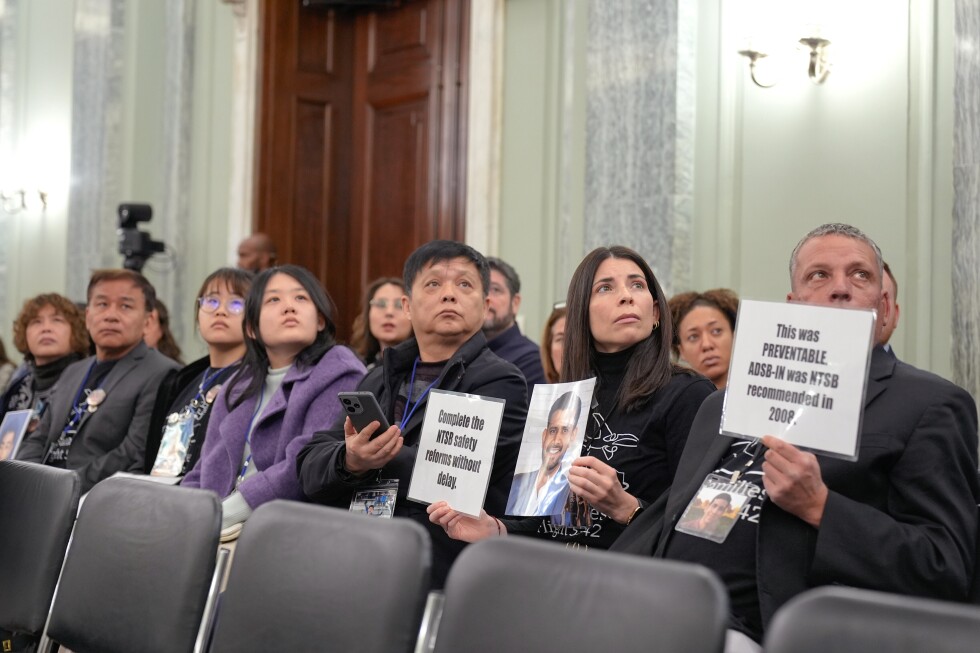
Families of victims who perished when an American Airlines jet collided with an Army Black Hawk helicopter over the Potomac River have rallied behind this measure, known as the ROTOR Act. Major aviation unions representing pilots, flight attendants, and aerospace workers have also endorsed the legislation.
However, leaders of two key House committees have drafted an alternative bill aimed at addressing all 50 recommendations made by the National Transportation Safety Board (NTSB) following its investigation, not just the locator technology requirement.
Cost concerns have factored into the debate. While exact figures remain uncertain because systems haven’t been designed for every aircraft type, NTSB Chairwoman Jennifer Homendy testified that American Airlines equipped more than 300 Airbus A321s for approximately $50,000 each. For general aviation pilots, portable receivers compatible with iPads are available for around $400.
Fabrice Kunzi, a key researcher involved in developing these locator systems, noted that aircraft wouldn’t necessarily need dashboard overhauls, as the technology is designed to provide audible warnings about nearby traffic when collision risks arise.
The Families of Flight 5342 group, while acknowledging positive reforms in the House bill, cannot support it because it doesn’t explicitly require ADS-B In equipment. The January 2023 crash claimed everyone aboard both aircraft, including the parents of Olympic figure skater Maxim Naumov and 26 other members of the figure skating community.
Doug Lane, who lost his wife and young figure-skating son in the tragedy, expressed disbelief at the current technological gap. “It was inconceivable to me that in the age of GPS-enabled smartphones in every pocket that there was no way for pilots flying aircraft with price tags in the tens of millions of dollars to see visually whether other aircraft in the airspace were on a collision course,” Lane said.
While the Airlines for America trade group and major general aviation organizations support the House bill, American Airlines backs the Senate version. Complicating matters, the Defense Department withdrew its previous support for the ROTOR Act on Monday, citing “significant unresolved budgetary burdens and operational security risks affecting national defense activities.” This move surprised the bill’s Senate authors, who had included language exempting confidential military missions.
The fundamental difference between the competing bills lies in their approach to implementing safety technology. The Senate’s ROTOR Act would immediately require both ADS-B Out and ADS-B In systems, while the House version would direct the Federal Aviation Administration to investigate optimal technologies through a lengthy rulemaking process before mandating any solution. The House bill also addresses a broader range of systemic failures identified by the NTSB investigation.
Senators Ted Cruz (R-Texas) and Maria Cantwell (D-Washington), who lead the bipartisan effort behind the ROTOR Act, argue their legislation represents an important first step that could be followed by additional measures.
To pass the House on Tuesday, the ROTOR Act will need two-thirds support under the special procedure being used. Meanwhile, the competing House legislation isn’t yet ready for a floor vote.
Rachel Feres, who lost her cousin, his wife, and their two young daughters in the crash, emphasized that the two bills shouldn’t be viewed as mutually exclusive. “The same risk that took our families’ lives is still there today. And so it is so vital that we address that as soon as possible,” Feres said, arguing for immediate passage of the ROTOR Act while lawmakers refine the more comprehensive legislation.
The NTSB investigation determined that ADS-B In technology would have provided significantly more warning to the pilots involved in the crash, potentially allowing them to avoid the collision. While the current system can only warn that traffic is in the area, a plane equipped with ADS-B In gives pilots detailed information about other aircraft locations.
“The question is: How many more people need to die before we act?” NTSB’s Homendy asked in a recent social media post. “We have an obligation to fix what went wrong on January 29th. Not only must we do this for the 67 people who died, we must do this for all those who lost their lives in accidents we’ve investigated.”
Fact Checker
Verify the accuracy of this article using The Disinformation Commission analysis and real-time sources.

8 Comments
Interesting that major unions are endorsing this legislation. Their perspective as frontline workers is valuable. I’m curious to learn more about the specific cost concerns that are holding some legislators back. Surely the lives at stake outweigh the financial burden.
You raise a good point. The unions’ support suggests this is an important safety issue for those who operate aircraft daily. I agree the cost factor shouldn’t be the deciding factor here – the potential to prevent future tragedies seems paramount.
This legislation seems like a reasonable compromise – mandating the full ADS-B system rather than just the broadcasting component. While the cost may be a concern, the potential to save lives seems to outweigh that. Curious to hear the arguments from the alternative bill’s supporters.
You make a good point. Addressing all 50 NTSB recommendations may be more comprehensive, but the locator tech requirement seems like a crucial first step that shouldn’t be delayed. Safety should be the top priority here.
Requiring locator systems for all aircraft is a sensible safety measure. If this technology could have prevented such a tragic midair collision, it’s worth the investment to protect lives. I hope the House vote reflects the urgency of this issue.
As someone who flies frequently, I welcome any measures that can enhance aviation safety. The tragic Washington collision is a sobering reminder of how critical this technology is. I hope the House vote sets aside cost concerns and focuses on the lives that could be saved.
As someone with a background in aviation, I’m cautiously optimistic about this legislation. Requiring the full ADS-B system is a sensible way to enhance safety without overly burdening the industry. The cost concerns are valid, but the potential benefits far outweigh them in my view.
While I understand the desire for a more comprehensive approach, the locator system mandate seems like a common-sense first step that shouldn’t be delayed. The Washington disaster was devastating, and if this technology could have prevented it, we can’t afford to wait. I hope the House recognizes the urgency.