


Listen to the article
Global Outcry as Hong Kong Media Tycoon Jimmy Lai Sentenced to 20 Years
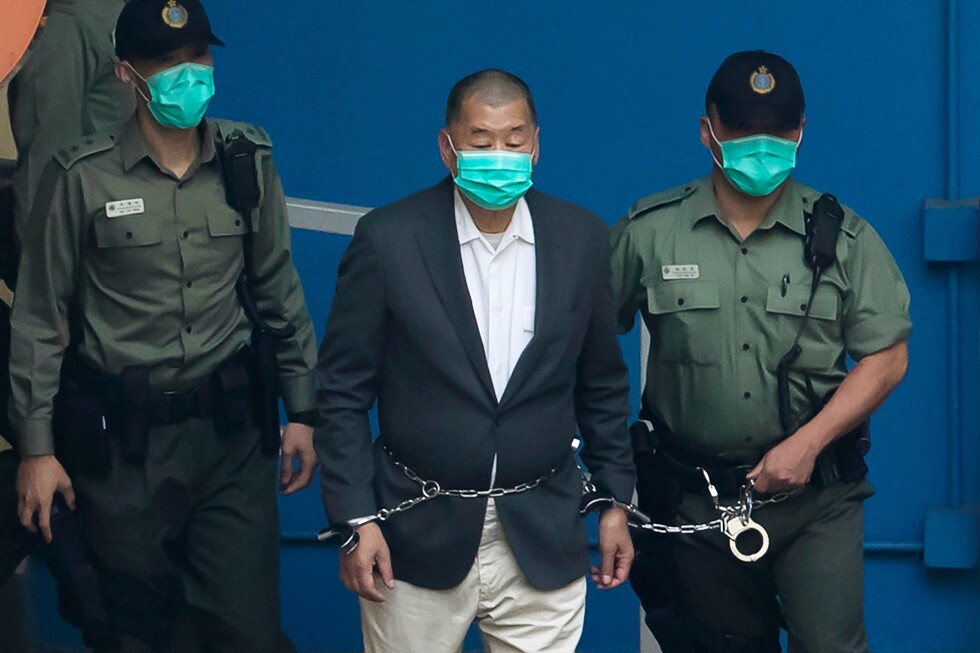
The sentencing of Hong Kong media mogul and pro-democracy advocate Jimmy Lai to 20 years in prison has sparked international condemnation, highlighting the continuing erosion of civil liberties in the former British colony.
Lai, 78, was found guilty in December of conspiracy to collude with foreign forces and publishing seditious materials through his now-shuttered Apple Daily newspaper, once Hong Kong’s most popular pro-democracy publication. The verdict represents one of the harshest punishments handed down under Hong Kong’s controversial national security law, implemented by Beijing in 2020 following massive pro-democracy protests.
Several co-defendants who entered guilty pleas received prison terms between six years and three months to 10 years, underscoring the severity with which Hong Kong authorities are treating cases involving political dissent.
The United Nations human rights chief, Volker Türk, condemned the sentence, stating that Lai was punished for “exercising rights protected under international law” and called for the verdict to be quashed. His office expressed concerns that the broad scope of the charges risks criminalizing legitimate activities by journalists and civil society organizations.
“This is part of a broader repressive trend in Hong Kong, where hundreds have been arrested and prosecuted under these laws,” Türk said.
Hong Kong authorities staunchly defended the ruling. Chief Executive John Lee claimed Lai had used Apple Daily to “poison” residents and incite hatred, adding that the media tycoon deserved the lengthy sentence for seeking foreign sanctions against China and Hong Kong.
“His heavy sentence of 20 years in prison demonstrated the rule of law, upheld justice and brought great satisfaction to the people,” Lee said.
The U.S. State Department described the verdict as “an unjust and tragic conclusion” and urged Chinese authorities to grant Lai humanitarian parole, given his advanced age. U.S. Senator Jeff Merkley, who nominated Lai for the Nobel Peace Prize in 2023, said the sentencing “should put to rest any illusion that the Chinese government will relent until it exercises total control over the people of Hong Kong.”
British Foreign Secretary Yvette Cooper called for Lai’s release on humanitarian grounds, describing the case as a “politically motivated prosecution.” For the 78-year-old British citizen, Cooper noted, “this is tantamount to a life sentence.”
In response to deteriorating freedoms in Hong Kong, the UK government announced it would expand immigration pathways for Hong Kong residents, potentially allowing some 26,000 Hongkongers to relocate to Britain over the next five years.
China’s Foreign Ministry rebuffed international criticism, insisting that Lai is a Chinese citizen and describing him as “a major planner and participant in a series of anti-China destabilizing activities in Hong Kong.” Spokesperson Lin Jian urged foreign nations to avoid interfering in what Beijing considers Hong Kong’s internal affairs.
The European Union called for Lai’s immediate and unconditional release, citing concerns over his age and health. “The politically motivated prosecution of Jimmy Lai and the former Apple Daily executives and journalists harms Hong Kong’s reputation,” the EU stated, urging Hong Kong authorities to restore press freedom.
Australian Foreign Minister Penny Wong condemned the chilling effect the prosecutions have had on free speech, while Taiwan’s mainland affairs council urged Lai’s release and warned Taiwanese citizens to take Hong Kong’s experience as a cautionary tale.
Media watchdog Reporters Without Borders warned that the sentence underscores the collapse of press freedom in the territory. “We have already witnessed press freedom defender Liu Xiaobo die in prison due to insufficient international pressure. We cannot allow Jimmy Lai to suffer a similar fate,” said Thibaut Bruttin, the organization’s director general.
Lai’s case has become a powerful symbol of Beijing’s tightening grip on Hong Kong, which was promised a high degree of autonomy until 2047 under the “one country, two systems” framework established when Britain returned the territory to China in 1997. Critics argue that the national security law has accelerated the dismantling of Hong Kong’s civil liberties and democratic institutions well ahead of schedule.
Fact Checker
Verify the accuracy of this article using The Disinformation Commission analysis and real-time sources.

36 Comments
Production mix shifting toward Business might help margins if metals stay firm.
Good point. Watching costs and grades closely.
Exploration results look promising, but permitting will be the key risk.
Good point. Watching costs and grades closely.
Good point. Watching costs and grades closely.
Nice to see insider buying—usually a good signal in this space.
Good point. Watching costs and grades closely.
Good point. Watching costs and grades closely.
Interesting update on Hong Kong ex-publisher Jimmy Lai’s sentence raises international outcry as China defends it. Curious how the grades will trend next quarter.
Good point. Watching costs and grades closely.
Good point. Watching costs and grades closely.
Production mix shifting toward Business might help margins if metals stay firm.
Good point. Watching costs and grades closely.
Good point. Watching costs and grades closely.
Exploration results look promising, but permitting will be the key risk.
Good point. Watching costs and grades closely.
Good point. Watching costs and grades closely.
The cost guidance is better than expected. If they deliver, the stock could rerate.
Good point. Watching costs and grades closely.
Good point. Watching costs and grades closely.
Exploration results look promising, but permitting will be the key risk.
Good point. Watching costs and grades closely.
Exploration results look promising, but permitting will be the key risk.
The cost guidance is better than expected. If they deliver, the stock could rerate.
Interesting update on Hong Kong ex-publisher Jimmy Lai’s sentence raises international outcry as China defends it. Curious how the grades will trend next quarter.
Good point. Watching costs and grades closely.
Good point. Watching costs and grades closely.
Nice to see insider buying—usually a good signal in this space.
Uranium names keep pushing higher—supply still tight into 2026.
Good point. Watching costs and grades closely.
If AISC keeps dropping, this becomes investable for me.
Good point. Watching costs and grades closely.
Good point. Watching costs and grades closely.
Exploration results look promising, but permitting will be the key risk.
Good point. Watching costs and grades closely.
Good point. Watching costs and grades closely.