


Listen to the article
Chinese Luxury Car Market Shifts as Domestic Brands Gain Ground
Chinese consumers are increasingly turning away from foreign luxury vehicles in favor of more affordable domestic models, creating significant challenges for European automakers that have long dominated China’s premium car segment.
The trend represents a major shift in the world’s largest automotive market, where brands like Porsche, Aston Martin, Mercedes-Benz, and BMW have historically enjoyed strong sales and brand prestige. Now, these companies face mounting pressure as economic headwinds and changing consumer preferences reshape the landscape.
China’s prolonged property market downturn has dampened consumer confidence, leaving many potential buyers reluctant to make big-ticket purchases. Wealthy consumers are also increasingly hesitant to display their affluence publicly, according to Paul Gong, UBS head of China Automotive Industry Research.
“Slowing economic growth is one key driver behind weaker demand for premium cars,” explains Claire Yuan, director of corporate ratings for China autos at S&P Global Ratings. This economic uncertainty has hit the premium segment particularly hard, with market share for luxury vehicles priced above 300,000 yuan ($42,400) dropping from 15% of total sales in 2023 to 13% in the first nine months of 2025.
Government incentives have further accelerated the shift toward domestic brands. A 20,000 yuan ($2,830) trade-in subsidy for purchasing electric and plug-in hybrid vehicles has steered many consumers toward entry-level models where the discount makes a more significant impact. These vehicles are predominantly manufactured by Chinese companies.
Chinese automakers have seized the opportunity by aggressively innovating and introducing new electric and hybrid models at competitive prices. Even in the premium segment, domestic brands now offer compelling alternatives to foreign luxury vehicles.
“Their products are more competitive and more affordable even in the premium segment,” Yuan notes of Chinese manufacturers. “That’s why these foreign brands are gradually losing momentum.”
The surge in domestic brands’ market share is striking. Chinese brands now account for nearly 70% of passenger car sales in the first 11 months of this year, according to the China Association of Automobile Manufacturers. German, Japanese, and American brands have been relegated to much smaller pieces of the market at 12%, 10%, and 6% respectively.
BYD exemplifies this shift, having overtaken Volkswagen as China’s largest car seller in recent years. The company has become the top-selling brand for “new energy vehicles” – including electric vehicles and hybrids – after implementing price cuts of up to 34% on its models, putting significant pressure on rivals.
The impact on European luxury carmakers has been severe. Mercedes-Benz reported a 27% year-over-year decline in China sales for the July-September quarter. BMW and Mini sales dropped 11.2% in the first nine months of 2025. Porsche, Aston Martin, and Ferrari have all cited weakening demand in the Chinese market.
Mercedes-Benz CEO Ola Källenius acknowledged the challenge in a recent investor call, stating that “hyper-competition in China is not going away anytime soon.” The company described the market situation in China’s premium and luxury segment as “tense.”
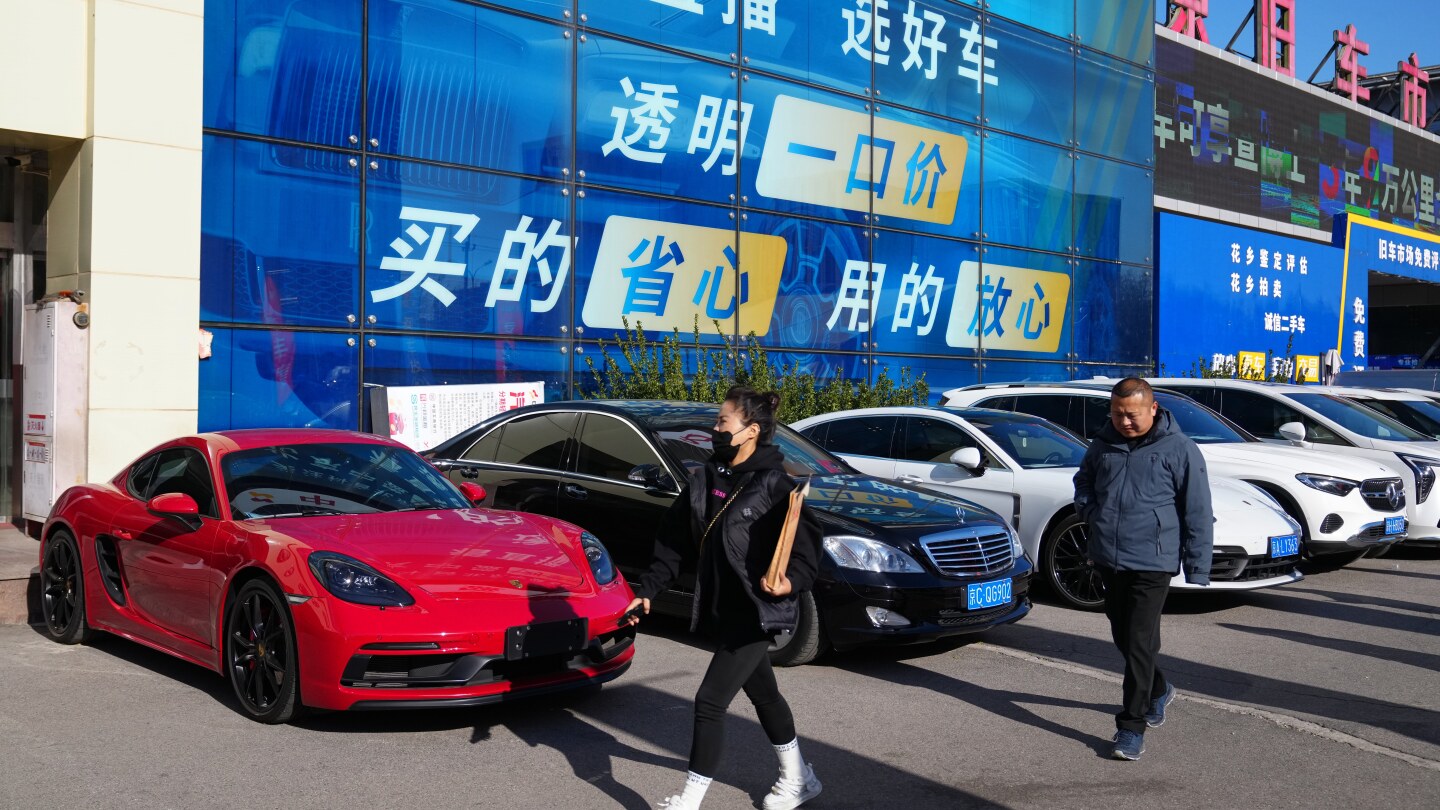
The secondary market reflects these challenges. At a Beijing Porsche center, a 2024 Panamera 2.9T with approximately 20,000 kilometers (12,400 miles) is now priced at 950,000 yuan ($134,300) – significantly below its original purchase price of about 1.4 million yuan ($198,454).
“It’s mainly due to the sluggish economic situation,” explains Li Yi, a salesperson handling second-hand cars at the center. “Not only Porsche. Benz, BMW, Bentley and Rolls-Royce all face the same situation.”
Used car dealers in Beijing report similar trends, with premium vehicles selling at substantially reduced prices over the past year despite China’s record auto production. In November, monthly production exceeded 3.5 million units for the first time, yet domestic sales dropped 4% year-over-year as consumer demand waned.
“Who still has money these days? People’s pockets are cleaner than their faces,” joked one used car salesperson who identified herself only as Hao, adding that prices have been declining for two years. “Now they think hard before they spend.”
Fact Checker
Verify the accuracy of this article using The Disinformation Commission analysis and real-time sources.

20 Comments
Interesting to see the rise of domestic Chinese brands in the premium car segment, given the historical dominance of European players. This shift reflects the broader economic and consumer trends in the country.
Curious to see how European automakers respond to the rise of domestic Chinese brands in the premium segment. Maintaining their edge in a changing market will be a key challenge.
Absolutely. Adapting their product offerings, pricing, and marketing strategies to better align with evolving Chinese consumer preferences will be critical for the European players.
The slowdown in China’s luxury car sales is a significant data point, given the importance of this market for European automakers. It will be crucial for them to understand and respond to the changing consumer preferences.
Absolutely. Adapting their product offerings and marketing strategies to better align with the evolving needs and preferences of Chinese consumers will be key for the European players.
The shift in China’s luxury car market is a significant development. It will be interesting to see how the European manufacturers adjust their strategies to remain competitive in this crucial market.
This news highlights the challenges facing European automakers as they navigate the shifting dynamics of China’s premium car market. Adjusting to the rise of domestic brands and changing consumer behaviors will be crucial.
Interesting shift in China’s auto market. Domestic brands gaining ground as economic headwinds impact consumer spending on premium vehicles. Curious to see how European automakers adapt to the changing landscape.
Absolutely, the rise of Chinese brands in the premium segment is a significant development. Affordability and shifting consumer preferences will be key factors as this unfolds.
The slowdown in China’s high-end car sales is an interesting development, given the market’s historical importance for European automakers. It will be fascinating to see how the industry responds to these shifting trends.
Agreed. The European players will need to carefully evaluate their strategies and adapt to the evolving preferences of Chinese consumers in order to maintain their competitiveness in this crucial market.
Interesting to see the impact of China’s economic headwinds on the premium car segment. This news underscores the importance of the Chinese market for European automakers and the need to stay agile in the face of changing consumer preferences.
This news highlights the importance of the Chinese market for European automakers and the challenges they face as economic headwinds and changing consumer preferences reshape the landscape.
You’re right, the European players will need to carefully evaluate their positioning and adapt accordingly to stay relevant in China’s evolving premium car market.
The slowdown in China’s premium car sales is an interesting data point. It speaks to the broader economic headwinds the country is facing and the impact on consumer spending patterns.
Agreed. This trend is likely to have ripple effects across the global automotive industry, particularly for the European manufacturers that have long relied on China for growth.
This news highlights the challenges facing European automakers in the crucial Chinese market. Slowing economic growth and changing consumer behaviors are squeezing demand for high-end vehicles.
You’re right, the European players will need to rethink their strategies to stay competitive as the market dynamics shift. Adapting to the evolving preferences of Chinese consumers will be crucial.
The slowdown in China’s high-end car sales is a significant data point, given the market’s strategic importance for European automakers. Adapting to the rise of domestic brands and evolving consumer behaviors will be crucial for these manufacturers.
Absolutely. The European players will need to carefully rethink their product offerings, pricing, and marketing strategies to remain competitive in China’s shifting premium car landscape.