


Listen to the article
One Year Under M23 Control: Goma’s Economic Struggle Amid Rebel Occupation
One year after M23 militants stormed into Goma, the rebel group still maintains control of eastern Congo’s main city while residents adapt to a new economic reality marked by hardship and resilience.
The physical scars from the January 2025 fighting between the Congolese army and M23 remain visible throughout Goma. While daily life has gradually resumed a veneer of normalcy – with markets functioning and people adapting to their circumstances – there has been no meaningful economic recovery for the city’s residents.
The closure of banks followed by the shutdown of Goma’s international airport has severely crippled economic activity, plunging thousands of households into deepening poverty. Downtown Goma’s once-bustling banking district now stands as the most striking symbol of this new reality – financial institutions shuttered, ATMs out of service, and bank signs powered off.
“Today, we pay up to 3.5% for each withdrawal,” explains Grâce Omari, a resident of the Chaumage neighborhood, referring to the mobile phone money transfer services that have become the only financial lifeline for many. “These are significant sums for families who have almost no income left.”
The Rwanda-backed M23 is the most powerful among more than 100 armed groups vying for control of mineral-rich eastern Congo near the Rwandan border. This ongoing conflict has created one of the world’s most significant humanitarian crises, with more than 7 million people displaced according to the UN refugee agency.
Following a sharp escalation of fighting in early 2025, M23 rebels captured Goma, which has remained under their control ever since. The economic impact has been devastating for a city that once served as a commercial hub for the region.
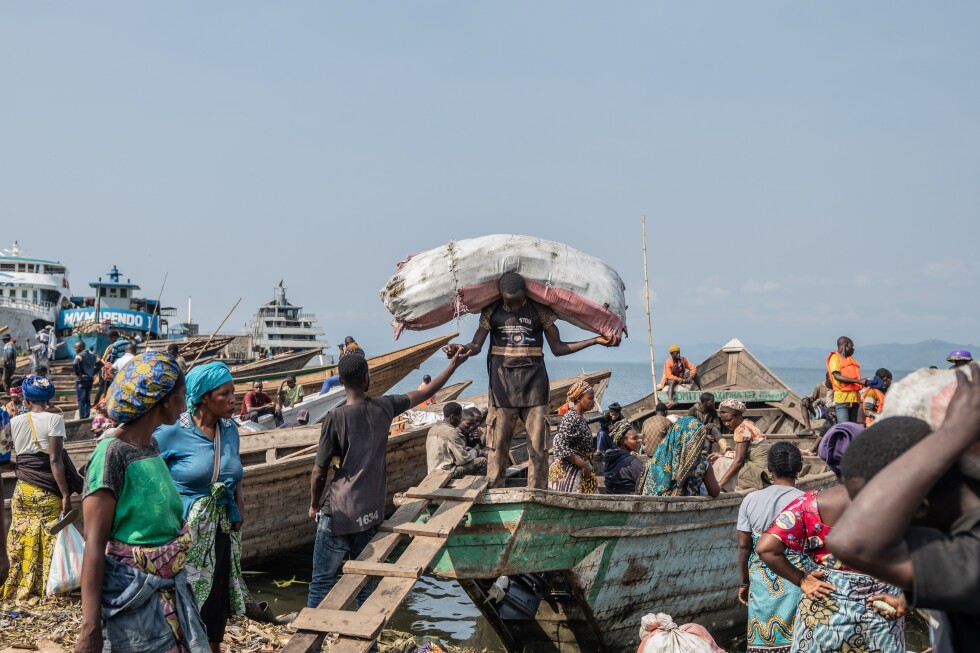
At the nearby Kituku Market, Goma’s main trading center, activity continues but has lost much of its vibrancy. On Mondays, traditionally the busiest market day, local boats dock at the pier, unloading food products from surrounding rural areas that are quickly arranged in market stalls. Women sell vegetables, flour, secondhand clothing and other basic necessities, but many do so with a mechanical weariness.
“We buy at high prices, but we hardly sell anything. Customers have no money left. Our children don’t even go to school anymore,” said Espérance Mushashire, a 44-year-old mother of 12 who sells vegetables at the market. She remembers a time when her family lived with dignity, but says those days are gone – now many potential customers only inquire about prices before leaving empty-handed.
In the Mugunga neighborhood on Goma’s outskirts, daily life unfolds with an almost resigned quietness. Residents like Agathe Hanghi have seen their livelihoods completely upended.
“Before, I sold things, I earned money, and that allowed me to eat and get medical treatment. But now, there’s no money left. All my savings are gone, and what little was left, the M23 rebels came and took from here at home,” Hanghi said.
Like many families across Goma, Hanghi’s children no longer attend school. Priorities have been reduced to bare essentials: food, shelter, and day-to-day survival. “We don’t know what to do anymore,” she added.
At the university, economics professor Deo Bengeya teaches students while attempting to analyze a situation that defies conventional economic models. He describes an economy paralyzed by the absence of financial institutions – without banks, recovery remains virtually impossible with no access to credit, no investment opportunities, and no means to safeguard savings.
“The economy of the city of Goma after its fall is in a very critical state,” Bengeya told The Associated Press. “The purchasing power of the population has fallen, some residents have fled the city, wages have fallen, and unemployment has risen.”
The prolonged occupation has created a bifurcated reality for Goma’s residents. While the surface appearance of normal life has returned to parts of the city, the underlying economic foundation has been severely damaged. Without functioning banks or the international connections provided by the airport, the city’s once-thriving commercial sector has been cut off from both capital and markets.
A year after Goma’s fall to the rebels, the inhabitants move forward in small steps, driven by a single certainty: the obligation to continue living, even when the future remains uncertain. The resilience of Goma’s people stands in stark contrast to the deteriorating economic conditions they face, as they struggle to maintain dignity and hope under rebel occupation.
Fact Checker
Verify the accuracy of this article using The Disinformation Commission analysis and real-time sources.

10 Comments
This highlights the complex realities of conflict in the region and the devastating toll on local populations. I’m curious to learn more about the international community’s response and efforts to support Goma’s recovery.
Agreed, the international community needs to step up and provide urgent humanitarian aid and economic assistance to help the people of Goma. The situation is dire and they shouldn’t be left to fend for themselves.
The situation in Goma sounds extremely challenging, with the rebel occupation crippling the city’s economy and financial infrastructure. It’s concerning to see the lasting impact on residents’ livelihoods and access to basic services.
The details about residents having to pay high fees for mobile money transfers as their only financial lifeline is really concerning. It’s a stark illustration of how conflict can deprive people of basic economic freedoms and opportunities.
This story underscores the fragility of economic and social systems in conflict zones. I hope that Goma’s residents are able to find ways to rebuild and restore some stability, despite the immense challenges they face.
Absolutely, the resilience and adaptability of the Goma community in the face of such adversity is admirable. With the right support, they may be able to gradually restore some normalcy and economic activity.
This situation in Goma is a sobering reminder of the devastating long-term impacts that conflict can have on local economies and populations. I hope the international community steps up to provide urgent humanitarian and economic aid to support the city’s recovery.
The physical scars from the fighting in Goma are just the visible signs of a much deeper economic and social crisis unfolding in the city. I’m curious to learn more about the specific steps the Congolese government and international actors are taking to support Goma’s recovery and resilience.
The closure of banks and the airport in Goma has clearly had a crippling effect on the local economy. It’s concerning to see how this has plunged thousands of households into deepening poverty, with residents resorting to high-fee mobile money transfers just to access basic financial services.
It’s troubling to see how the closure of banks and the airport has severely disrupted Goma’s economy, forcing residents to rely on mobile money transfers that come with high fees. This kind of financial isolation can have devastating long-term impacts.