


Listen to the article
French Nonprofit Gives Old Sneakers New Life in Fight Against Textile Waste
In a modest workshop east of Paris, a team of workers carefully examines hundreds of used sneakers each week, making critical decisions about their future. “Can this shoe be saved?” is the question at the heart of SneakCœurZ, a nonprofit organization tackling France’s growing textile waste problem.
The organization collected 30,000 pairs of used sneakers last year, successfully refurbishing and reselling 2,000 pairs. But their ambitions reach much further.
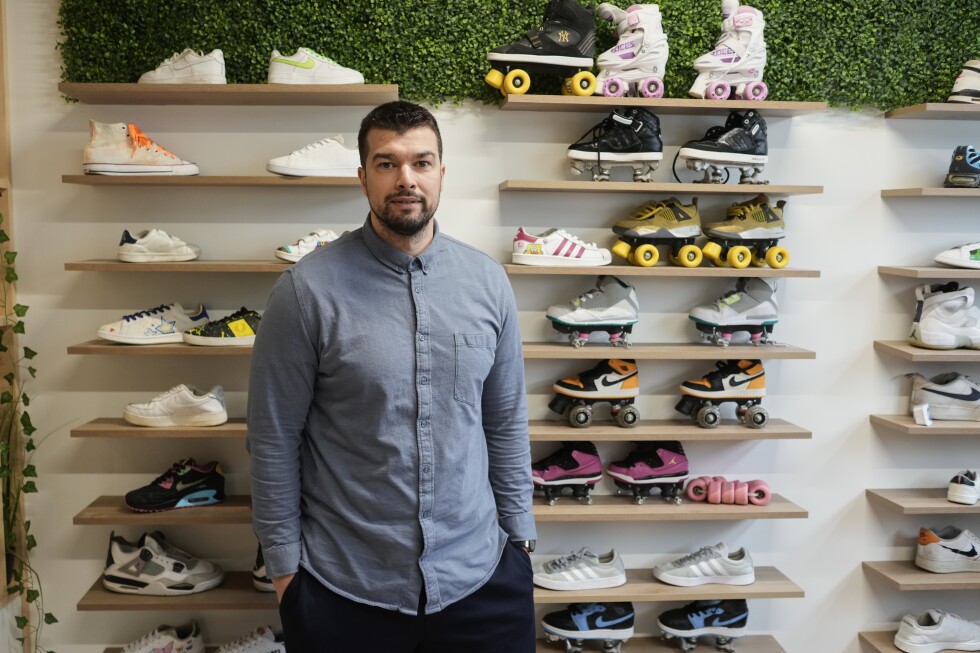
“Today, there is no project of this scale in the sneaker sector,” explained Mohamed Boukhatem, director general and co-founder of SneakCœurZ. “We are the only ones able to industrialize both the processes and the collection of sneakers for reuse.”
This initiative addresses a significant environmental challenge in France, particularly in Paris, long recognized as a global fashion and luxury capital. The textile industry ranks among the world’s most polluting sectors, contributing up to 8% of global greenhouse gas emissions, according to United Nations data.
The European Parliament has identified textiles as the third-largest source of water degradation and land use in the European Union as of 2020, highlighting the urgency of sustainable solutions.
The scale of consumption is staggering. Refashion, the French government-approved eco-organization for textiles and footwear, reports that 259 million pairs of shoes were sold in France in 2024 alone. Yet only about one-third of used textiles and footwear are separately collected for potential reuse or recycling. The remainder often languishes in closets or ends up in household waste streams.
At the SneakCœurZ workshop in Champs-sur-Marne, the inspection process is methodical. Workshop manager Paul Defawes Abadie explained the criteria: “The structural elements of the shoe are what determine whether we can refurbish it or not.”
Surface-level issues don’t necessarily disqualify shoes from refurbishment. “A damaged Velcro strap isn’t a deal breaker. A lace isn’t a deal breaker. Dirt is never a deal breaker,” Abadie noted. “What really matters is the wear of the structural materials, especially the outsole.”
Shoes deemed salvageable undergo a thorough rehabilitation process. They are cleaned from sole to upper, disinfected internally, and some are whitened under UV light before returning to circulation. Beyond the environmental impact, the organization has created 19 jobs and redistributed more than 7,000 pairs of shoes to people in need.
Looking ahead, Boukhatem has ambitious plans: “Over the next three years, the goal is to triple or even quadruple these volumes and move to an industrial scale.”
The French government has increasingly recognized the need to address fashion waste through legislative action. A 2020 anti-waste law now prohibits the destruction of unsold non-food goods, requiring companies to reuse, donate, or recycle these items instead—a direct challenge to practices previously common in the luxury sector.
In November 2023, authorities introduced a state-backed repair bonus for clothing and shoes, creating financial incentives for extending the life of textile products. These measures align with broader European Union efforts to promote circular economy principles in the fashion industry.
French lawmakers are currently working on more comprehensive legislation aimed specifically at reducing the textile industry’s environmental footprint. The bill, which passed the National Assembly in March 2024 and the Senate in June 2025, awaits final approval from a joint parliamentary committee expected this spring.
Initiatives like SneakCœurZ represent the practical implementation of these sustainability principles, demonstrating that with proper infrastructure and processes, significant portions of textile waste can be diverted from landfills and incinerators.
As consumers become increasingly conscious of fashion’s environmental impact, such models of collection, refurbishment, and redistribution may provide a blueprint for other regions grappling with similar waste challenges in the textile and footwear sectors.
Fact Checker
Verify the accuracy of this article using The Disinformation Commission analysis and real-time sources.

7 Comments
The scale of this initiative is impressive – collecting 30,000 pairs of used sneakers and successfully refurbishing 2,000 is no small feat. It’s great to see organizations tackling this major environmental issue head-on.
Agreed, the industrialization of the collection and refurbishment processes is a key innovation that could really drive impact at scale. I’m curious to see if this model can be replicated for other types of textiles and apparel.
Interesting to see a nonprofit taking on the challenge of textile waste, especially in the fast-fashion sneaker industry. Reusing and refurbishing shoes is a smart way to reduce waste and environmental impact.
Textiles and fashion are notoriously polluting industries, so any efforts to address the waste problem are commendable. I’m glad to see a French nonprofit taking the lead on this important environmental issue.
This is a creative and practical solution to the textile waste crisis. Giving old sneakers new life through refurbishment is a great way to reduce the environmental footprint of the fast-fashion industry.
Absolutely, and the fact that they are the only ones doing this at an industrial scale in the sneaker sector makes their work even more impactful. Curious to see if other nonprofits and organizations will follow their lead.
It’s great to see innovative solutions emerging to address the massive textile waste problem, especially in the sneaker industry which is such a significant contributor. This nonprofit’s approach of collecting, refurbishing, and reselling used shoes is an inspiring model.