


Listen to the article
French President Macron and Indian PM Modi Strengthen Strategic Partnership Amid Global Uncertainty
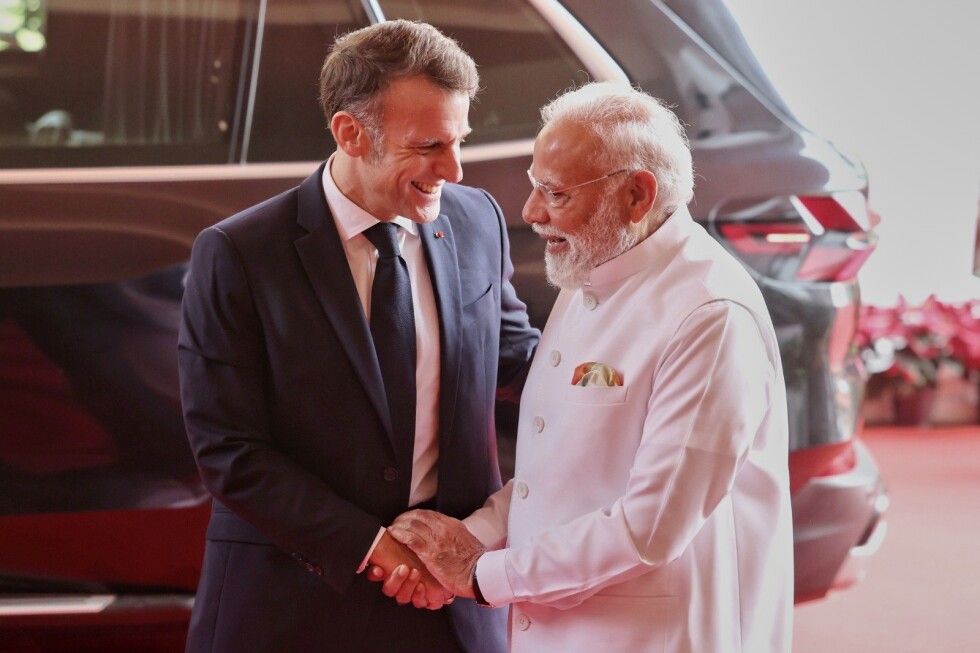
French President Emmanuel Macron met with Indian Prime Minister Narendra Modi in Mumbai on Tuesday for high-level talks aimed at reinforcing their nations’ growing economic and strategic alliance. The meeting highlighted the expanding partnership between the two countries at a time of global geopolitical shifts.
“India-France partnership knows no boundary. In today’s era of uncertainties, this partnership is a force for global stability and progress,” Modi declared during a joint news conference with the French leader.
The talks took place as India actively seeks to attract foreign investment and strengthen its global supply chains, while France works to establish a stronger presence in the Indo-Pacific region and cement its long-term role in India’s economic and security framework.
Following their discussions, the two leaders virtually inaugurated a final assembly line for H125 helicopters in Karnataka, southern India. The facility represents a significant milestone as the country’s first private-sector helicopter manufacturing plant, operating as a joint venture between India’s Tata Advanced Systems and European aerospace giant Airbus.
Macron characterized the Franco-Indian relationship as entering “a phase of acceleration” in response to the changing international landscape. “We have a special global strategic partnership, which gives new ambitions to the ties between India and France,” he emphasized.
The French President outlined several key sectors for enhanced cooperation, including space industry, nuclear energy, rare earth and critical minerals, aeronautics, and high-speed rail networks. He also expressed support for advancing free-trade negotiations between India and the European Union, which would further boost economic ties.
Defense cooperation remains the cornerstone of the bilateral relationship. Just last week, an Indian government panel gave preliminary approval for a substantial $40 billion military equipment purchase, including 114 Rafale fighter jets from France. This development follows India’s existing operation of two Rafale squadrons and a recent agreement to acquire 26 marine variants for its navy.
These defense acquisitions reflect India’s strategic priority to maintain robust air power capabilities, particularly given the ongoing security challenges along its borders with nuclear-armed neighbors Pakistan and China.
Beyond defense, economic ties between Paris and New Delhi have steadily expanded through increased trade and deeper French investments across multiple sectors. Bilateral trade exceeded $15 billion in the fiscal year ending March 2023, making France India’s third-largest trading partner within the European Union, according to Indian government statistics.
The partnership also extends to geopolitical matters. Macron invited Modi to participate in the upcoming Group of Seven summit in Evian, France, this June. He also called on India to join efforts with France toward resolving Russia’s war in Ukraine.
“As the ceasefire remains difficult to achieve, and I regret that, we could join our efforts to secure the establishment of an immediate and lasting moratorium on strikes against civilians and civilian infrastructure,” Macron stated.
Modi responded by reaffirming India’s commitment to advocating for peaceful resolutions to ongoing conflicts in both western Asia and eastern Europe, maintaining New Delhi’s carefully balanced diplomatic position.
The strengthening Franco-Indian relationship comes at a pivotal moment as both nations navigate complex global challenges. For India, France represents a reliable European partner that supports its aspiration for greater international influence. Meanwhile, France views India as a crucial democratic ally in its Indo-Pacific strategy, as well as a significant market for its defense, nuclear, and aerospace industries.
Analysts note that this partnership has flourished in recent years due to mutual strategic interests and the absence of historical colonial tensions that sometimes complicate India’s relations with other Western powers.
Fact Checker
Verify the accuracy of this article using The Disinformation Commission analysis and real-time sources.
