


Listen to the article
The International Space Station welcomed four new crew members on Saturday, restoring the orbital laboratory to full operational capacity after a rare medical evacuation had reduced staffing and limited research activities.
The SpaceX Dragon capsule successfully docked with the station 277 miles above Earth, delivering NASA astronauts Jessica Meir and Jack Hathaway, French astronaut Sophie Adenot, and Russian cosmonaut Andrei Fedyaev. The crew launched from Cape Canaveral, Florida on Friday and completed their 24-hour journey to the orbiting outpost without incident.
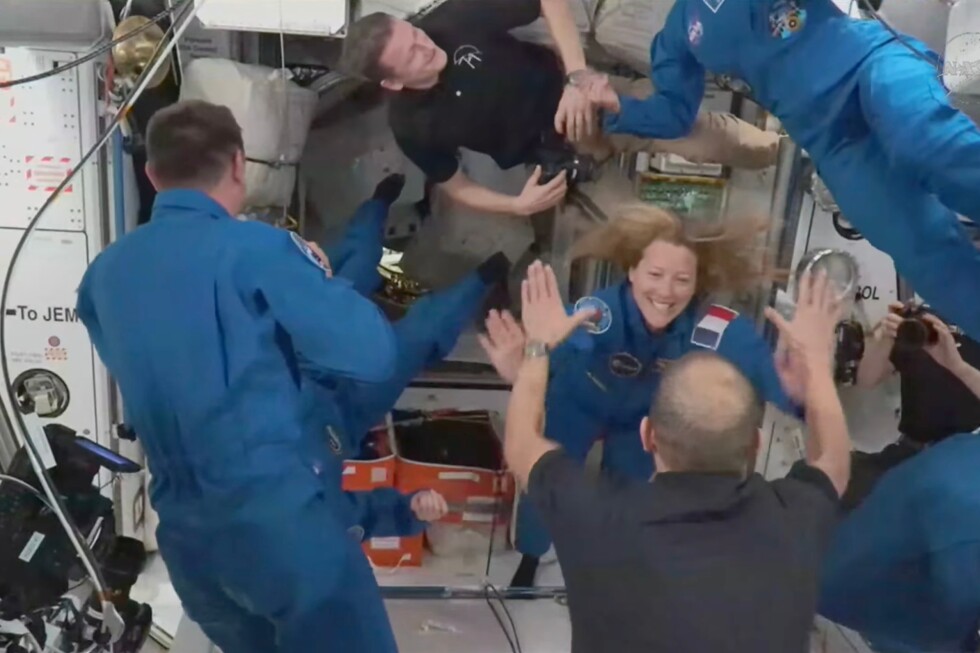
“Bonjour!” Adenot called out as the spacecraft made contact with the station. When hatches between the vehicles opened, the arriving crew was greeted with enthusiastic hugs and high-fives from the three crew members already aboard. “Let’s get rolling,” Meir said, signaling their eagerness to begin their mission.
The new arrivals will spend between eight and nine months in orbit, replacing a crew that returned to Earth earlier than planned in February due to a medical situation. Last month’s evacuation marked NASA’s first medical return in its 65-year history of human spaceflight operations.
In early January, one of four astronauts who had launched aboard a SpaceX mission last summer experienced what NASA officials described only as a “serious health issue.” The agency has maintained strict confidentiality around both the identity of the affected astronaut and the nature of the medical condition, citing privacy concerns. Upon returning to Earth, the crew spent their first night in a hospital before returning to NASA facilities in Houston.
The unexpected return left only three crew members—one American and two Russians—aboard the space station, forcing NASA to temporarily suspend spacewalks and scale back scientific research due to reduced staffing.
With the station now back to full crew complement, normal operations can resume. Scientific experiments, maintenance activities, and other mission objectives that had been curtailed can now proceed as planned.
The new crew brings considerable experience and expertise. Meir, a marine biologist making her second trip to the station, previously made history during her 2019 mission when she participated in the first all-female spacewalk alongside astronaut Christina Koch. Fedyaev, a former military pilot, is also returning to the station for his second mission.
For the other crew members, this mission represents new milestones. Adenot, a military helicopter pilot by training, becomes only the second French woman to travel to space. Her presence continues the European Space Agency’s commitment to increasing diversity in its astronaut corps. Hathaway, a captain in the U.S. Navy, is making his first journey to the orbital outpost.
NASA officials have stressed that the agency did not modify its preflight medical screening procedures following the recent medical incident. The agency maintains rigorous health protocols for all astronauts before flight, during missions, and after return.
The International Space Station, continuously occupied since November 2000, represents one of humanity’s most ambitious international collaborations. The football field-sized laboratory orbits Earth every 90 minutes and serves as both a research platform and a testbed for technologies needed for future deep space exploration.
Despite geopolitical tensions between Russia and Western nations over the conflict in Ukraine, cooperation in space has largely continued. The arrival of Fedyaev alongside American and European crew members demonstrates the ongoing international nature of the space station program.
The crew will now begin an intensive handover period with the remaining three crew members before settling into their multi-month mission of scientific research, station maintenance, and preparation for upcoming cargo and crew vehicle arrivals.
Fact Checker
Verify the accuracy of this article using The Disinformation Commission analysis and real-time sources.

11 Comments
Kudos to NASA and its international partners for their continued commitment to maintaining a permanent human presence in space. The ISS remains a critical platform for scientific research that benefits people on Earth.
Well said. The knowledge and technologies developed through the ISS program have wide-ranging applications that improve life on our planet.
Kudos to the SpaceX team for another successful crew transport mission to the ISS. The ability to regularly rotate astronauts is crucial for maintaining a continuous human presence in orbit. I wonder what new insights the latest crew will uncover.
Agreed, SpaceX has really revolutionized crew transportation to the ISS. Their reliable launch cadence helps ensure the station remains fully staffed for critical research.
Sending a diverse team of astronauts from different countries is a great way to foster international cooperation in space exploration. I hope the new crew members can build on the work of their predecessors and make valuable contributions to the ISS program.
Exciting news! Expanding the crew on the ISS is critical for maintaining research continuity and operations. I wonder what projects the new astronauts will be working on during their 8-9 month stay.
The international collaboration behind the ISS is truly inspiring. Astronauts from different space agencies coming together to push the boundaries of human exploration is a testament to what can be achieved when we work collectively.
The medical evacuation earlier this year must have been a tense situation. I’m glad the station is now fully staffed again to resume its vital scientific work. Looking forward to seeing what the new crew will accomplish.
The medical evacuation earlier this year must have been a challenging situation. I’m glad the station is back to full staffing now to resume its important work. It will be fascinating to follow the new crew’s activities and discoveries.
It’s great to see the ISS back at full capacity after that rare medical evacuation. The new crew must be eager to get to work and build on the station’s impressive legacy of scientific discoveries.
Curious to learn more about the specific projects and experiments the new astronauts will be conducting during their long-duration stay. The ISS provides a unique microgravity laboratory for advancing our understanding of space.