


Listen to the article
China’s economic strategy has shifted dramatically as it floods Latin American markets with low-priced goods, particularly automobiles and e-commerce products, in response to U.S. tariffs and changing geopolitical dynamics.
The world’s second-largest economy has become a crucial trading partner for many Latin American nations, seeking both their abundant natural resources and growing consumer markets while expanding its influence in what former President Trump described as “America’s Backyard.”
Faced with slowing domestic demand, Chinese businesses are aggressively targeting new markets as the country increases production capacity across numerous industries. Exports to Latin America, a region with over 600 million consumers, have surged while shipments to the United States fell by 20% last year.
“Latin America has a solid middle class, relatively high purchasing power and real demand,” explained Margaret Myers, director of the Asia and Latin America program at the Inter-American Dialogue think tank in Washington. “Those conditions make it one of the easiest places for China to offload its excess industrial production.”
This influx of Chinese-made cars, clothing, electronics, and home furnishings has created friction in countries attempting to develop globally competitive industries. Several nations, including Mexico, Chile, and Brazil, have responded by raising tariffs or implementing protective measures for local businesses.
Chinese e-commerce platforms like Temu and Shein have accelerated market penetration. According to market intelligence company Sensor Tower, Temu averaged 114 million monthly active users in Latin America during the first half of 2025, representing a 165% year-over-year increase from 2024. During the same period, Shein’s monthly active users in the region grew by 18%.
For consumers like Chilean restaurant manager Lady Mogollon, these platforms offer significant savings: “I use Temu all the time, whether to buy clothes or household items. The same things I would find in brand-name stores or shopping malls, I find on Temu at a much lower price.”
The impact extends beyond online shopping. Chinese-made products now dominate markets across the region. In downtown Mexico City, local business owners like Ángel Ramírez, who manages a lamp shop, struggle to compete as the number of stores selling Chinese goods has more than tripled in recent years, sometimes forcing established Mexican businesses to close.
Argentina has been particularly hard hit, with local factories shutting down and laying off workers in a manufacturing sector that employs nearly a fifth of the country’s workforce. Government statistics show the volume of e-commerce imports—primarily from China—increased by 237% in October compared to the same month the previous year.
“We’re operating at historically low capacity as imports break record highs,” said Luciano Galfione, president of the Pro Tejer Foundation, which represents textile manufacturers. “We’re under indiscriminate attack.”
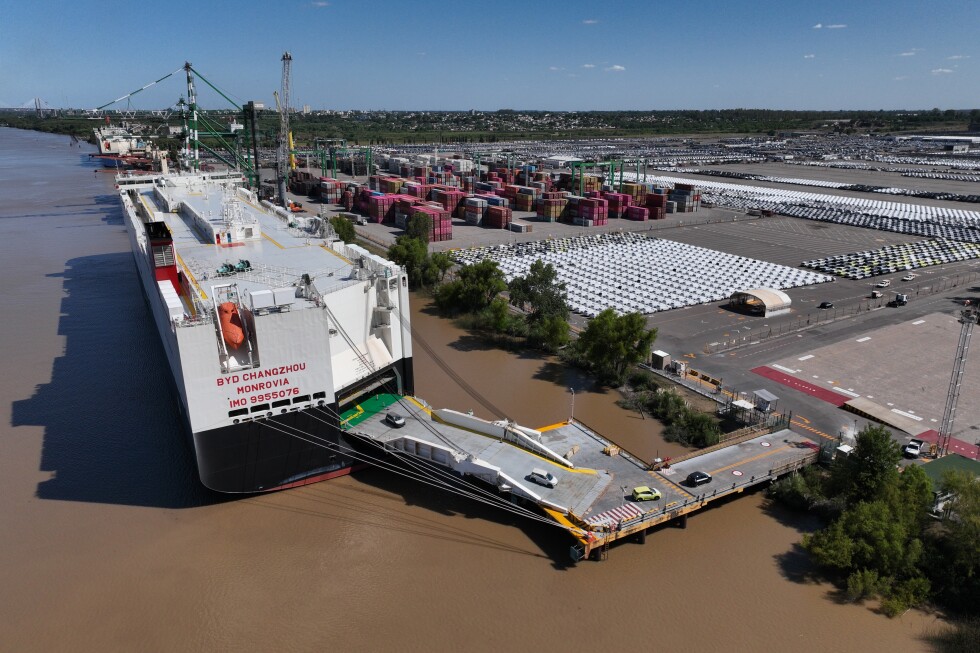
The automotive sector is also feeling the pressure. In Brazil, the world’s sixth-largest auto market, Chinese brands accounted for more than 80% of the 61,615 electric vehicles sold in 2024, according to the Brazilian Association of Electric Vehicles. Meanwhile, Mexico has become the largest destination for Chinese auto exports, receiving 625,187 vehicles last year, according to the China Passenger Car Association.
Both countries already have established auto industries. Mexico, a manufacturing base for major global automakers, ranks as the world’s seventh-largest auto producer, making nearly 4 million vehicles last year. Brazil produced approximately 2.6 million vehicles, including many EVs and hybrids. However, these numbers pale in comparison to China’s output of 34.5 million vehicles, with over 7 million exported globally.
“China does have a comparative advantage on EVs,” noted Jorge Guajardo, a partner at consultancy DGA Group and former Mexican ambassador to China, citing affordable prices and massive government support.
While Chinese manufacturers like BYD and GWM are investing in local production facilities in countries like Brazil, potentially creating hundreds of jobs, concerns persist. Last year, Brazilian prosecutors sued BYD over alleged poor labor conditions, which the company denied.
The trading relationship between China and Latin America is complex. China heavily relies on the region’s natural resources, from lithium in Brazil to copper in Chile and fishmeal in Peru. However, trade deficits with China are widening across the region.
Mexico’s deficit with China, its second-largest trading partner after the U.S., reached $120 billion in 2024, with exports totaling only about $9 billion. Argentina’s trade deficit with China grew to nearly $8.2 billion in 2025. Brazil and Chile are exceptions, recording trade surpluses with China due to their significant commodity exports.
Beyond trade, China has provided approximately $153 billion in loans and grants to Latin American and Caribbean countries between 2014-2023, significantly outpacing the U.S. contribution of around $50.7 billion during the same period.
“There may be deep concern about competitiveness, but politically, many countries don’t feel they have the space to resist China’s export surge,” Myers observed. “The relationship has become too important economically.”
Some nations are implementing protective measures. Mexico has imposed tariffs of up to 50% on certain Chinese imports. Brazil is eliminating tax exemptions for overseas parcels costing less than $50 and increasing tariffs on EV imports. Chile has raised tariffs and added a 19% value-added tax on low-value parcels.
However, as Leland Lazarus, founder of Lazarus Consulting, points out, countries face a “balancing act when it comes to protectionist policies” given China’s growing influence in the region. “They can’t go too far, or China may retaliate in kind. So, their leverage has a limit.”
Fact Checker
Verify the accuracy of this article using The Disinformation Commission analysis and real-time sources.

9 Comments
The surge of Chinese imports is a double-edged sword for Latin America. On one hand, it provides access to low-cost goods, but on the other, it threatens local manufacturing. I’m curious to see how this plays out in terms of trade policy and economic development in the region.
China’s economic strategy in Latin America is certainly an interesting geopolitical dynamic to watch. The region’s growing middle class represents a lucrative market, but protecting domestic industries is also a priority. It will be important to find the right policy mix to address these competing interests.
Interesting to see Latin America taking a more assertive stance against the flood of Chinese imports. Protecting domestic industries is important, but it will require careful policymaking to ensure the right balance between economic interests.
Interesting to see Latin America fighting back against the flood of cheap Chinese goods. Protecting domestic industries is important, but it will be a challenge balancing trade relationships with China’s economic might.
Agreed. Latin American nations will need to be strategic in their approach, leveraging trade policies and incentives to support local manufacturing while maintaining important trade ties with China.
The influx of cheap Chinese goods is a complex issue without easy solutions. While it benefits consumers, it also puts pressure on local manufacturers. I hope Latin American leaders can craft nuanced policies that support both economic growth and domestic industry.
This is a tricky balancing act for Latin American nations. They want to maintain strong trade ties with China, but also need to protect their own industries and jobs. Curious to see how they navigate this challenge going forward.
This is a complex issue with no easy solutions. China’s export-driven growth has disrupted many economies, but Latin America also benefits from access to affordable Chinese products. Finding the right balance will require careful negotiation.
That’s true. Policymakers will need to weigh the pros and cons carefully, considering the impacts on consumers, domestic industries, and broader geopolitical dynamics. It’s a delicate balancing act.