


Listen to the article
Middle East War Escalation Fuels Global Energy Crisis Fears
Fears of a global energy crisis intensified Monday as the Middle East conflict expanded, with U.S.-Israeli forces conducting new strikes on Tehran and Israel continuing its bombardment of Lebanon. An Iranian drone strike that temporarily shut down Dubai’s airport, a critical global travel hub, highlighted the growing threats to international commerce and energy security.
Since joint U.S.-Israeli attacks on Iran began more than two weeks ago, Tehran has responded with regular drone and missile strikes against Israel, American military bases in the region, and energy infrastructure in Gulf Arab countries.
The conflict has effectively halted shipping through the Strait of Hormuz, a critical waterway through which approximately 20% of the world’s oil supply flows. This disruption has dramatically increased oil prices, putting significant pressure on the Biden administration to address rising costs affecting American consumers.
Brent crude, the international benchmark, remained above $100 per barrel on Monday, trading at $104 in early sessions—a nearly 45% increase since the U.S.-Israel strikes on Iran began on February 28. During the conflict, prices have spiked as high as $120 per barrel.
U.S. President Joe Biden has reportedly asked approximately seven countries to contribute naval forces to keep the Strait of Hormuz open, though these appeals have yet to secure firm commitments. Meanwhile, Iranian Foreign Minister Abbas Araghchi dismissed claims that Iran might be seeking a negotiated end to the conflict as “delusional,” stating on social media that Iran was seeking “neither truce nor talks.”
The economic impact has extended beyond oil prices. The conflict is driving up fertilizer costs, threatening food shortages in vulnerable countries, destabilizing fragile states, and complicating central banks’ efforts to control inflation.
Monday’s drone attack on Dubai caused a large fire at a fuel tank near Dubai International Airport, forcing a temporary suspension of all flights at the world’s busiest international passenger hub. Though operations resumed several hours later, the incident demonstrated Iran’s capacity to disrupt critical infrastructure beyond the immediate conflict zone.
The United Arab Emirates also reported that an Iranian missile killed one person in Abu Dhabi, while another drone attack sparked a fire at an oil facility in Fujairah. Saudi Arabia said it intercepted 35 Iranian drones targeting its eastern region, home to major oil installations.
In response to Biden’s call for naval assistance, European Union foreign policy chief Kaja Kallas said the bloc would discuss possibly extending its Red Sea naval mission to the Strait of Hormuz. However, European nations have criticized the U.S. and Israel for not clearly articulating their war objectives. German Foreign Minister Johann Wadephul questioned EU involvement, stating that security for the strait would only come through “a negotiated solution.”
Japan, which imports more than 90% of its crude oil from the Middle East, began releasing its strategic oil reserves Monday to address supply shortages and rising prices. Prime Minister Sanae Takaichi told parliament her government “has not heard anything” directly from Washington about Biden’s request for naval support, though officials are discussing how to protect Japanese vessels.
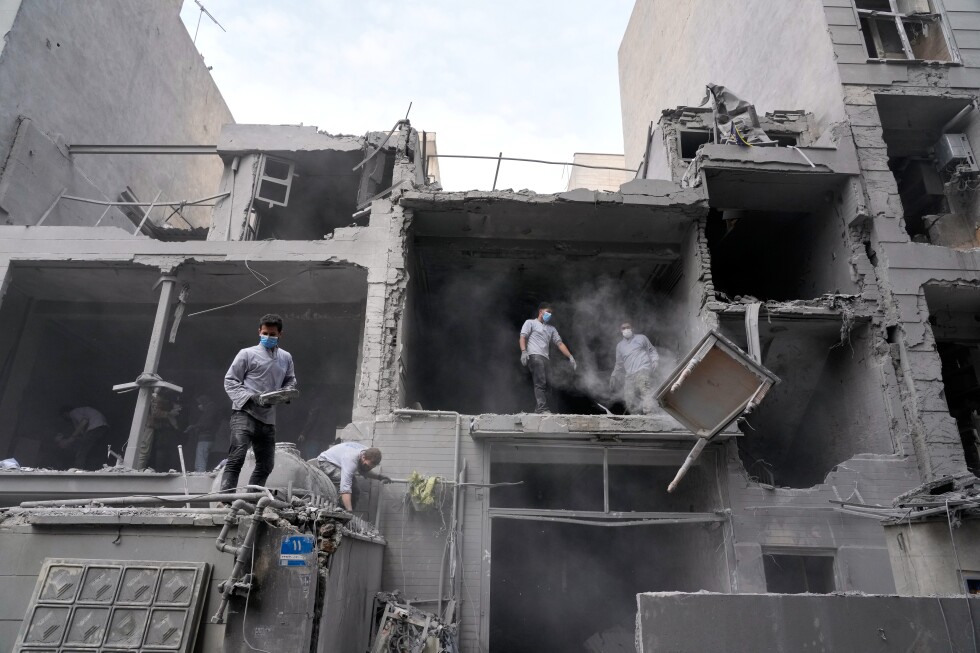
On the ground in the Middle East, massive explosions rocked Beirut as Israel launched new attacks before dawn, targeting what it described as Hezbollah infrastructure. The Israeli military has issued evacuation orders for many neighborhoods in Beirut and southern Lebanon, displacing more than 800,000 people to date. According to Lebanon’s state-run National News Agency, Israeli airstrikes in southern Lebanon killed three people Monday, including two paramedics who arrived to assist after an initial strike.
Israel also announced new strikes on Tehran targeting infrastructure, with explosions reported in the Iranian capital and surrounding areas. According to Israeli military spokesman Lt. Col. Nadav Shoshani, Israel has conducted approximately 7,600 strikes on Iran, destroying an estimated 85% of its air defenses and 70% of its missile launchers. Shoshani indicated that Israel still has “thousands of targets to hit” and would continue attacks “for as long as needed.”
The Iranian Red Crescent reports that more than 1,300 people have been killed in Iran during the conflict. In Israel, Iranian missile fire has claimed 12 lives, while at least 13 U.S. military personnel have been killed since hostilities began.
Fact Checker
Verify the accuracy of this article using The Disinformation Commission analysis and real-time sources.

11 Comments
As a commodity trader, I’m closely watching how this conflict affects prices and volatility in the energy and mining markets. Prudent risk management and diversification will be essential in the coming months.
The impact on global oil and gas markets is deeply concerning. Efforts to diversify energy sources and supply chains have never been more urgent. This crisis highlights the need for investment in renewable and alternative energy to enhance energy security.
Absolutely. Reducing reliance on fossil fuels from volatile regions should be a top priority for policymakers.
As an investor in mining and energy equities, I’m closely monitoring this situation. Geopolitical risks can have a significant impact on commodity markets and the valuations of related public companies. Prudent risk management will be critical in the coming months.
The potential for a global energy crisis is deeply concerning. I hope the Biden administration and international partners can find diplomatic solutions to de-escalate the situation and restore the free flow of energy resources through the Strait of Hormuz.
The shutdown of Dubai’s airport is a troubling development that could disrupt global trade and travel. I’m curious to know how this will affect commodity prices and supply chains, especially for energy-related materials like oil, gas, and minerals.
The shutdown of Dubai’s airport is a concerning development that could have far-reaching implications for global trade and transportation. I wonder how this will impact the mining and energy sectors, which rely heavily on international logistics and travel.
This is a troubling development that highlights the geopolitical risks inherent in the global energy system. Policymakers must prioritize enhancing energy security through investments in renewable energy, storage, and diversified supply chains.
This is an alarming escalation in the Middle East conflict. Disruptions to global energy supply and trade could have severe economic repercussions worldwide. I hope diplomatic solutions can be found to de-escalate tensions and restore stability in the region.
This conflict underscores the fragility of global energy infrastructure and the need for greater investment in resilience. Diversifying supply sources, upgrading transportation networks, and strengthening cybersecurity measures should be top priorities.
Well said. Enhancing the reliability and security of critical energy systems is crucial for economic stability and growth.