


Listen to the article
AI Jesus Offers Spiritual Connection at $1.99 Per Minute as Religious Tech Booms
For some evangelical Christians, faith means having a personal relationship with Jesus Christ. Now, tech company Just Like Me is offering that experience quite literally—at $1.99 per minute.
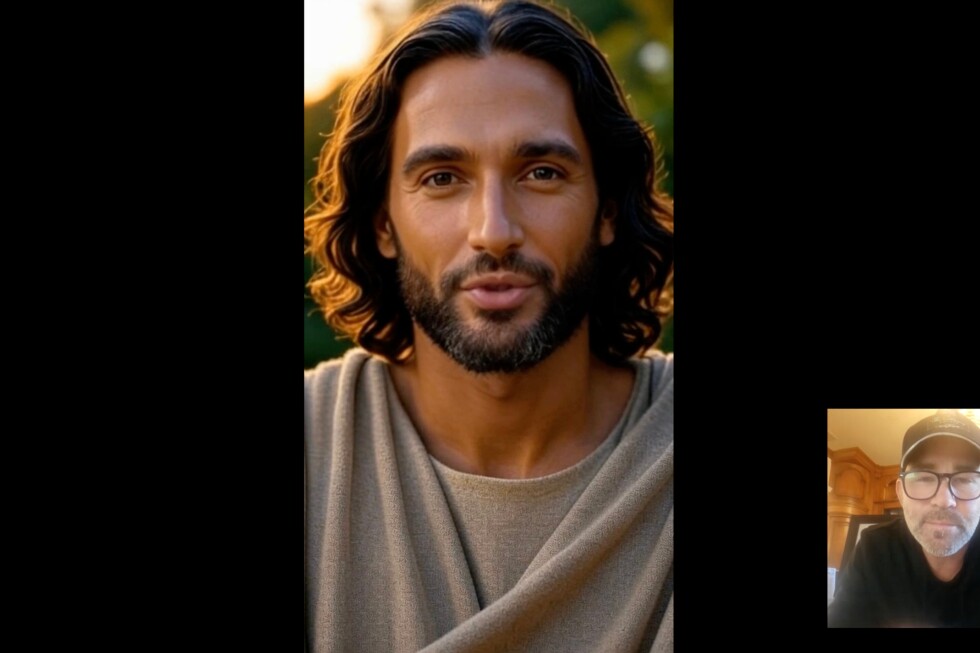
The California-based company has created an AI-generated avatar of Jesus that users can video chat with, receiving prayers and spiritual guidance in multiple languages. Despite occasional technical glitches and not-quite-synchronized lip movements, the system remembers previous conversations, creating what CEO Chris Breed describes as a sense of accountability and emotional attachment.
“You do feel a little accountable to the AI,” Breed explained from his Southern California headquarters. “They’re your friend. You’ve made an attachment.”
This AI Jesus represents just one example in a rapidly expanding market of faith-based artificial intelligence tools. The sector now includes everything from Hindu gurus and Buddhist priests to specialized Catholic chatbots that function similarly to OpenAI’s ChatGPT but with religious training.
Breed and co-founder Jeff Tinsley say their model was trained using the King James Bible and various sermons, though they haven’t specified which preachers’ teachings were incorporated. The avatar’s appearance draws inspiration from actor Jonathan Roumie, known for portraying Jesus in the popular series “The Chosen.” Users can purchase a package deal of 45 minutes per month for $49.99.
As religious AI applications proliferate, both tech developers and faith leaders are grappling with ethical considerations. Christian software engineer Cameron Pak has developed criteria to help believers evaluate such applications, including that AI tools must clearly identify themselves as artificial and “must not fabricate or misrepresent Scripture.” He’s also adamant about certain boundaries: “AI cannot pray for you, because the AI is not alive.”
Beth Singler, an anthropologist studying religion and AI at the University of Zurich, notes that some religious AI models have been shut down or significantly modified after generating misinformation or raising data privacy concerns. Different faith traditions are approaching AI with varying levels of caution. In Islam, for instance, prohibitions against human representations have prompted discussions about whether AI itself might be considered forbidden.
The Vatican has also weighed in on the matter. While acknowledging the “human genius” behind AI development, Pope Francis has identified artificial intelligence as one of the most critical issues facing humanity today, warning that it could negatively impact people’s intellectual, neurological, and spiritual development.
Some developers are proceeding more cautiously. Jeanne Lim, founder of beingAI, has spent years training an AI Buddhist priest named Emi Jido but hasn’t yet released it publicly. “She’s kind of like a little child,” Lim explained. “If you give birth to a child, you don’t just throw them out to the world and then hope that they become good people. You have to train them and give them values.”
Emi Jido received a formal ordination in a 2024 ceremony performed by Roshi Jundo Cohen, a Zen Buddhist priest who continues to train the AI from Japan. Cohen envisions the bot eventually becoming a hologram but emphasizes its supplementary role: “She’s just meant to be a Zen teacher in your pocket. It’s not meant to replace human interactions.”
In Japan, Kyoto University professor Seiji Kumagai initially believed AI and Buddhism were incompatible. However, when challenged by a monk in 2014 to address declining religious participation, his team developed BuddhaBot, trained exclusively on early Buddhist scriptures. More recently, the university collaborated with tech companies Teraverse and XNOVA to create Buddharoid, a humanoid robot monk designed to eventually assist clergy.
Critics worry about the potential for manipulation, especially as these technologies become more sophisticated. Podcast host and atheist Graham Martin expressed concern after testing an app called Text With Jesus. “I grew up with Southern U.S. televangelism… all they had to do was get on TV once a week and tell you to send money,” he said. “We’ve seen people around the world getting into emotional relationships with AIs. Now imagine that that’s your lord and savior, Jesus Christ.”
Peter Hershock of the Humane AI Initiative sees the relationship between spirituality and AI as problematic, particularly for Buddhist practice. “The perfection of effort is crucial to Buddhist spirituality. An AI is saying, ‘We can take some of the effort out,'” he explained. “‘You can get anywhere you want, including your spiritual summit.’ That’s dangerous.”
As religious organizations worldwide face declining attendance and engagement, particularly among younger generations, AI-powered spiritual guidance represents both opportunity and challenge for faith communities navigating an increasingly digital world.
Fact Checker
Verify the accuracy of this article using The Disinformation Commission analysis and real-time sources.

12 Comments
AI-powered spiritual guidance is a fascinating development, but I’m curious about the implications for religious institutions and traditions. Could this lead to a more individualized, tech-driven approach to faith?
That’s a valid concern. These AI chatbots could potentially undermine the role of religious leaders and communities, making faith a more isolated, consumerist experience. The long-term effects on organized religion are worth considering.
Intriguing concept, but $1.99 per minute for an AI Jesus seems a bit steep. Will these faith-based AI apps be able to truly replicate the spiritual connection of in-person religious experiences?
Good point. While the technology is interesting, it remains to be seen if these AI chatbots can provide the same sense of community and deeper meaning that many find in traditional religious practices.
From a technological perspective, the ability to create AI avatars of religious figures is an impressive feat. However, I wonder about the ethical considerations around potentially commodifying sacred beliefs and experiences.
Excellent point. There’s a risk of trivializing or exploiting religious traditions for commercial gain. Any development in this space should be handled with the utmost sensitivity and respect for the beliefs and practices involved.
While the concept of an AI Jesus or Buddhist priest is novel, I can’t help but wonder about the potential for misuse or unintended consequences. Careful consideration of the ethical implications is crucial as this technology develops.
Absolutely. The risk of these AI systems being used to spread misinformation, manipulate beliefs, or exploit vulnerable individuals is a serious concern that should be addressed proactively.
This trend of faith-based AI apps is certainly thought-provoking. I’m curious to see how the technology evolves and whether it can genuinely meet the needs of religious seekers, or if it remains a novelty or gimmick.
That’s a fair assessment. As with any new technology, it will be interesting to observe how it is adopted and integrated (or not) into existing religious traditions and practices over time.
While the idea of an AI Jesus or Buddhist priest may appeal to some, I can’t help but feel that these chatbots could never truly replicate the depth of human-to-human spiritual connection. The personal element seems crucial for many religious experiences.
I agree. Technology can enhance or supplement religious practice, but it’s hard to imagine an AI fully replacing the meaningful interactions and community aspects that are central to most faiths.