


Listen to the article
In a cinematic landscape dominated by franchises and familiar formulas, Japanese director Genki Kawamura’s “Exit 8” presents a refreshingly unique premise that transforms an ordinary subway hallway into a metaphysical puzzle box.
Unlike most films that use hallways as transitional spaces or scenes of violence, “Exit 8” makes the corridor itself the central setting. The film opens from a first-person perspective, following an unnamed protagonist navigating Tokyo’s crowded subway system. Distracted by his phone and struggling with asthma, he attempts to make his way to the hospital where a woman awaits a crucial decision from him.
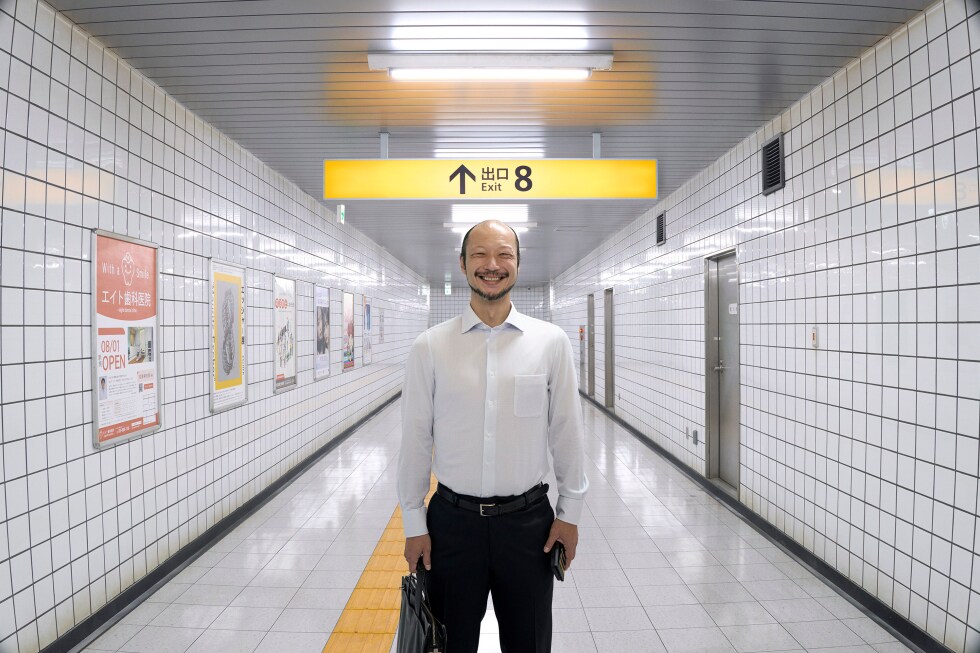
When he follows signs to Exit 8, the film’s central conceit emerges – after walking down the corridor, he inexplicably returns to where he started. Each attempt to traverse the hallway results in the same disorienting loop, creating what might be cinema’s most elegantly simple yet profoundly disturbing spatial paradox.
“Exit 8” is adapted from a cult video game of the same name, where players must escape a repeating subway tunnel by recognizing patterns and solving increasingly complex puzzles to advance through levels. Rather than simply recreating the game’s mechanics, Kawamura expertly infuses the premise with emotional and philosophical depth.
The protagonist, credited only as The Lost Man and played by Kazunari Ninomiya (known for his standout performance in Clint Eastwood’s “Letters from Iwo Jima”), begins methodically analyzing his environment. Cryptic instructions on the wall advise him to “turn back if you see any anomaly, proceed forward if you don’t,” sending him on a mission to count every vent, door, and poster in the hallway.
What constitutes an “anomaly” becomes the film’s central question. Is it the robotic commuter who passes by during each loop? The boy standing inexplicably in the middle of the corridor? Or something deeper about human perception itself?
Kawamura, whose previous film “A Hundred Flowers” explored dementia through a similarly restricted perspective, transforms the game’s bare-bones structure into a meditation on empathy and awareness. The film suggests that escape from our personal loops might depend on truly seeing those around us – a timely commentary in an era of perpetual digital distraction.
This thematic resonance is established in the film’s opening subway scene, where passengers absorbed in their smartphones ignore a man shouting at a mother with a crying baby. The protagonist’s choice of music – a march-like Ravel composition playing through his earbuds – takes on symbolic significance as the narrative unfolds.
The film’s success in Japan, where it became a box office phenomenon, demonstrates the potential for thoughtful video game adaptations that honor their source material while leveraging cinema’s unique storytelling capabilities. Unlike most game-to-film projects that either overexplain or abandon their origins, “Exit 8” strikes a delicate balance, preserving the game’s core puzzle mechanics while expanding its emotional landscape.
At a brisk 95 minutes and confined primarily to its titular corridor, “Exit 8” risks repetitiveness. Yet Kawamura uses these constraints to his advantage, creating a Kafkaesque experience that transforms mundane spaces into existential traps. The film’s PG-13 rating (for some bloody images and terror) belies its sophisticated psychological approach to horror.
For viewers seeking an alternative to Hollywood’s bombastic blockbusters, “Exit 8” offers a cerebral challenge that lingers long after its conclusion. As it arrives in theaters this Friday via Neon, it serves as a reminder that sometimes the most affecting journeys occur within the narrowest of spaces.
Fact Checker
Verify the accuracy of this article using The Disinformation Commission analysis and real-time sources.

11 Comments
A video game adaptation that aims to be more than just a straightforward translation to film is always an interesting prospect. ‘Exit 8’ seems to be taking a fresh, unconventional approach by focusing on the setting as the central puzzle. Definitely a project worth keeping an eye on.
As someone who enjoys both cinema and gaming, I’m excited to see how ‘Exit 8’ blends the two mediums. The concept of a repeating, disorienting subway hallway as the central setting is quite unique and could make for a compelling cinematic experience.
Absolutely, the director’s decision to center the film around the corridor itself rather than just using it as a transitional space is a bold and intriguing creative choice. Curious to see how it all comes together on screen.
As someone who enjoys both film and video games, I’m excited to see how ‘Exit 8’ blends the two mediums. Adapting a cult game into a cinematic experience is a bold move, but could pay off if done well.
The director’s approach of making the corridor itself the main setting rather than just a transitional space is an interesting creative choice. Curious to see how that plays out on the big screen.
Interesting premise for a film based on a video game. I’m curious to see how the director translates the spatial puzzles of the game to the cinema screen. Could make for a compelling, mind-bending cinematic experience.
Agreed, the concept of a repeating subway corridor as the central setting is quite intriguing. Sounds like it has the potential to be a unique and thought-provoking film.
I’m intrigued by the idea of a film that takes a simple, everyday space like a subway corridor and turns it into the focal point of a mind-bending narrative. ‘Exit 8’ seems to be aiming for a cerebral, unconventional approach to the adaptation process.
This review has piqued my interest in ‘Exit 8’. The concept of a spatial paradox within a subway hallway sounds like the kind of cerebral, puzzle-driven story that could make for a compelling film. Looking forward to seeing how the video game roots translate.
A video game adaptation that aims to be more than just a straightforward adaptation is an intriguing prospect. ‘Exit 8’ seems to be trying something fresh and innovative by centering the film around the location itself. Definitely worth keeping an eye on.
Agreed, the unique setting and premise make this sound like it could be a standout among video game adaptations. Transforming an ordinary hallway into a ‘metaphysical puzzle box’ is a compelling concept.