


Listen to the article
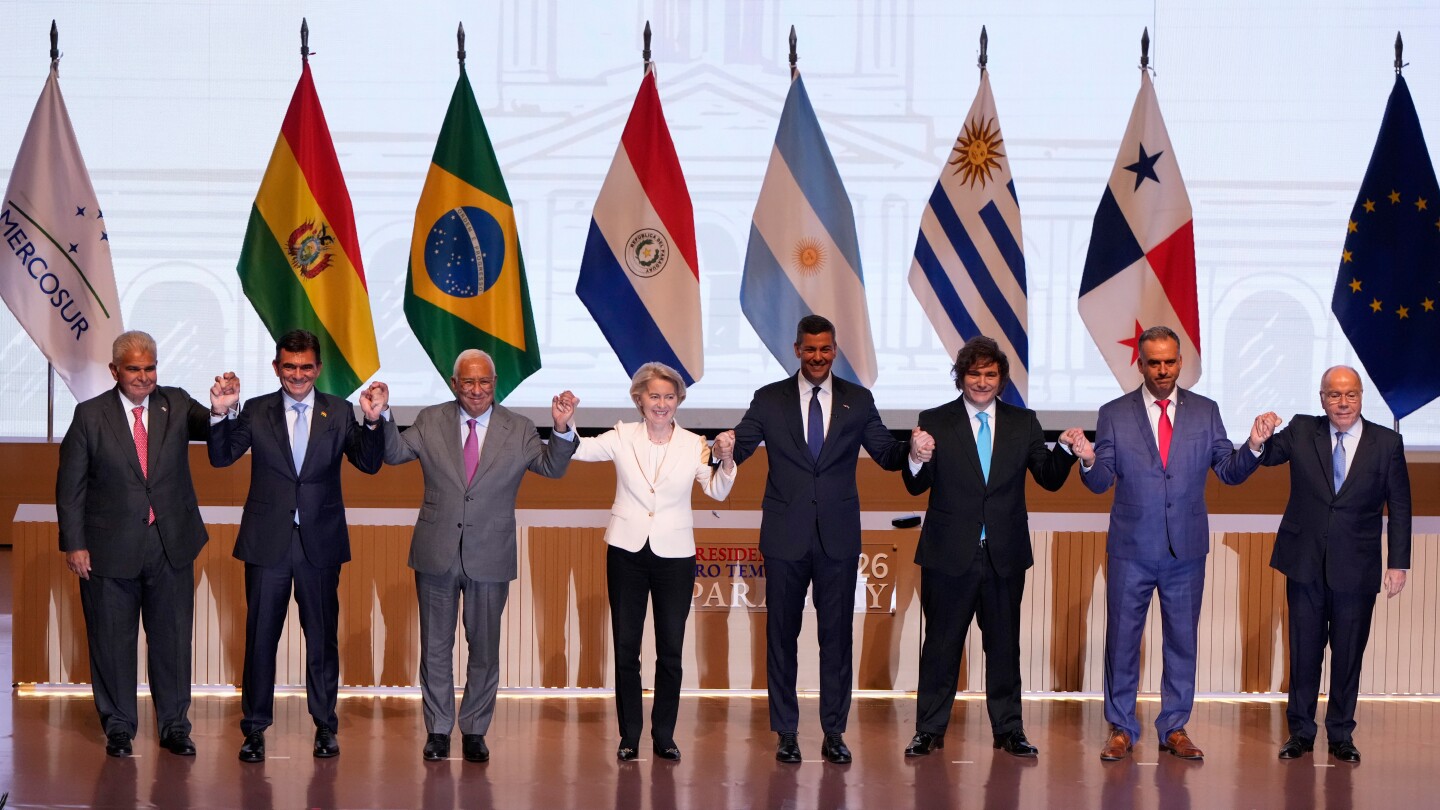
After decades of negotiations, the European Union and Mercosur bloc of South American countries formally signed a landmark free trade agreement Saturday in Asuncion, Paraguay, creating one of the world’s largest free trade zones encompassing more than 700 million consumers.
The historic accord, which will gradually eliminate over 90% of tariffs on goods ranging from Argentine beef to German cars, represents a significant geopolitical victory for the EU amid rising global trade tensions and protectionism. It strengthens the bloc’s commercial foothold in resource-rich South America, a region increasingly contested by both Washington and Beijing.
European Commission President Ursula von der Leyen framed the agreement as a deliberate choice for open markets over isolation. “We choose fair trade over tariffs. We choose a productive long-term partnership over isolation,” von der Leyen declared at the ceremony. Her comments came as U.S. President Donald Trump announced 10% tariffs on eight European nations over their stance on Greenland.
Brazilian President Luiz Inácio Lula da Silva, a longtime advocate of the deal, celebrated it on social media as a triumph for global cooperation. “At a time when unilateralism isolates markets and protectionism inhibits global growth, two regions that share democratic values and a commitment to multilateralism choose a different path,” Lula wrote on X.
Despite his public enthusiasm, Lula notably skipped the signing ceremony, revealing tensions between the trading partners. Brazil had prepared to host the signing ceremony last month when European countries abruptly called it off, demanding additional concessions for their farmers who feared competition from cheaper South American agricultural imports.
The lengthy negotiation process, spanning over 25 years, was largely complicated by Brussels’ demands for controls on South American agricultural processes. European farmers insisted they couldn’t compete fairly unless their South American counterparts adhered to similar standards on issues ranging from deforestation regulation to packaging rules.
“The EU’s maximalist wish lists of demands from developing economies willing to sign free trade agreements are often perceived as patronizing,” said Agathe Demarais, a senior policy fellow with the European Council on Foreign Relations.
To address these concerns, the final agreement incorporated environmental regulations, strict quotas on farm imports like beef and sugar, and staggered timelines for tariff reductions. The EU further appeased its agricultural sector with promises of substantial subsidies, which helped secure crucial support from agricultural powerhouse Italy earlier this month.
However, the agreement still faces challenges before implementation. While ratification is considered virtually assured in South America, where the deal enjoys broad support, it must clear the European Parliament—a hurdle that powerful lobbying groups hope will derail the accord.
France remains notably opposed, with President Emmanuel Macron concerned that farmers’ frustration could drive more voters toward the far right in the upcoming 2027 presidential election. EU trade commissioner Maroš Šefčovič told The Associated Press he would immediately begin lobbying European Parliament members to support the deal, hoping for passage in the first half of this year.
“We’ll have very intense communication with all the members on a group level, on an individual level,” Šefčovič said, expressing confidence that “everyone will do the procedures as quickly as possible so we can benefit from this historic achievement.”
The agreement marks a revival for the Mercosur bloc—comprising Argentina, Brazil, Paraguay, and Uruguay—after years of political conflicts, economic crises, and protectionist policies. Bolivia, the bloc’s newest member, isn’t included in the trade deal but could join in coming years. Venezuela, currently suspended from the bloc, is excluded from the agreement.
Perhaps most surprising is the enthusiastic support from Argentine President Javier Milei, a self-proclaimed libertarian who admires Trump and shares his skepticism of global institutions. Despite previously criticizing Mercosur as a “prison” and threatening withdrawal, Milei’s free-market principles ultimately aligned with the trade deal’s objectives.
“Argentina understands firsthand that closure and protectionism, sheltered by rhetoric rather than results, are the greatest causes of economic stagnation,” Milei said before signing the agreement.
The EU-Mercosur pact sends a powerful message that South America is maintaining diverse trade and diplomatic relationships even as the United States pushes for greater geopolitical influence in the Western Hemisphere. For the EU, it represents a strategic win in securing access to valuable resources and expanding market opportunities at a time when global trade faces increasing uncertainty.
Fact Checker
Verify the accuracy of this article using The Disinformation Commission analysis and real-time sources.

18 Comments
The timing of this deal is significant, given the rising tensions over trade and geopolitics globally. It demonstrates that major economies can still find common ground and pursue mutually beneficial agreements.
The timing of this agreement is noteworthy, given the rising tide of protectionism globally. It demonstrates the EU’s commitment to free and fair trade in the face of growing isolationist pressures.
Absolutely. This deal sends a clear signal that the EU remains dedicated to an open, rules-based international trading system, even as other major economies turn inward.
I’m curious to see how this agreement will impact key commodity exports like beef, minerals, and agricultural products from South America. It could open up new export opportunities for those industries.
That’s a good point. Reduced tariffs should boost trade flows for natural resources and agricultural goods, benefiting producers and consumers alike on both continents.
This agreement represents a significant diplomatic achievement for the EU and Mercosur countries. It will be interesting to see how it shapes regional and global trade dynamics in the years ahead.
This is a landmark agreement that will create one of the world’s largest free trade zones. It will be fascinating to see how it impacts commodity markets and the geopolitical landscape in South America.
While the tariff reductions are positive, I hope the agreement also includes robust provisions to address environmental and social concerns, such as deforestation, worker rights, and indigenous land rights.
That’s an important point. A truly sustainable trade deal must balance economic interests with strong environmental and social safeguards, especially in sensitive sectors like mining and agriculture.
This is an important step towards deepening economic integration between the EU and Latin America. It will be interesting to see how it impacts investment and trade flows, especially in key commodity sectors.
I wonder how this pact will affect the competitiveness of European and South American companies, particularly in industries like mining, energy, and agriculture. Will it lead to greater efficiency and innovation?
That’s a good question. Increased competition and access to a larger market could spur companies in those sectors to improve productivity and develop new technologies to stay competitive.
This is a geopolitical win for the EU as it competes with China and the US for influence in South America. Securing a free trade pact with Mercosur gives the bloc more clout in the region.
Indeed, the EU is asserting its position as a global economic power. This deal will help counter growing Chinese and American dominance in the strategically important South American market.
This is a major milestone for trade relations between the EU and Mercosur. Reducing tariffs on goods will benefit consumers and businesses on both sides. It’s good to see countries choosing cooperation over isolation in these uncertain times.
Absolutely. Strengthening commercial ties is crucial for economic growth and stability. This deal sends a strong signal in favor of free and fair trade.
While the elimination of tariffs is positive, I’m curious about the environmental and labor provisions in the agreement. Ensuring sustainable practices and worker protections will be critical.
That’s a valid concern. The trade deal should include robust mechanisms to uphold environmental standards and labor rights, not just focus on tariff reductions.