


Listen to the article
European Parliament Approves US-EU Trade Deal with New Safeguards
The European Parliament voted Thursday to approve a trade agreement between the European Union and the United States, but with significant amendments designed to protect European interests should Washington fail to uphold its commitments.
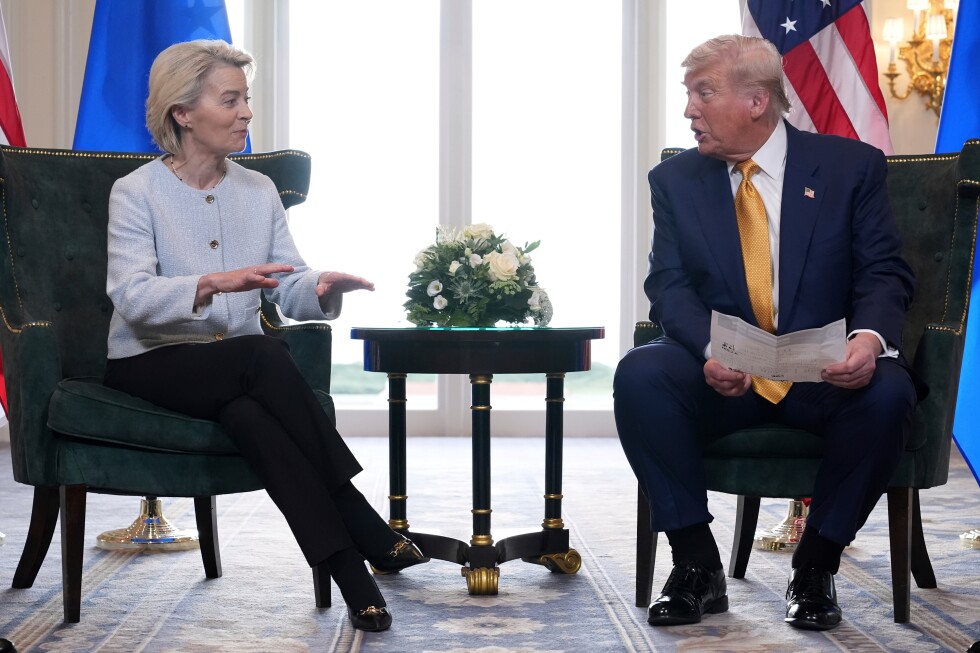
The deal, originally negotiated in July at Turnberry, Scotland, between US President Donald Trump and European Commission President Ursula von der Leyen, established a 15% tariff on most goods. This agreement was crafted to prevent much higher import duties that threatened to destabilize global economies.
Lawmakers added crucial new language allowing for the suspension of the agreement if it is determined that the US “undermined the objectives of the deal, discriminated against EU economic operators, threatened member states’ territorial integrity, foreign and defense policies, or engaged in economic coercion.”
According to Bernd Lange, a German lawmaker who heads the EU’s parliamentary trade committee, this protective clause was specifically crafted in response to tensions over Greenland. Trump had previously drawn widespread criticism across the 27-nation bloc by threatening to take control of the semiautonomous Danish territory.
“If this would happen again, then immediately the tariffs would be installed,” Lange explained at a post-vote news conference, describing the modifications as “weatherproofing” the Turnberry agreement.
The approved framework will now advance to further negotiations between EU trade representative Maroš Šefčovič and his US counterpart Jamieson Greer, who are scheduled to meet Friday on the sidelines of the World Trade Organization gathering in Yaoundé, Cameroon.
Following the parliamentary vote, Šefčovič emphasized the importance of finalizing the agreement: “We need the EU-US deal in force on both sides — delivering real certainty for EU businesses and showing that genuine partnership gets results.”
The vote to introduce protective clauses passed with substantial majorities — one measure secured 417-154 approval, while the other passed 437-144, with dozens of abstentions on each vote.
US Ambassador to the EU Andrew Puzder welcomed the development, stating it would provide “stability and predictability” for businesses on both sides of the Atlantic while driving economic growth. “We encourage all parties to think to the future and the importance of unleashing opportunities for businesses on both sides of the Atlantic,” he added.
The progress comes after months of uncertainty. The EU had temporarily paused the deal following a February US Supreme Court ruling that struck down Trump’s use of emergency powers to set new import taxes. The European Commission had sought clarity regarding the implications of this court decision before proceeding.
Business leaders expressed relief at the forward movement. Malte Lohan, CEO of the American Chamber of Commerce to the European Union, called the vote “the right signal for businesses that have been stuck in limbo over the past year” and “a necessary step towards a more predictable transatlantic marketplace.”
The economic stakes are enormous. According to EU statistics agency Eurostat, the value of EU-US trade in goods and services reached 1.7 trillion euros ($2 trillion) in 2024, averaging 4.6 billion euros daily. Europe’s primary exports to the US include pharmaceuticals, automobiles, aircraft, chemicals, medical instruments, and alcoholic beverages. The US mainly exports professional and scientific services like payment systems and cloud infrastructure, along with oil, gas, pharmaceuticals, medical equipment, aerospace products, and vehicles.
Despite recent trade tensions between Brussels and Washington, Croatian lawmaker Željana Zovko highlighted that transatlantic commerce has actually grown over the past year. “This resilience proves the trans-Atlantic trade works, and if it works, we should strengthen it, not hold it back,” she noted.
The amendments reflect Europe’s determination to maintain sovereignty while pursuing economic cooperation with its largest trading partner, creating a framework that balances opportunity with protection against potential unilateral actions by Washington in the future.
Fact Checker
Verify the accuracy of this article using The Disinformation Commission analysis and real-time sources.

12 Comments
This new trade deal between the EU and US seems to have some important safeguards against economic coercion. It will be interesting to see how it plays out, especially with the tensions over Greenland that are mentioned.
Yes, the ability to suspend the agreement if the US undermines it or discriminates against EU companies is a crucial protection. Geopolitics can really complicate trade relationships.
The EU is wise to include those safeguards against coercion in the new trade deal with the US. Smaller economies need tools to defend their interests, especially on sensitive issues like Greenland.
Agreed. Maintaining national sovereignty is critical, even as countries deepen economic integration. The EU is striking the right balance here.
Glad to see the European Parliament taking a firm stance on this and adding those protective clauses. Economic and military coercion by major powers is a growing concern globally.
Absolutely. Smaller economies need ways to defend themselves against unfair pressure from larger trading partners. This deal seems to provide some good safeguards in that regard.
The new EU-US trade deal looks like it strikes a good balance – boosting economic ties while also preserving key European interests and principles. The coercion protections are an important safeguard.
Yes, it’s crucial for smaller economies to have those kinds of mechanisms to defend themselves. Geopolitical tensions can easily spill over into trade disputes if not properly managed.
This is an interesting development in the EU-US trade relationship. The new protections against economic and military coercion seem like a prudent addition, given recent global dynamics.
Absolutely. With great power competition heating up, it’s smart for the EU to put those kinds of guardrails in place. Hopefully it leads to more stable and mutually beneficial trade ties.
It’s good to see the EU pushing back against potential US bullying tactics. Protections against economic coercion and threats to territorial integrity are smart additions to the trade agreement.
Agreed. The EU is right to be vigilant, especially given the tensions over Greenland. Maintaining sovereignty in the face of great power competition is vital.