


Listen to the article
The European Union has postponed a landmark free-trade agreement with South American countries following intense protests by European farmers and growing opposition from member states. The decision to delay the EU-Mercosur deal came after France and Italy raised objections, forcing European Commission President Ursula von der Leyen to announce Friday that additional weeks would be needed to “address some issues with member states.”
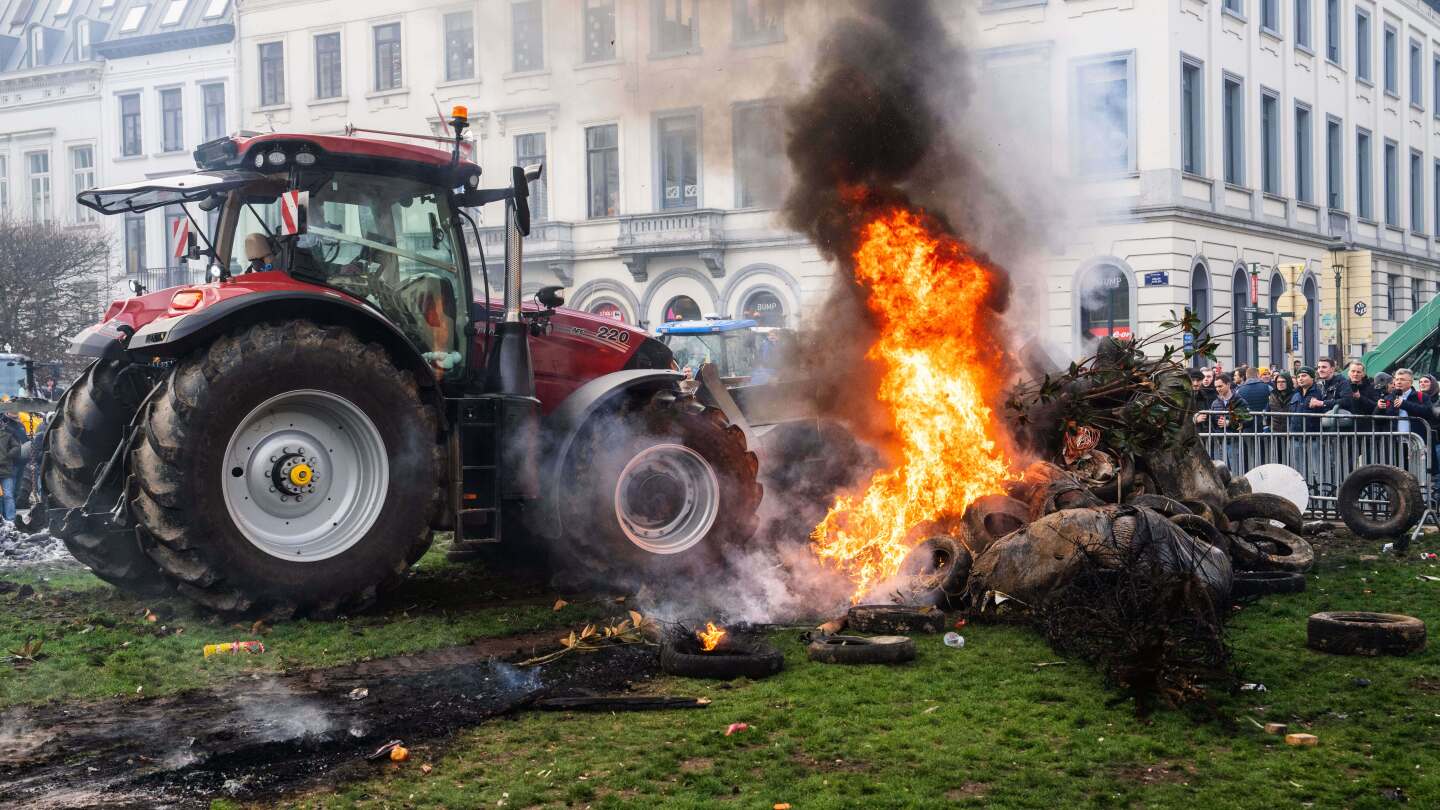
The announcement followed dramatic scenes in Brussels, where hundreds of farmers blocked streets with tractors, set tires ablaze, and clashed with police who responded with tear gas and water cannons. Protesters, some traveling from as far as Spain and Poland, expressed fears that the trade deal would devastate their livelihoods by flooding European markets with cheaper South American agricultural products.
“We are fighting to defend our jobs,” said Armand Chevron, a 23-year-old French farmer participating in the demonstrations that became violent enough to force a partial evacuation of the European Parliament.
The EU-Mercosur agreement, under negotiation for 26 years, would create one of the world’s largest free-trade zones, covering 780 million people and approximately a quarter of global GDP. The pact would progressively eliminate tariffs on most goods traded between the European Union and the five Mercosur countries: Brazil, Argentina, Uruguay, Paraguay, and Bolivia.
French President Emmanuel Macron welcomed the postponement, having emerged as one of the deal’s most vocal opponents. “Farmers already face an enormous amount of challenges,” Macron said at Thursday’s EU summit, where he indicated he had been coordinating with leaders from Italy, Poland, Belgium, Austria, and Ireland to address agricultural concerns.
The French government has demanded stronger safeguards, including mechanisms to monitor and prevent economic disruption in European markets, stricter regulations on pesticides in Mercosur nations, and enhanced import inspections at EU ports. These demands come as Macron faces domestic political pressure from a surging far right that has weaponized opposition to the trade deal.
Italian Premier Giorgia Meloni also raised last-minute objections, saying, “Work is underway to postpone the Mercosur summit, which gives us a few more weeks to try to provide the answers our farmers are asking for.” According to EU officials, an agreement to delay the signing was reached between von der Leyen, European Council President Antonio Costa, and Meloni, with Italy committing to vote in favor of the agreement in January.
Trade experts warn that the delay could damage the EU’s credibility in global trade negotiations, particularly as Europe seeks to establish new commercial relationships amid tensions with the United States and China. German Chancellor Friedrich Merz emphasized this concern, stating, “If the European Union wants to remain credible in global trade policy, then decisions must be made now.”
The deal also carries significant geopolitical implications. Agathe Demarais, a senior fellow at the European Council on Foreign Relations, noted that “a failure to sign the EU-Mercosur free-trade agreement risks pushing Latin American economies closer to Beijing’s orbit.” The agreement is seen by supporters as offering a counterweight to China’s export controls and America’s tariff policies under both current and potential future administrations.
In South America, leaders have expressed frustration with the delay. Brazilian President Luiz Inácio Lula da Silva, who had hoped to finalize the deal this weekend as a major diplomatic achievement ahead of next year’s elections, voiced his disappointment. “If we don’t do it now, Brazil won’t make any more agreements while I’m president,” Lula warned at a Cabinet meeting, adding that the agreement would “defend multilateralism” against unilateralism.
Despite ideological differences, both Lula and Argentina’s right-wing President Javier Milei support the agreement. Milei has argued that “we must stop thinking of Mercosur as a shield that protects us from the world and start thinking of it as a spear that allows us to effectively penetrate global markets.”
For the EU, the path forward remains complicated. Von der Leyen needs support from at least two-thirds of EU nations to secure the deal, and Italy’s opposition could give France enough votes to block the Commission president’s signature. The coming weeks will be crucial in determining whether the quarter-century of negotiations will finally yield results or face further obstacles.
Fact Checker
Verify the accuracy of this article using The Disinformation Commission analysis and real-time sources.

9 Comments
This delay highlights the delicate balance between free trade and domestic industries. While the EU-Mercosur deal could boost economic growth, the strong pushback from European farmers underscores the need for careful consideration of all stakeholders’ interests.
Agreed. Policymakers will need to find creative solutions that address the legitimate concerns of local farmers without completely scuttling the potential benefits of this major trade agreement.
This delay is a setback, but I’m hopeful the EU and Mercosur can find a path forward that works for all sides. Protecting domestic industries is important, but so is maintaining open trade and economic cooperation. With good-faith negotiations, a compromise may be possible.
The protests by European farmers are a stark reminder of the real-world impacts that trade deals can have on local industries. Hopefully the EU can find a way to move forward that protects vulnerable sectors while still realizing the broader economic opportunities.
I’m curious to see how the EU navigates this situation. Maintaining open trade is important, but the livelihoods of European farmers should not be sacrificed in the process. Creative compromise will be key to reaching a durable agreement.
Interesting development in the EU-Mercosur trade deal negotiations. Farmers’ concerns over potential flood of cheaper South American agricultural goods seem valid, but I wonder if there are ways to structure the deal to protect livelihoods while still realizing the broader economic benefits.
This debate over the EU-Mercosur deal underscores the complexity of modern trade policy. While free trade offers macroeconomic benefits, the potential harm to domestic industries cannot be ignored. Careful negotiation will be crucial to striking the right balance.
Well said. Policymakers will need to weigh the broader economic pros and cons while also addressing the very real human impacts on local communities and workers.
The clashes between protesters and police highlight the high stakes involved in these trade negotiations. Farmers are rightfully concerned about the threat to their livelihoods, and the EU must find a way to assuage those fears without completely derailing the deal.