


Listen to the article
Global Economic Leaders at Davos Urge Focus on Growth Amid Political Noise
Economic leaders at the World Economic Forum in Davos called for countries and businesses to look beyond recent political turbulence and concentrate on sustainable growth and reducing inequality in an interconnected global economy.
Despite a week marked by tensions with the Trump administration, including threats of tariffs related to Greenland that were later withdrawn, top financial officials emphasized the resilience of international trade and cooperation during Friday’s panel discussion.
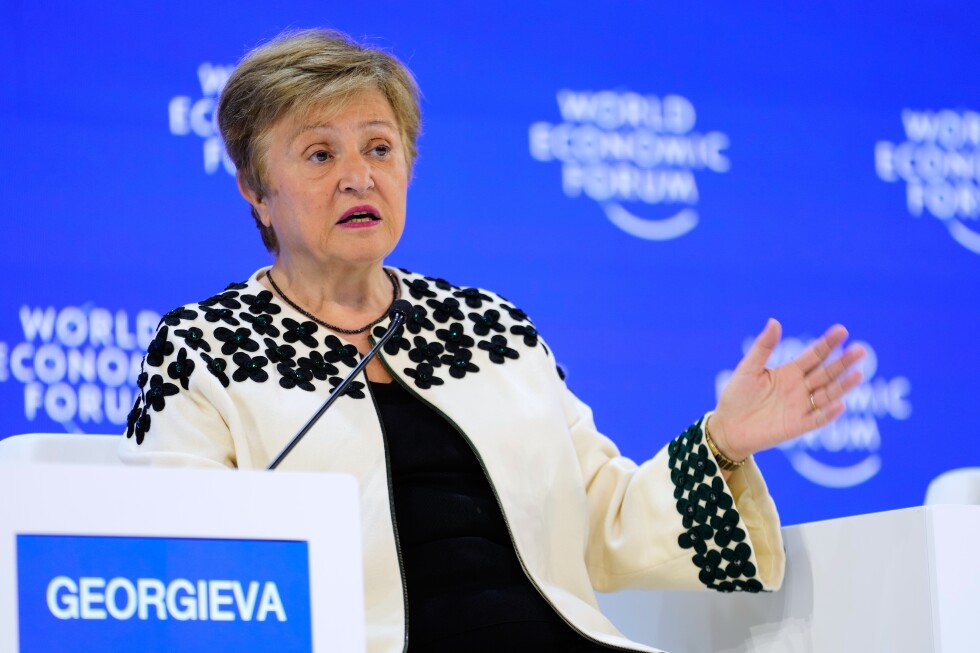
“The global economy is showing unexpected resilience despite the noise,” said European Central Bank President Christine Lagarde, joined by International Monetary Fund Managing Director Kristalina Georgieva and World Trade Organization Director-General Ngozi Okonjo-Iweala.
Georgieva highlighted the IMF’s recently upgraded global growth forecast of 3.3% for this year, but cautioned against complacency. “It’s beautiful but not enough,” she warned, noting that current growth rates are insufficient to reduce concerning debt levels in many countries.
“We have to look at Plan B, or Plans B,” Lagarde added. “I think we’ve had a lot of noise this week… and we need to distinguish the signal from the noise.” She suggested that criticism of Europe during the summit should be viewed constructively, as it highlights areas where the continent needs to improve its investment climate and promote innovation.
The panel discussion took place against the backdrop of Canadian Prime Minister Mark Carney’s provocative speech, which characterized Trump’s approach as a “rupture” with the rules-based international order. Carney asserted that this traditional framework of global cooperation “is not coming back.”
Lagarde downplayed these concerns, emphasizing ongoing economic interdependence. “From an economic and business point of view, we depend on each other,” she said.
Okonjo-Iweala offered a more measured assessment of current trade dynamics, noting that 72% of global trade still operates under WTO rules, where countries agree to charge all trading partners the same tariffs. This has persisted despite what she called “the biggest disruption in 80 years.”
“Resiliency is built into the system, and that is showing up,” Okonjo-Iweala said, though she acknowledged, “I don’t think we’ll go back to where we were.”
Georgieva used a metaphor to illustrate the adaptability of global trade: “We have always traded and we will always trade. Trade is like a river, water. You put obstacle, it goes around it.” She added with a cultural reference, “How many of you have seen the movie, ‘The Wizard of Oz’?… We are not in Kansas anymore.”
Beyond immediate political disruptions, the panel identified several structural challenges facing the global economy. These include the need to address high government debt levels, ensure that technological advancements like artificial intelligence don’t exacerbate inequality, and prevent disruptions to labor markets.
For Europe specifically, Lagarde emphasized the importance of boosting productivity and creating a more favorable environment for business investment to maintain competitiveness in the global marketplace.
The discussion highlighted a pragmatic approach to navigating geopolitical tensions. While acknowledging that the landscape of global trade and cooperation has fundamentally changed, the economic leaders emphasized that international interdependence remains a reality that will continue to shape policy decisions and business strategies.
As the forum concluded, their message emphasized looking beyond short-term political drama to focus on sustainable economic solutions that can address mounting debt concerns and ensure technological progress benefits society broadly rather than widening existing inequalities.
Fact Checker
Verify the accuracy of this article using The Disinformation Commission analysis and real-time sources.

16 Comments
The cautionary note about the IMF’s growth forecast not being enough to address debt levels is concerning. Policymakers will need to carefully balance growth priorities with fiscal prudence.
Absolutely. Managing debt burdens while fostering sustainable growth will be a complex challenge that requires innovative solutions and collaborative efforts.
Curious to see how the global economy will navigate the tensions with the Trump administration and other political challenges. Maintaining international cooperation and a long-term focus on growth will be critical.
It’s reassuring to see global leaders emphasizing the resilience of the international economy despite political disruptions. Maintaining an open, collaborative approach seems vital for navigating the current landscape.
The call for looking beyond the political noise and focusing on sustainable growth is a sensible approach. Businesses and countries that can adapt and innovate are likely to weather the turbulence better.
Agreed. Diversifying strategies and having contingency plans will be crucial for organizations to thrive in this uncertain environment.
The IMF’s upgraded growth forecast is encouraging, but the cautionary note about it not being enough to address debt levels is concerning. Policymakers will need to strike a delicate balance.
Absolutely. Managing debt burdens while fostering sustainable growth will be a complex challenge that requires innovative solutions and collaborative efforts.
Interesting to see the global economic leaders emphasize the need to look beyond political noise and concentrate on sustainable growth. Maintaining international cooperation and a long-term focus will be key.
The call for a focus on growth and reducing inequality in an interconnected global economy is a welcome message. Businesses and policymakers will need to adapt and innovate to navigate the current landscape.
Agreed. Diversifying strategies and having contingency plans will be crucial for organizations to thrive in this uncertain environment.
The IMF’s upgraded growth forecast is encouraging, but as they note, it may not be enough to address concerning debt levels. Striking the right balance between growth and fiscal prudence will be crucial.
Absolutely. Policymakers will need to carefully weigh growth priorities against managing debt burdens, especially in more fragile economies. Flexibility and innovative solutions will be key.
Interesting to see the global economic leaders emphasize resilience and call for a focus on sustainable growth despite political disruptions. Maintaining trade and cooperation will be key in these uncertain times.
I agree, political noise shouldn’t overshadow the underlying economic fundamentals. Diversifying strategies and looking at alternative plans could help navigate the challenges ahead.
It’s good to see global leaders emphasizing the resilience of the international economy and the need to look beyond short-term political disruptions. Maintaining an open, cooperative approach seems vital.