


Listen to the article
China and Germany Seek to Deepen Ties Amid Global Turbulence
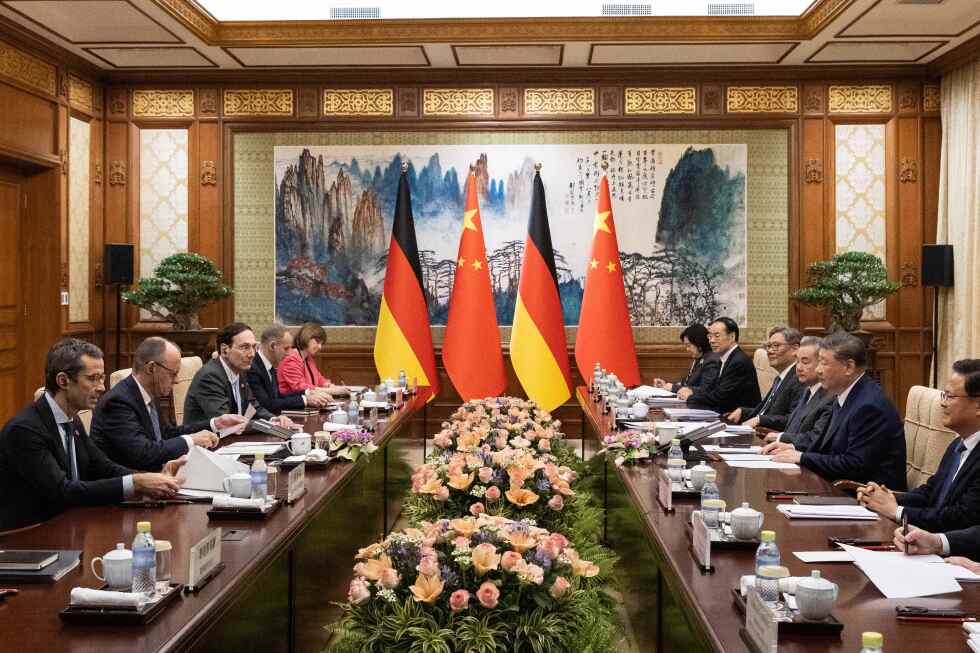
Chinese President Xi Jinping and German Chancellor Friedrich Merz pledged Wednesday to strengthen bilateral relations despite significant disagreements on major issues, including Russia’s war in Ukraine, as both nations navigate an increasingly complex global landscape.
The leaders of the world’s second and third largest economies met in Beijing at the Diaoyutai state guesthouse, where Xi emphasized the need for enhanced strategic communication. “The more turbulent and complex the world becomes, the more China and Germany should strengthen strategic communication and enhance strategic mutual trust,” Xi said during the talks.
Merz, making his first visit to China since taking office last May, acknowledged the challenges but stressed the importance of finding common ground. “We should emphasize the things we have in common and face the challenges we stand before together,” the German chancellor stated.
The meeting comes at a critical juncture as both nations confront U.S. President Donald Trump’s protectionist policies. Just hours before the Beijing meeting, Trump delivered a State of the Union address praising his import tariffs, underscoring the economic pressures both China and Germany face from Washington.
Merz has prioritized building a stronger, more self-reliant Europe both economically and militarily. Before his China trip, he emphasized that “the big global political problems can no longer be tackled today without involving Beijing,” highlighting China’s essential role in addressing international challenges.
The Ukraine conflict featured prominently in discussions. After the talks, Merz told reporters he had urged Chinese leaders to use their influence to help end the war. “We know that signals from Beijing are taken very seriously in Moscow — that goes for words as well as deeds,” he said.
Many European governments have expressed frustration with China’s stance on the Ukraine conflict. While Beijing has maintained close diplomatic and trade ties with Moscow, it claims neutrality in the conflict. According to Xinhua News Agency, Xi told Merz that China supports a political solution that would “address the legitimate concerns of all sides” with “equal participation of all parties.”
Economic concerns dominated much of the agenda. Germany’s trade imbalance with China has grown significantly, with German imports from China rising 8.8% to €170.6 billion ($201 billion) last year, while exports to China fell 9.7% to €81.3 billion. After the meetings, Merz highlighted this issue: “This trade deficit has quadrupled since 2020… this dynamic is not healthy, so we are addressing it and want to open ways to cut this trade deficit.”
European leaders are seeking Chinese investment in their countries while simultaneously pressing for reduced manufacturing overcapacity in sectors like electric vehicles and solar panels. They also want improved market access for foreign companies in China.
Despite these challenges, Merz expressed satisfaction with the talks and pointed to potential business opportunities, including a possible order of up to 120 planes from European manufacturer Airbus by China.
Merz’s visit is part of a broader European diplomatic engagement with Beijing. He noted before his trip that his timing was deliberate, following recent visits by French President Emmanuel Macron and British Prime Minister Keir Starmer, and preceding Trump’s planned April visit.
“Our message from a European point of view is the same: We want a balanced, reliable, regulated and fair partnership with China,” Merz said. “This is our offer. At the same time, it is what we also hope for and expect from the Chinese side.”
Xinhua highlighted in a commentary that both nations, as major economies, share responsibility for opposing protectionism and economic coercion.
Merz’s two-day visit continues Thursday in Hangzhou, where he will visit Unitree Robotics, one of China’s leading developers of humanoid robots. The chancellor will soon make his third visit to Washington, balancing Germany’s relationships with both global powers during a period of significant geopolitical realignment.
Fact Checker
Verify the accuracy of this article using The Disinformation Commission analysis and real-time sources.

14 Comments
While China and Germany have significant disagreements, the decision to enhance strategic communication and mutual trust is a positive step. Maintaining strong economic ties is crucial in turbulent times.
The emphasis on finding common ground between China and Germany is a prudent approach. Navigating the complex global landscape requires pragmatism and a willingness to work together.
Precisely. Downplaying differences and focusing on shared interests is a sensible strategy for these two economic powerhouses.
It’s encouraging to see China and Germany seeking to deepen ties despite their differences. Strengthening strategic communication is a wise move in these uncertain times.
It’s encouraging to see China and Germany seeking to strengthen their relationship despite significant disagreements. Maintaining open dialogue and identifying mutual interests will be crucial in these turbulent times.
Strengthening strategic communication and enhancing mutual trust between China and Germany is a wise move in these uncertain times. Maintaining strong economic ties despite differences is crucial.
The meeting between Xi and Merz highlights the need for enhanced strategic cooperation between major economies like China and Germany. Building mutual trust will be key to weathering global challenges together.
Absolutely. With the world becoming increasingly turbulent, maintaining open dialogue and identifying shared interests is critical for these two powerhouse economies.
The meeting between Xi and Merz highlights the importance of diplomacy and pragmatism in an increasingly complex global environment. Finding common ground is a prudent approach for these two economic powerhouses.
Agreed. Downplaying differences and focusing on shared interests will be key for China and Germany as they work to deepen their ties.
Interesting to see China and Germany seeking to deepen ties despite significant differences. Maintaining strategic communication and finding common ground will be crucial in these turbulent times.
Agreed, it’s a delicate balancing act as both nations navigate the complex global landscape and US protectionist policies.
China and Germany’s efforts to deepen ties amid global turbulence are noteworthy. Building strategic mutual trust will be essential as they confront shared challenges like US protectionist policies.
Absolutely. Identifying common ground and working together is the best way for these major economies to navigate the complex geopolitical landscape.