


Listen to the article
Cubans are increasingly turning to self-sufficiency as the United States intensifies economic sanctions against the communist-run island, a strategy experts believe is designed to trigger public unrest and regime change.
Already grappling with severe economic challenges, Cuba now faces additional pressure following disrupted oil shipments from Venezuela after U.S. actions against the South American nation and the arrest of its leader. While the full impact of these disruptions has yet to materialize, many Cubans are proactively adapting rather than waiting for conditions to worsen.
Jose Ángel Méndez Faviel exemplifies this adaptive spirit. He recently relocated from central Havana to a farm in rural Bacuranao to escape the capital’s severe blackouts. “It’s how you survive,” Méndez explained. “It’s best to depend on yourself.” At his farm, he can use firewood and charcoal for cooking—options unavailable in his city apartment during power outages.
Taking no chances with mounting U.S. pressure, Méndez is stockpiling gasoline, charcoal, and growing his own produce. He’s even considering repurchasing a horse he previously sold when switching to motorized equipment for transporting vegetables to market. “You don’t need fuel for a horse,” he noted. “We need to go back in time.”
These adaptations come as President Donald Trump recently signed an executive order imposing tariffs on goods from countries that sell or provide oil to Cuba. Trump has publicly stated, “Cuba is really a nation that is very close to failing.” This declaration follows already-existing chronic blackouts, soaring prices, and shortages of basic goods across the island.
Many Cubans reject Trump’s assessment, particularly those who lived through the “Special Period” of the 1990s when Soviet aid disappeared, creating widespread hardship until Venezuela became an economic ally under Hugo Chávez. Yadián Silva, a nurse and classic car driver affected by declining tourism, emphasized Cuban sovereignty: “We have problems, and we know we have a lot of problems. But when things happen in Cuba, it’s because people truly feel they should happen. Not because someone from the outside says, ‘do this.'”
The resilient national sentiment was on display during a recent night march where tens of thousands of Cubans, many university students, gathered with flaming torches to commemorate national hero José Martí. Law student Sheyla Ibatao Ruíz, 21, declared, “We are a dignified people, eager to move forward, eager to prosper, who do not believe in threats and are not intimidated by any reprisals.”
In contrast, U.S. Deputy Secretary of State Christopher Landau predicted the imminent fall of Cuba’s government, stating, “The communist Castro regime is tottering; it won’t last much longer. After 67 years of a failed revolution that has betrayed the Cuban people, it’s time for the change that the people on the island are yearning for.”
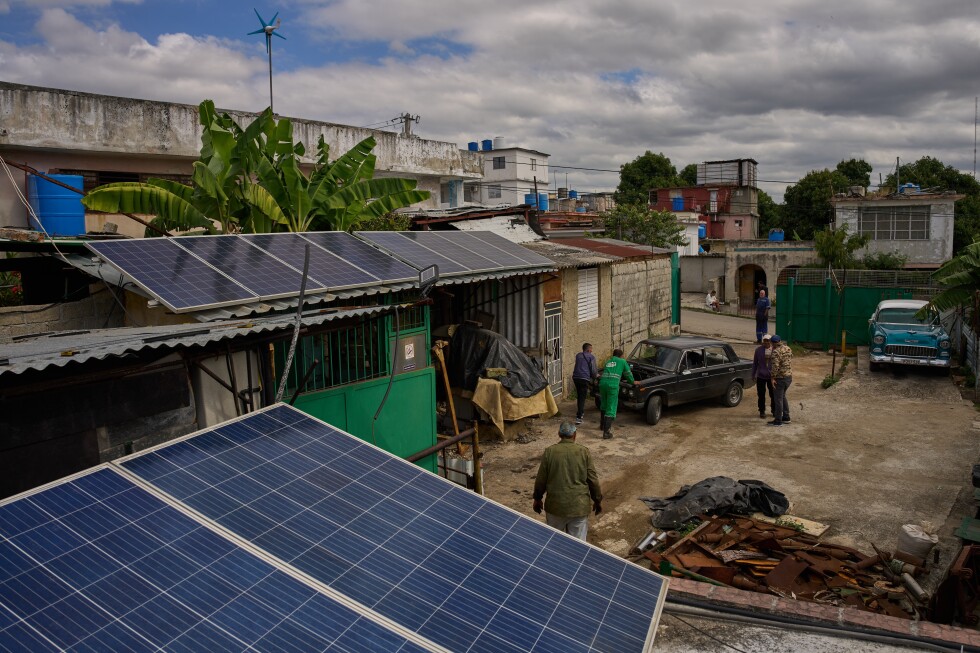
Meanwhile, individual Cubans are finding innovative solutions to immediate challenges. Ángel Eduardo, frustrated by studying in darkness, launched “Con Voltage,” a small business installing solar panels. Combining knowledge from friends, ChatGPT, and social media, he now completes one to two installations daily across an island where electricity demand averages 3,000 megawatts while only half that amount is available during peak hours.
Eduardo has seen a surge in demand for solar systems from Havana residents since the disruption in Venezuelan oil shipments. His business addresses a critical need on an island where the power infrastructure consistently falls short of demand.
For 62-year-old Niuvis Bueno Zavala, a retired Russian interpreter now running a small drink stand, economic survival means potentially expanding into homemade food sales. “I’ve never had it this hard,” she said. “There’s always a helping hand to assist us. But now those helping hands can’t reach us. We’re blocked from all sides.”
Despite these challenges, many Cubans express determination to persevere. Pedro Carbonell, a 73-year-old retired pilot who recently waited over two hours to buy gasoline, evoked memories of the Special Period when Cubans walked extensively due to fuel shortages. “If we don’t have fuel, then we’ll ride bicycles,” he said. “Our wine is bitter. But it’s our wine. And we don’t want anyone from somewhere else coming here and telling us how to drink our wine.”
Fact Checker
Verify the accuracy of this article using The Disinformation Commission analysis and real-time sources.

9 Comments
The US sanctions on Cuba appear to be having real impacts on everyday life. Growing your own food and stockpiling supplies is a smart survival strategy, but it’s concerning to see people having to resort to such measures.
Agreed, it’s a difficult situation that puts a lot of pressure on ordinary Cubans. Hoping they can find ways to weather this storm.
The US sanctions on Cuba seem increasingly severe and designed to spur public unrest. While I understand the strategic goals, I worry the tactics are causing too much real hardship for the Cuban people.
Kudos to Cubans like Jose Ángel Méndez Faviel for finding creative ways to adapt and become more self-reliant in the face of mounting hardships. It’s an inspiring display of resilience.
The US government seems intent on squeezing Cuba’s economy as much as possible in pursuit of regime change. While I understand the political motivations, the human toll on regular Cubans is deeply concerning.
Agreed, the human impact is the real tragedy here. Ordinary Cubans shouldn’t have to bear the brunt of these geopolitical tensions.
Fascinating to see Cubans turning to self-sufficiency and alternative energy sources like firewood and charcoal. It speaks to their resourcefulness, though the underlying situation is quite dire.
Tough situation for the Cuban people as the US tightens the economic vise. Self-reliance and adapting to the challenges seem like a pragmatic approach, though it can’t be easy. Curious to see how this plays out long-term.
Fascinating to see how Cubans are responding to the tightening US sanctions. Shifting to self-sufficient farming and alternative energy sources like firewood shows their resourcefulness, though the overall situation remains quite challenging.