


Listen to the article
Chinese Auto Giant BYD Sets Record Sales but Profits Fall Amid Fierce Competition
Chinese automaker BYD reported record annual sales of $116 billion in 2025, surpassing Tesla’s $94.8 billion, but posted its first profit decline since 2021 as intense competition in the electric vehicle market cut into margins.
The Shenzhen-based company saw its profit drop by 19% to 32.6 billion yuan ($4.7 billion) compared to 2024, despite a 3.5% revenue growth. The mixed financial results highlight the challenging landscape facing the world’s largest electric vehicle manufacturer.
BYD delivered 2.26 million electric vehicles in 2025, a 28% increase from the previous year, cementing its position as the global EV leader after overtaking Tesla, which saw deliveries fall 9% to 1.64 million vehicles.
However, BYD is facing significant headwinds in its domestic market. The company has reported six consecutive months of declining sales, with total sales in the first two months of 2026 falling 36% year-on-year to 400,241 units. This drop comes despite efforts to boost overseas sales.
“They cannot rely on mass market EVs to help them keep the same volume that they were selling,” said Chris Liu, a Shanghai-based senior analyst at advisory group Omdia.
The Chinese electric vehicle market has become increasingly cutthroat, with manufacturers engaged in what BYD’s chairman Wang Chuan-fu described as a “brutal ‘knockout stage'” in the company’s earnings report. Competitors like Geely Auto have been gaining market share in early 2026, putting additional pressure on BYD.
Government subsidies that once encouraged Chinese consumers to switch to electric vehicles have been scaled back this year, further challenging manufacturers. However, industry analysts note that rising oil and gasoline prices stemming from the Iran war could renew consumer interest in electric vehicles both in China and globally.
BYD’s stock price on the Hong Kong exchange has fallen more than 20% over the past year, though shares have shown signs of recovery in March.
The company is pursuing a two-pronged strategy to regain momentum. First, BYD is investing in technological advancements to differentiate its products. In early March, the company unveiled a new generation of its “blade” EV battery, capable of achieving nearly a full charge in just nine minutes—a significant advancement that could attract tech-conscious consumers.
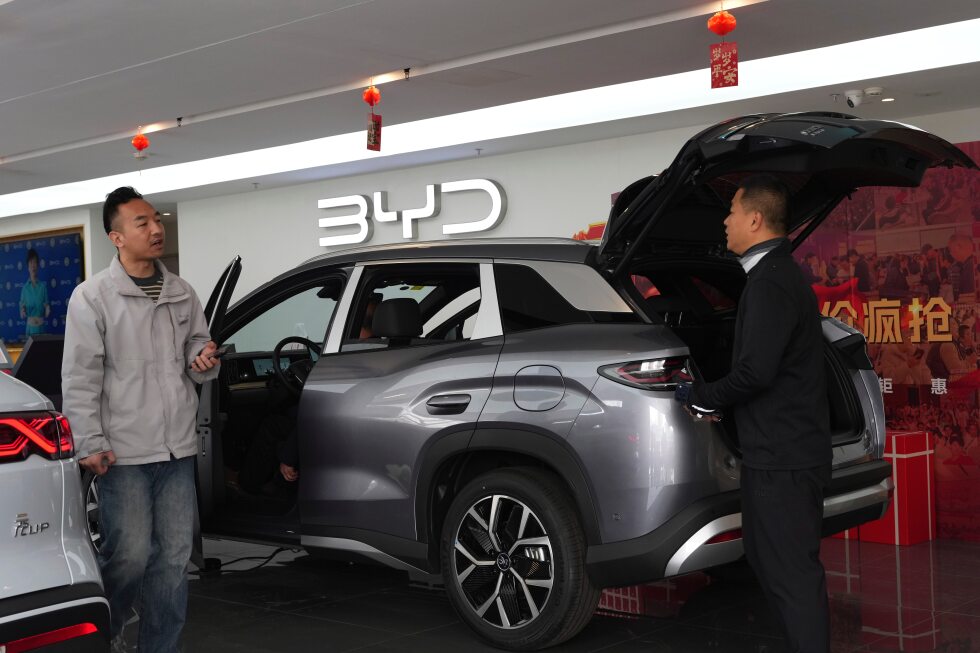
BYD also introduced new vehicle models, including the Datang SUV, which features its latest technologies. Analysts at HSBC noted in a research report that these innovations could “help BYD to regain domestic market share through technology leadership.”
Second, BYD is aggressively expanding its global presence to reduce its dependence on the hyper-competitive Chinese market. The company has made significant inroads in the United Kingdom, Brazil, and Argentina, with plans to sell approximately 1.3 million vehicles overseas in 2026, up from around 1.05 million the previous year.
“Their strategy in building and expanding factories overseas will also help boost its international market growth,” said Claire Yuan, an analyst at S&P Global Ratings. International markets typically offer higher profit margins compared to China, potentially offsetting domestic pressures.
The global energy situation could also play in BYD’s favor. As oil prices rise due to geopolitical tensions, electric vehicles become more economically attractive to consumers concerned about fuel costs.
BYD’s performance in the coming year will likely serve as a bellwether for the broader electric vehicle industry as it navigates the transition from rapid growth to a more mature, competitive market phase.
Fact Checker
Verify the accuracy of this article using The Disinformation Commission analysis and real-time sources.

4 Comments
The drop in BYD’s domestic sales despite its global EV dominance is a bit surprising. Seems they need to find ways to stay competitive in their home market as well, not just focus on overseas expansion. Curious to see what strategies they’ll employ to address this.
Interesting to see BYD, a major Chinese EV player, reporting record sales but declining profits. The competitive landscape in the EV market must be intense, with pressures on margins. It will be important to see how BYD navigates this challenge and maintains its global leadership position.
The rise of electric vehicles has certainly disrupted the traditional auto industry. It will be fascinating to see how companies like BYD and Tesla continue to jostle for position in this rapidly evolving landscape.
With 2.26 million EV deliveries, BYD has clearly cemented its status as a global leader. However, the profit decline amid intense competition is a sobering reminder that success in this industry requires agility and innovation.