


Listen to the article
China Pushes Forward with Tech-Focused Five-Year Plan Amid Global Tensions
While much of the world’s attention is focused on the Iran conflict, China continues to advance its national priorities with significant global implications. Although Beijing remains attentive to the war’s impact on energy supplies and geopolitics, the world’s second-largest economy views its growing rivalry with the United States through a different lens: the race to develop cutting-edge technologies that will shape the 21st century.
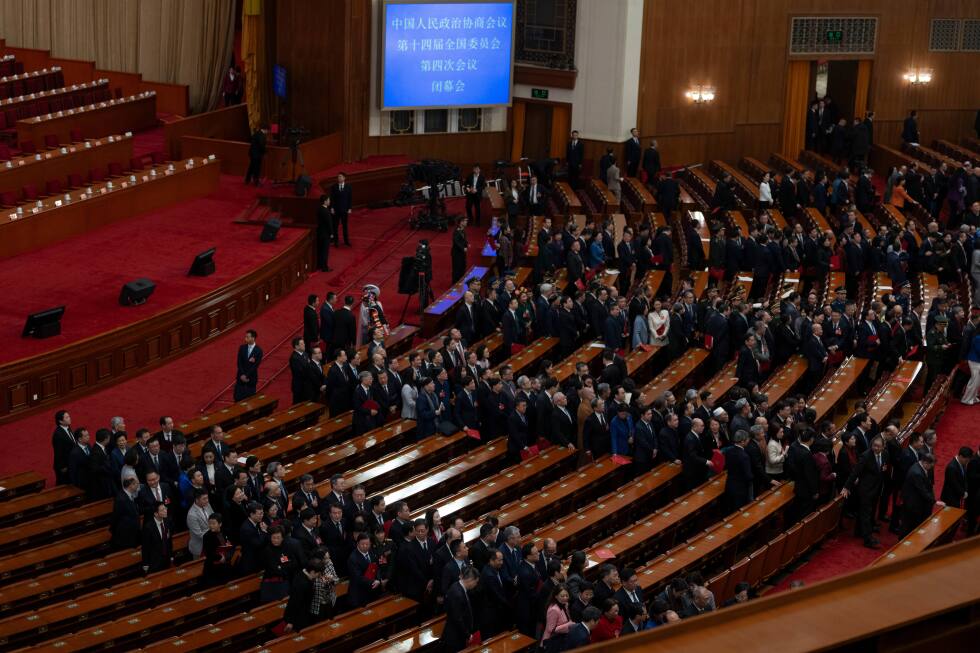
This strategic focus was clearly articulated in a five-year plan formally endorsed Thursday by the National People’s Congress at the conclusion of its annual meeting, China’s most significant political event of the year. Rather than shifting course, China is intensifying its efforts to transform its economy and position itself at the forefront of technological innovation. State media characterized China’s determination to maintain its development trajectory as a stabilizing force in an uncertain global environment.
“A stable and developing China injects more stability and certainty into a world fraught with change and turbulence,” declared the official People’s Daily newspaper in a front-page column on Wednesday, with other state outlets echoing this sentiment.
The official commentaries carefully avoided direct mentions of U.S. President Donald Trump, whose tariffs and military interventions from Venezuela to Iran are disrupting the post-World War II global order. China publicly champions this international system while advocating for reforms that better reflect the interests of developing nations alongside wealthy ones.
Trump is scheduled to visit Beijing in three weeks for talks with Chinese President Xi Jinping, adding significance to the timing of these policy announcements.
The National People’s Congress also approved three laws during its closing session, including one governing ethnic minorities. These votes are largely ceremonial with near-unanimous results, designed to demonstrate unity behind the Communist Party’s vision. The five-year plan received overwhelming support with 2,758 votes in favor, one against, and two abstentions.
“We are forging ahead at full speed in building a great country,” Foreign Minister Wang Yi stated during an annual news conference held during the Congress.
Technology remains the centerpiece of China’s economic strategy, despite many economists arguing that the country needs to bolster domestic consumption and reduce its reliance on export-driven growth. While Chinese leadership conceptually agrees with boosting consumer spending, the five-year plan confirms that technological advancement remains the top priority.
Analysts anticipate that measures to increase consumption will be implemented gradually, such as expanding social security and healthcare benefits, while government resources continue to flow into artificial intelligence, robotics, and other strategic sectors. Premier Li Qiang announced a moderate economic growth target of 4.5% to 5% for 2026, providing the government with flexibility to focus on the long-term objectives outlined in the five-year plan.
On environmental issues, China’s approach remains measured. The five-year plan does not commit to reducing absolute carbon emissions, instead targeting a 17% reduction in “emissions intensity” – the amount of pollutants relative to economic output. This approach could allow emissions to increase by 3% or more as the economy expands, according to analysts.
“International good practice is to move away from intensity targets towards absolute emission reduction targets,” noted Niklas Hohne of Germany’s NewClimate Institute. Despite setting conservative targets, China’s rapid expansion in solar and other renewable energy sources may drive emissions down regardless. As the world’s largest greenhouse gas emitter, Chinese officials have consistently emphasized that the country’s population size and economic scale must be considered when evaluating its environmental impact.
The Congress also endorsed a comprehensive ethnic minorities law that critics argue formalizes government assimilation policies by emphasizing the creation of “a common consciousness of the Chinese nation.” While the government describes the legislation as promoting community cohesion and shared economic development, critics see it as part of a broader shift under Xi that prioritizes national unity over distinct ethnic cultures and languages.
“It puts a death nail in the party’s original promise of meaningful autonomy,” said James Leibold, a professor at Australia’s LaTrobe University who specializes in China’s ethnic minority policies.
Proposals to improve work-life balance generated significant social media attention during this year’s Congress. Many focused on establishing a “right to rest,” including provisions allowing employees to disconnect from work communications after hours. With many Chinese workers receiving only five days of paid vacation annually, economist Yu Miaojie proposed doubling the statutory minimum annual leave to ten days.
The popularity of these proposals reflects growing concern about China’s intense workplace competition and recognizes that providing more leisure time could boost domestic consumption by giving workers more opportunities to spend.
Fact Checker
Verify the accuracy of this article using The Disinformation Commission analysis and real-time sources.

14 Comments
It’s noteworthy that China is doubling down on its tech-driven economic agenda even as the rest of the world grapples with the fallout from the Iran conflict. This speaks to their long-term, big-picture approach.
You raise a good point. China appears to be playing the long game, focusing on strengthening its technological capabilities while others are distracted by more immediate geopolitical crises.
The article provides an insightful look at China’s strategic calculus. By positioning itself as a force for stability, China is attempting to project an image of responsible leadership on the global stage.
You make a good point. China’s rhetoric about stability and certainty seems aimed at countering the narrative of it being a disruptive, revisionist power. It’s a savvy public relations move.
The article highlights China’s efforts to position itself as a stabilizing force amidst global tensions. This reflects their growing confidence and ambition to shape the international order to their advantage.
China seems determined to assert its influence and compete with the US for technological supremacy. Their economic and political priorities are clearly aligned with this strategic goal.
China’s commitment to its tech-driven five-year plan during a time of global instability demonstrates its confidence and ambition. It will be critical to monitor how this plays out in the broader geopolitical context.
Indeed, China’s unwavering focus on technological innovation, even in the face of global turmoil, underscores its long-term strategic vision. This could significantly reshape the international order in the years to come.
The article highlights the tension between China’s domestic priorities and its global ambitions. Its pursuit of technological supremacy seems to be a key driver of its foreign policy calculus.
That’s a perceptive observation. China’s drive to become a technological powerhouse is clearly shaping its broader geopolitical strategy and positioning on the world stage.
China’s focus on technology and innovation during this challenging global environment is an intriguing strategic move. It will be interesting to see how their domestic tech push impacts the broader geopolitical landscape.
You’re right, China’s tech-centric five-year plan could significantly shift the global balance of power if they’re successful in developing cutting-edge capabilities.
China’s five-year plan underscores its aspirations to be a global technology leader. This will likely intensify the US-China rivalry and force other countries to recalibrate their economic and strategic priorities.
Absolutely. The technology race between the US and China is shaping up to be a key geopolitical battleground in the coming years. The implications for the global order could be profound.