


Listen to the article
Lebanon’s Gold Reserve: A Lifeline Amidst Economic Collapse or Sacred Asset?
Sitting atop one of the Middle East’s largest gold reserves, Lebanon is facing a pivotal decision about whether to tap into this prized asset as the country struggles through a devastating economic crisis. The government is weighing the possibility of using its gold stockpile to help rescue a crippled economy, while citizens increasingly turn to gold as a safe haven for their diminished wealth.
Lebanon has entered 2026 with persistent inflation and ongoing state deterioration, with no meaningful reforms to address corruption in sight. The country’s banking system imploded in late 2019, wiping out depositors’ savings and plunging nearly half of Lebanon’s 6.5 million population into poverty—the culmination of decades of corruption, waste, and mismanagement.
The financial sector has suffered approximately $70 billion in losses, further compounded by an additional $11 billion in damages from the 2024 Israel-Hezbollah conflict. This catastrophic economic situation has prompted renewed interest in the country’s substantial gold reserves.
Since the 1960s, Lebanon’s central bank has maintained an impressive 286 tons of gold—approximately nine million ounces—making it the second-largest gold reserve in the Middle East after Saudi Arabia. At its peak, these reserves were valued at around $50 billion, more than double Lebanon’s GDP.
The government is now considering a contentious proposal to use a portion of these reserves to bail out banks and compensate depositors who lost their savings. However, this approach faces significant hurdles, including a 1986 law that explicitly prohibits selling the country’s gold, enacted during Lebanon’s civil war to protect state assets in times of instability.
A senior banking official, speaking anonymously due to regulatory constraints, revealed that some financial institutions are advocating for accessing the gold reserves to partially repay depositors. This would effectively use the nation’s only viable public asset to bail out the banking sector.
The gold reserves have remained untouched through multiple crises—surviving the 15-year civil war that ended in 1990 and several conflicts with Israel. Some economists have proposed using a small percentage of the reserves, alongside comprehensive reforms, to rehabilitate critical sectors like electricity, education, and healthcare.
Any decision to tap into the gold would require parliamentary approval, a politically unpopular move unlikely to gain traction, especially with elections on the horizon. When the topic was raised in a recent parliamentary session, Speaker Nabih Berri quickly shut down the discussion, declaring it “not feasible.”
Meanwhile, a draft fiscal gap law proposing a framework to return some depositors’ losses remains stalled in parliament. The debate centers on who should bear the financial burden: the banking sector, which resists accountability, or the already indebted state.
Public trust in authorities remains extremely low. Years of failed promises to implement meaningful anti-corruption reforms, reduce waste, and improve public services have left many Lebanese citizens adamant that the gold reserves should remain untouched for future generations.
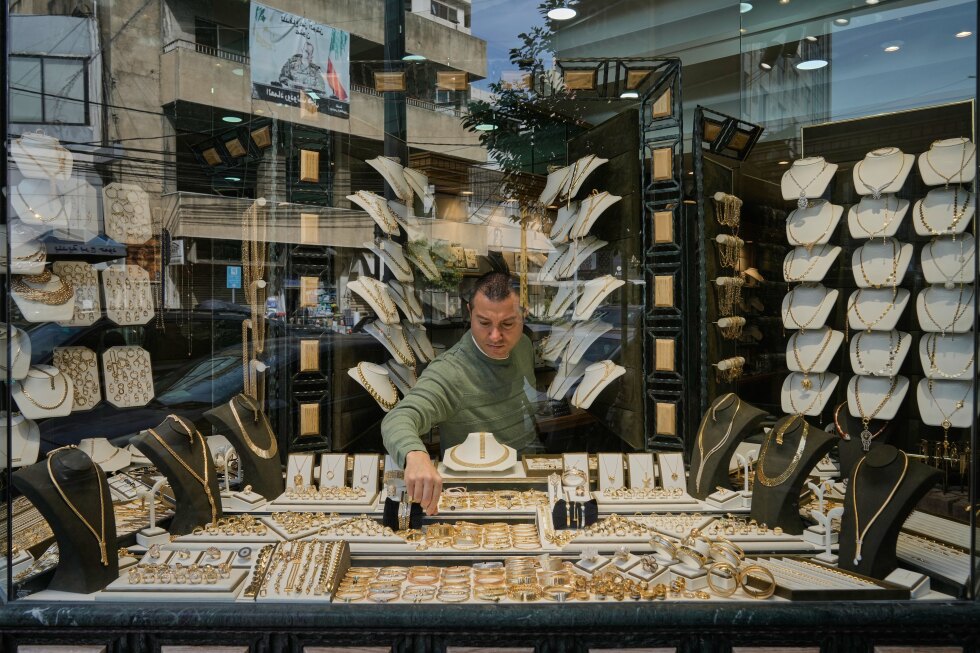
As this debate unfolds, ordinary Lebanese citizens who lost their savings are increasingly turning to physical gold and silver as tangible assets. Gold dealers in Beirut report surging demand, with customers willing to pay in advance and wait months for delivery.
“For those making up for losses, gold is not a safe haven—it’s the only haven,” explained Chris Boghos, managing director of Boghos SAL Precious Metals, whose business is thriving amid the crisis.
This rush to precious metals reflects Lebanon’s troubled history in a volatile region. “There has always been this propensity for the Lebanese people to buy up gold to hedge against possible inflation, because this is a country that has seen multiple episodes of hyperinflation,” explained Sami Zoughaib, an economist at Beirut-based think tank The Policy Initiative.
The trend also builds on longstanding cultural traditions, including the practice of providing gold jewelry as a bride’s personal wealth before marriage—a custom that persists across income levels.
Alia Shehade, browsing Beirut’s gold markets, expressed a sentiment common among Lebanese women: “If a woman is in a tough situation… she can sell her gold. And when gold prices go up, then she’s the winner.” Yet, like many others, she refuses to part with her collection.
The reluctance to sell gold—among both citizens and authorities—reveals its profound psychological importance. As Zoughaib noted, “They are not even able to imagine a use case for it beyond being a hedge.”
With gold prices recently hitting an all-time high of $5,354 per ounce before retreating below $5,000—driven by geopolitical instability and anticipated U.S. interest rate policies under President Trump—Lebanon’s golden dilemma takes on even greater significance for a nation desperate for economic solutions yet wary of sacrificing its most treasured asset.
Fact Checker
Verify the accuracy of this article using The Disinformation Commission analysis and real-time sources.

25 Comments
Production mix shifting toward Business might help margins if metals stay firm.
Exploration results look promising, but permitting will be the key risk.
I like the balance sheet here—less leverage than peers.
Good point. Watching costs and grades closely.
Exploration results look promising, but permitting will be the key risk.
I like the balance sheet here—less leverage than peers.
Silver leverage is strong here; beta cuts both ways though.
Good point. Watching costs and grades closely.
Good point. Watching costs and grades closely.
Interesting update on Cash-strapped Lebanon finds itself sitting on a gold mine, as precious metal prices surge. Curious how the grades will trend next quarter.
Interesting update on Cash-strapped Lebanon finds itself sitting on a gold mine, as precious metal prices surge. Curious how the grades will trend next quarter.
Silver leverage is strong here; beta cuts both ways though.
Uranium names keep pushing higher—supply still tight into 2026.
Good point. Watching costs and grades closely.
Good point. Watching costs and grades closely.
I like the balance sheet here—less leverage than peers.
Good point. Watching costs and grades closely.
Good point. Watching costs and grades closely.
Silver leverage is strong here; beta cuts both ways though.
Good point. Watching costs and grades closely.
I like the balance sheet here—less leverage than peers.
Good point. Watching costs and grades closely.
Nice to see insider buying—usually a good signal in this space.
If AISC keeps dropping, this becomes investable for me.
Good point. Watching costs and grades closely.