


Listen to the article
California’s Unused Gas Price Protection Law Under Scrutiny as Prices Soar
Three years ago, California created groundbreaking legislation designed to shield drivers from volatile oil markets by allowing regulators to cap refinery profits and penalize companies for price gouging. Despite Governor Gavin Newsom declaring that “California took on Big Oil and won,” this landmark law has never been implemented. Instead, the California Energy Commission voted last year to delay the rules for five years.
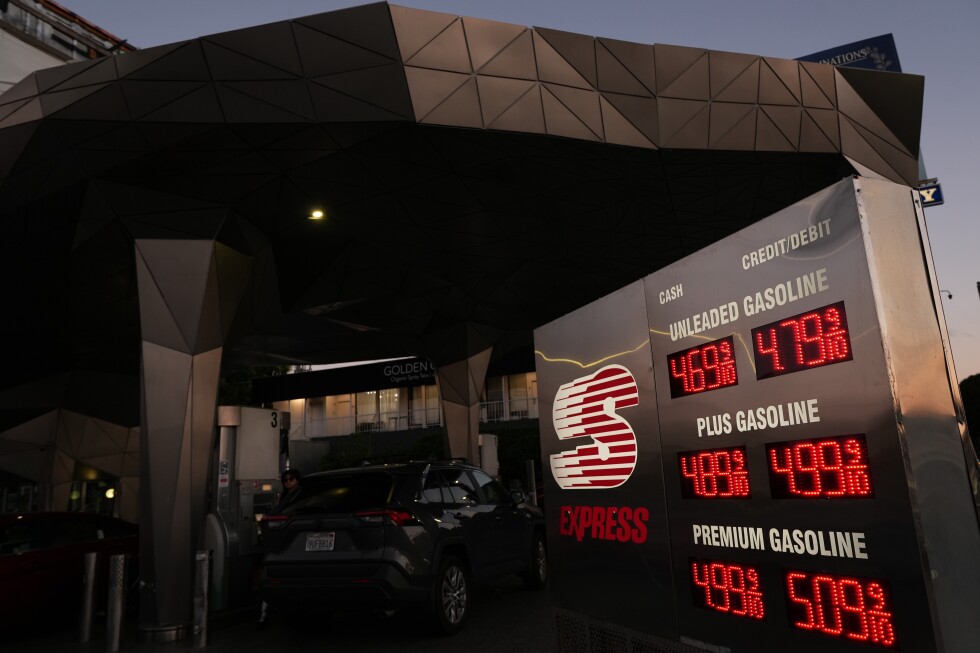
With gasoline prices now exceeding $5.30 per gallon across California and the conflict in Iran sending global oil prices soaring, the decision to delay the law faces renewed scrutiny. While the Iran conflict contributes to higher prices nationwide, California’s unique market structure—characterized by fewer refineries, a captive market, and limited outside supply options—amplifies these increases locally.
“These are the moments we need them, because when the price of a commodity goes through the roof—be it crude oil or refined gasoline—that’s when companies make outrageous profits,” said Jamie Court, president of Consumer Watchdog.
Supporters of the delay argue it was a necessary concession to prevent refiners from leaving the state entirely. The situation highlights California’s energy dilemma: protecting consumers from an industry the state eventually wants to phase out, while still depending on that same industry for essential fuel supplies.
The Energy Commission’s decision to postpone the rules came after Newsom had already begun retreating from his confrontation with the oil industry. Despite initially pushing through sweeping new powers to curb gasoline price spikes in special legislative sessions, the governor shifted to a more conciliatory approach by last summer.
A commission analysis found Californians paid an unexplained premium of about 41 cents per gallon between 2015 and 2024, costing drivers an estimated $59 billion. “What that information shows is that Californians are at the mercy of a very few refiners with immense power,” said Kassie Siegel, director of the Climate Law Institute at the Center for Biological Diversity.
California’s oil industry strongly opposed the measures. UC Berkeley energy economist Severin Borenstein cautioned that capping refinery profits could backfire: “The last thing we need is to start trying to regulate refinery margins. As much as people don’t like high gasoline prices, they really, really hate gas lines.”
By August 2023, refinery closures were looming, and warnings of $8-a-gallon gasoline circulated in Sacramento. After Valero announced plans to close its Benicia refinery, Newsom directed the Energy Commission to “work closely with refiners” to ensure a “reliable supply of transportation fuels.” The commission’s recommendations aligned largely with industry requests, including a pause on the profit-cap rules.
Oil industry representatives maintain the decision was sensible. “The real problem is California is an energy island—we’re losing 17% of our refining capacity,” said Zachary Leary, a lobbyist for the Western States Petroleum Association.
California faces a challenging transition period as it moves toward its goal of phasing out fossil fuels by 2045 while still heavily dependent on gasoline. Phillips 66 shut its Los Angeles refinery last year, and Valero is closing its Benicia facility next month, both citing California’s difficult regulatory environment.
“If you start losing refineries—as we are going to—and you don’t have an alternative source of supply, we’re going to start getting price spikes when there’s any sort of disruption at one of our refineries,” Borenstein explained.
Siva Gunda, vice chair of the California Energy Commission, described this period as the “mid-transition,” warning it would not be smooth: “Every time you lose a refinery, it’s going to be a double-digit percent of refined fuel lost in California. So that abrupt transition will mean an abrupt increase in imports.”
The recent jump in gasoline prices primarily reflects global oil market disruptions tied to the Iran conflict. The international benchmark for crude oil has climbed more than $25 a barrel—typically translating to about 60 cents per gallon at the pump.
A key concern is the potential closure of the Strait of Hormuz, which previously carried more than 20 million barrels of oil daily—roughly one-fifth of global supply. Ryan Cummings, chief of staff at the Stanford Institute for Economic Policymaking, warned a prolonged closure could push crude prices above $130 or $140 per barrel, potentially driving California prices closer to $7 per gallon or higher.
As California grapples with these challenges, competing solutions have emerged. Some advocate for immediately implementing the profit-cap rules and requiring larger fuel inventories. Others focus on infrastructure, such as converting the Benicia refinery to a fuel import terminal or building the proposed Western Gateway Pipeline to bring refined gasoline from Midwest refineries.
With the profit-cap rules on hold until 2029, California may lose more refineries before then—and continue facing the gasoline price shocks Newsom once promised to solve in America’s most expensive fuel market.
Fact Checker
Verify the accuracy of this article using The Disinformation Commission analysis and real-time sources.

21 Comments
If AISC keeps dropping, this becomes investable for me.
Good point. Watching costs and grades closely.
Interesting update on California passed a law to curb spikes in gas prices. Why isn’t it using those powers now?. Curious how the grades will trend next quarter.
Good point. Watching costs and grades closely.
Good point. Watching costs and grades closely.
Nice to see insider buying—usually a good signal in this space.
The cost guidance is better than expected. If they deliver, the stock could rerate.
Good point. Watching costs and grades closely.
If AISC keeps dropping, this becomes investable for me.
Good point. Watching costs and grades closely.
Good point. Watching costs and grades closely.
I like the balance sheet here—less leverage than peers.
Good point. Watching costs and grades closely.
Good point. Watching costs and grades closely.
The cost guidance is better than expected. If they deliver, the stock could rerate.
Good point. Watching costs and grades closely.
Silver leverage is strong here; beta cuts both ways though.
Silver leverage is strong here; beta cuts both ways though.
Good point. Watching costs and grades closely.
Good point. Watching costs and grades closely.
Exploration results look promising, but permitting will be the key risk.