


Listen to the article
Behind the Scenes: Drone Technology Revolutionizes Olympic Winter Sports Coverage
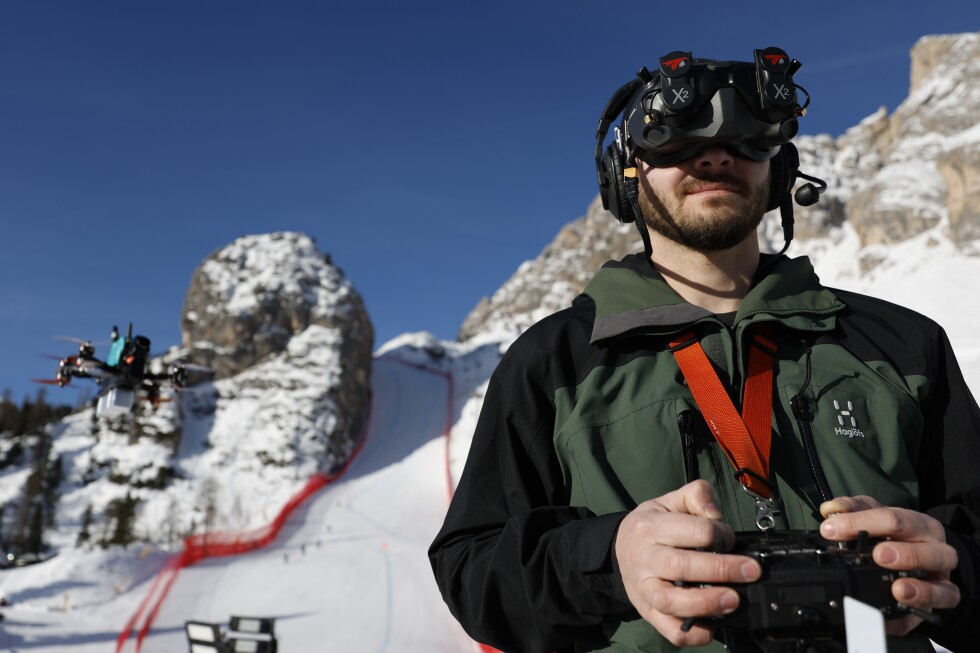
In the dramatic setting of Cortina d’Ampezzo, Italy, Martin Bochatay stands atop a tower overlooking the iconic Tofana schuss, a narrow passage between towering Dolomite rock walls. Unlike the athletes preparing to hurtle down the slopes below, Bochatay’s focus is not on a gold medal but on capturing the perfect shot.
“In my mind, I’m not flying a drone. I’m flying with the skiers,” Bochatay told The Associated Press. “It’s an immersive thing. The skiers don’t see us. But I’m right there with them. You become the drone.”
Bochatay is part of an elite team of drone pilots whose work has transformed how viewers experience the Milan Cortina Winter Olympics. Their remotely piloted aircraft follow athletes down slopes, tracks, and jumps, providing breathtaking perspectives previously impossible to capture with traditional camera setups.
These aerial cameras have become a staple across virtually every winter sport at the Games, from Alpine skiing and snowboarding to luge and ski jumping. The technology offers unprecedented intimacy with the athletes’ experience, revealing the true speed and technical challenges they face.
“The skill of those drone pilots is just phenomenal,” noted U.S. bobsledder and flag bearer Frank Del Duca. “It gets a really unique perspective.”
While viewers may have noticed the distinctive humming sound of the drones during broadcasts, Norwegian downhiller Kajsa Vickhoff Lie assured that it doesn’t affect competitors: “No, you just maybe hear them on the start, but you don’t hear them when you ski.”
The technology has come a long way since its inauspicious debut in Alpine skiing 11 years ago, when a primitive, much larger drone crashed and nearly struck Austrian skiing legend Marcel Hirscher during a slalom race. Today’s Olympic drones are engineering marvels—lightweight at just half a pound (250 grams), incredibly agile, and capable of accelerating beyond 100 mph (170 kph).
Safety protocols are rigorous. The drones must maintain a safe distance behind athletes and are never permitted to overtake competitors. This ensures both athlete safety and optimal camera angles.
The technology behind these flying cameras is sophisticated. Each drone carries two cameras—a high-quality broadcast camera controlled remotely by television production teams and a lower-resolution camera that feeds directly to the pilot’s goggles, allowing them to navigate.
Piloting these machines requires exceptional skill. Operators use a two-handed remote control with dual switches to manage the drone’s pitch, roll, yaw, and throttle simultaneously.
“There’s always these four,” Bochatay explained. “It’s not like you move one then the other. It’s everything at the same time.”
The operation faces practical challenges too. Battery life is limited, especially in the cold alpine environments, requiring a dedicated “pit stop crew” to quickly swap depleted batteries between athlete runs. These batteries must be kept in warming cases to maintain their efficiency in frigid temperatures.
Olympic broadcasting officials focused on two key priorities with this technology: showcasing the stunning beauty of the venues and capturing the athletes’ perspective. The International Olympic Committee has expressed delight with the results, as the footage brings viewers closer to the action than ever before—sometimes uncomfortably so.
“Looking at the screen in the downhill, I almost feel motion sickness,” admitted Pierre Ducrey, the IOC’s sports director. “That’s how much we are able to project ourselves thanks to this new way of broadcasting the sport.”
U.S. bobsledder Elana Meyers Taylor shared similar sentiments: “I’m not concerned about the drone or anything like that, but I will say I was watching the luge footage the other day and I was like, ‘This is slightly nauseating.’ I don’t know if I could watch this all the way down the run.”
Despite occasional viewer vertigo, athletes appreciate how the technology showcases key aspects of their sports. As Norwegian skier Lie noted, “It’s cool to see the speed a little bit more for the spectators.”
The drone technology represents the latest evolution in sports broadcasting, offering unprecedented access to Olympic moments while highlighting both the natural beauty of the Italian Alps and the incredible athleticism on display at the Winter Games.
Fact Checker
Verify the accuracy of this article using The Disinformation Commission analysis and real-time sources.

14 Comments
Wow, the drone cams at the Olympics are a game-changer. Being able to get those up-close, dynamic perspectives must make the viewing experience so much more thrilling and engaging. I’m curious to see how they continue to push the boundaries of what’s possible with this technology in future Olympics.
Absolutely, the drone footage is truly next-level. It really puts you right in the middle of the action, which must be an incredible feeling for viewers. Can’t wait to see what other innovative camera techniques they come up with to enhance the Olympic viewing experience.
The drone footage from the Olympics is just stunning. It’s amazing how the pilots can fly those drones so precisely to capture those intimate, dynamic angles that put the viewer right in the action. That kind of immersive perspective must make the viewing experience so much more thrilling and engaging. Really looking forward to seeing more innovative camera work like this in future Olympics.
Absolutely, the drone cams are a game-changer. Those high-speed, up-close angles must make you feel like you’re actually racing alongside the athletes. It’s incredible how far this technology has come and I can’t wait to see how it continues to evolve and enhance the Olympic viewing experience.
Wow, the drone cams at the Olympics are taking sports coverage to a whole new level. Being able to get those immersive, up-close angles that make you feel like you’re right there with the athletes must be an incredible viewing experience. I’m really curious to see how this technology continues to evolve and transform the way we watch major sporting events.
The drone footage from the Olympics is truly impressive. Being able to get those intimate, dynamic perspectives that put the viewer right in the middle of the action must make the coverage so much more thrilling and engaging. I’m really curious to see how this technology continues to push the boundaries of what’s possible in sports broadcasting.
Drone technology has really revolutionized sports coverage, especially for high-speed winter events. Being able to capture those immersive, up-close perspectives must make viewers feel like they’re right there with the athletes. It’s amazing how far camera drones have come.
Absolutely, the drone footage looks incredible. It really puts you in the action and highlights the incredible skill and speed of the athletes. Can’t wait to see more of these dynamic visuals during the Olympics.
Drone technology is really transforming the way we experience and view winter sports at the Olympics. Those up-close, high-speed angles from the drone cams must be thrilling to watch. I can only imagine how much more intense and visceral it must feel for viewers compared to traditional camera setups.
Agreed, the drone footage is a game-changer. It’s amazing how they can pilot those drones to capture such intimate, dynamic perspectives that really place you in the action. Can’t wait to see how they continue to push the boundaries of what’s possible with this tech at future Olympics.
The drone footage from the Olympics is just stunning. It’s incredible how these pilots can fly the drones so precisely to capture those intimate, immersive angles. Really brings the viewer right into the action in a way traditional cameras just can’t match. Definitely a technological leap forward for sports broadcasting.
The drone cams at the Olympics are so impressive. Being able to get those intimate, dynamic angles that put the viewer right alongside the athletes must make the coverage so much more exciting and immersive. I’m really curious to see how this tech continues to evolve and change the way we experience major sporting events.
Fascinating to see how drone technology is transforming the viewing experience for winter sports. Putting viewers right in the thick of the action with the athletes must create a whole new level of excitement and engagement. I’m curious to see what other innovative camera angles and techniques they come up with.
Agreed, the drone shots are a game-changer. It’s like you’re riding alongside the skiers and snowboarders. Really gives you a visceral sense of the speed and intensity. Can’t wait to see more of these innovative camera perspectives during the Olympics.