


Listen to the article
UK Prime Minister Seeks to Rebuild Ties with China in Pragmatic Approach to Trade
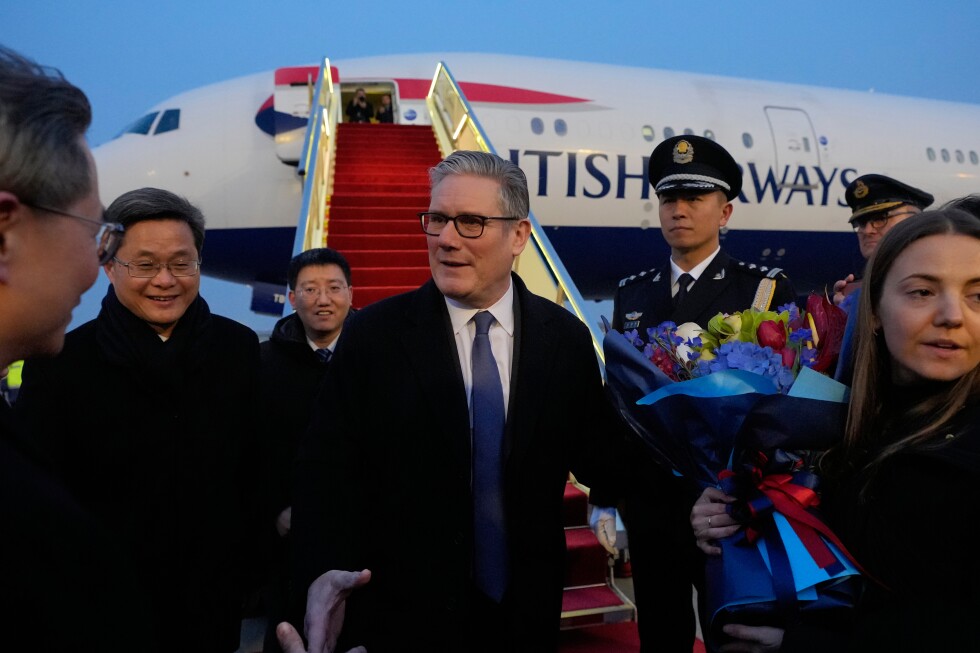
UK Prime Minister Keir Starmer arrived in Beijing on Wednesday, launching a four-day visit aimed at repairing strained relations and expanding economic opportunities for British businesses in China’s vast market, while carefully balancing security concerns.
“I’m a pragmatist, a British pragmatist applying common sense,” Starmer told reporters while en route to China, emphasizing that the UK would not have to choose between its relationships with the United States and China.
The visit marks the first by a British prime minister to Beijing since Theresa May in 2018. During the intervening years, bilateral relations deteriorated significantly over concerns about Chinese espionage, Beijing’s support for Russia in the Ukraine war, and its crackdown on civil liberties in Hong Kong, the former British colony.
Despite these tensions, both nations appear ready to pursue what Chinese Ambassador to the UK Zheng Zeguang described as “seeking common ground while managing differences” in a recent commentary for The Times of London.
Starmer’s Labour government, which has struggled to deliver promised economic growth since taking office, is bringing an impressive business delegation of more than 50 British executives, including representatives from major firms like British Airways, HSBC bank, and Jaguar Land Rover. His itinerary includes meetings with Chinese President Xi Jinping and other senior leaders in Beijing, along with a visit to Shanghai, China’s financial center and major port city.
Wang Yiwei, a European affairs expert at Renmin University of China, noted that Britain’s strengths in finance, consulting and other services align well with China’s growing demand for services such as healthcare and elderly care. “It’s a huge market,” Wang emphasized.
The trade relationship between the two nations remains heavily imbalanced in goods, with China exporting $85.1 billion to the UK in 2025 while importing just $18.6 billion worth, according to Chinese statistics. However, the UK maintains a surplus in services trade, an area where growth opportunities appear most promising.
“With recent Chinese policy directives focused on boosting domestic consumption and further opening the services sector to international businesses, we see significant opportunities for growth for UK businesses,” the China-Britain Business Council stated in anticipation of the visit.
The meeting comes at a pivotal moment in global trade relations. Many governments, including both Britain and China, have been buffeted by U.S. President Donald Trump’s protectionist trade policies and are seeking to diversify their overseas markets and supply chains. Canadian Prime Minister Mark Carney made a similar trip to China earlier this month with comparable objectives.
This approach carries risks, however. Trump has threatened to impose 100% tariffs on Canadian goods if Ottawa reaches a trade deal with Beijing. While Canada and China have a preliminary agreement to reduce tariffs on electric vehicles and agricultural products, Carney has explicitly stated that Canada has no intention of pursuing a comprehensive free trade agreement with China.
Finding the right balance in an increasingly uncertain global economy presents challenges for many nations. Even China, often viewed as challenging American global dominance, must maintain workable relations with the U.S., as evidenced by Trump’s planned April visit to Beijing. “We are not against but we criticize,” Wang observed.
Security concerns remain a significant complication in UK-China relations. Rising apprehension about Chinese espionage and surveillance has prompted the UK to bar Chinese investment in sensitive telecommunications infrastructure and nuclear power plants, which has soured ties.
Starmer’s government has indicated it will protect national security while maintaining diplomatic dialogue and economic cooperation. In a recent move that may help improve relations, the UK approved plans for a large Chinese Embassy in London, overriding critics who argued the “mega-embassy” would facilitate espionage and intimidation of dissidents.
Human rights issues present particular challenges for British leaders due to the UK’s historical ties to Hong Kong. Starmer’s visit comes less than two months after Hong Kong courts convicted Jimmy Lai, a British citizen and former newspaper publisher, under the national security law imposed by Beijing following pro-democracy protests in 2019.
Chris Patten, who served as the last British governor of Hong Kong from 1992 to 1997, has urged Starmer to firmly address Lai’s imprisonment and other human rights concerns during his meetings with Chinese officials.
As global economic uncertainty grows, Starmer’s visit reflects a pragmatic attempt to rebuild economic ties while managing complex political differences—a delicate balancing act that many Western leaders are attempting in their relations with China.
Fact Checker
Verify the accuracy of this article using The Disinformation Commission analysis and real-time sources.

32 Comments
If AISC keeps dropping, this becomes investable for me.
If AISC keeps dropping, this becomes investable for me.
Good point. Watching costs and grades closely.
Good point. Watching costs and grades closely.
Production mix shifting toward Business might help margins if metals stay firm.
Good point. Watching costs and grades closely.
Uranium names keep pushing higher—supply still tight into 2026.
Good point. Watching costs and grades closely.
Uranium names keep pushing higher—supply still tight into 2026.
Silver leverage is strong here; beta cuts both ways though.
Good point. Watching costs and grades closely.
Interesting update on British leader’s trip to China is a balancing act between trade, national security and Trump. Curious how the grades will trend next quarter.
Good point. Watching costs and grades closely.
Good point. Watching costs and grades closely.
Uranium names keep pushing higher—supply still tight into 2026.
Good point. Watching costs and grades closely.
The cost guidance is better than expected. If they deliver, the stock could rerate.
Good point. Watching costs and grades closely.
Good point. Watching costs and grades closely.
Silver leverage is strong here; beta cuts both ways though.
Good point. Watching costs and grades closely.
Good point. Watching costs and grades closely.
Nice to see insider buying—usually a good signal in this space.
Uranium names keep pushing higher—supply still tight into 2026.
Good point. Watching costs and grades closely.
Good point. Watching costs and grades closely.
Exploration results look promising, but permitting will be the key risk.
Good point. Watching costs and grades closely.
Good point. Watching costs and grades closely.
Uranium names keep pushing higher—supply still tight into 2026.
Good point. Watching costs and grades closely.
Good point. Watching costs and grades closely.