


Listen to the article
Oil Prices Surge as Middle East Tensions Disrupt Global Supply Routes
Brent crude oil traded near $105 per barrel on Monday as the conflict in the Middle East entered its third week, with Gulf countries reporting additional attacks by Iran. The international benchmark dipped slightly after opening above $106, but still remains more than 40% higher since hostilities began.
U.S. benchmark crude gained 1% to reach $99.68 per barrel, marking a nearly 50% increase since the conflict’s outbreak. These dramatic price movements reflect growing concerns about global oil supply disruptions as the situation deteriorates.
The crisis has effectively halted cargo traffic through the strategic Strait of Hormuz, a narrow waterway through which approximately one-fifth of the world’s oil normally passes. Oil producers have been forced to cut production as their crude shipments face significant logistical challenges.
“The truth is that at this point, much of the market is operating in the fog,” said Stephen Innes of SPI Asset Management. “For context, the strait normally handles roughly 25 oil and LNG tankers every single day.”
In just over a week since the closure of the Strait of Hormuz, more than 12 million barrels of oil equivalent per day have been taken offline, according to independent research firm Rystad Energy. While reports suggest a handful of tankers have managed to navigate the strait, considerable uncertainty remains about the reliability of these crucial shipping lanes.
The International Energy Agency has responded to the crisis by making a record 400 million barrels of oil available from emergency reserves. However, this intervention appears to have done little to reassure increasingly nervous energy markets.
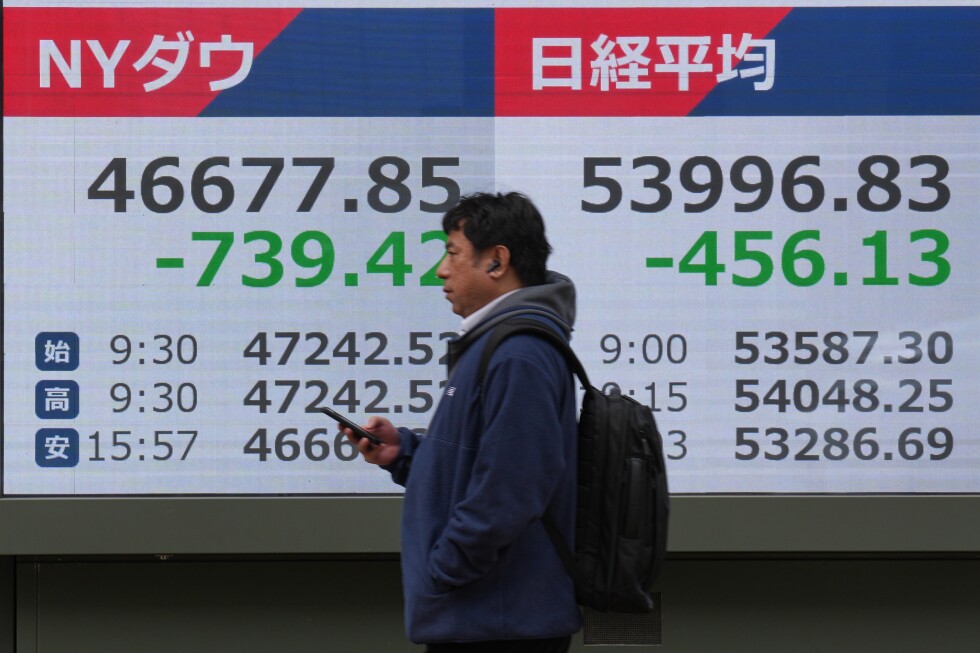
Global stock markets showed mixed reactions to the ongoing crisis. Tokyo’s Nikkei 225 fell 0.4% to 53,609.49, while Hong Kong’s Hang Seng rose 1.1% to 25,755.53. The Shanghai Composite shed 0.7% to 4,066.40, and Australia’s S&P/ASX 200 gave up 0.4% to 8,583.50. In South Korea, the Kospi climbed 0.6% to 5,521.17.
U.S. futures showed signs of optimism, with S&P 500 contracts up 0.5% and Dow Jones Industrial Average futures rising 0.4%. This comes after Wall Street experienced deepening losses on Friday as oil prices pushed above $100 per barrel, intensifying inflationary pressures on the global economy.
The S&P 500 fell 0.6% to 6,632.19 on Friday, bringing its year-to-date decline to 3.1%. The Dow Jones Industrial Average lost 0.3% to 46,558.47, while the Nasdaq composite finished 0.9% lower at 22,105.36. All three major indexes recorded their third consecutive weekly losses.
The prolonged disruption of oil supplies from the Persian Gulf threatens to trigger a damaging surge in inflation worldwide. This complicates the Federal Reserve’s efforts to lower interest rates and support economic growth. The U.S. central bank is not expected to cut rates at its policy meeting this week as it monitors these developments.
Recent economic data shows inflation was already creeping higher before the Middle East crisis caused oil and gas prices to spike. The Commerce Department reported that consumer prices rose 2.8% in January compared to a year earlier, while core prices (excluding volatile food and energy components) rose 3.1% – the highest increase in nearly two years.
Despite these inflationary pressures, consumers maintained solid spending habits, with expenditures increasing at a 0.4% pace in January, matched by income growth at the same rate. However, the University of Michigan’s latest consumer sentiment gauge declined slightly to its lowest reading of the year, reflecting concerns about rising gasoline prices since the conflict began.
The U.S. economy’s underlying growth has also shown signs of weakness. Economic activity in the October-December quarter expanded at a sluggish 0.7% annual rate, a downward revision from initial estimates. This slower growth was attributed in part to last fall’s 43-day government shutdown.
In currency markets, the U.S. dollar slipped to 159.47 Japanese yen from 159.55 yen, while the euro rose to $1.1442 from $1.1425.
Fact Checker
Verify the accuracy of this article using The Disinformation Commission analysis and real-time sources.

11 Comments
It’s concerning to see the Gulf region facing further attacks, which are directly impacting global energy markets. Investors will likely remain cautious until there are signs of de-escalation and a restoration of normal shipping operations in the Strait of Hormuz.
The volatility in crude oil prices underscores the sensitivity of global energy markets to regional conflicts. Diversifying energy sources and enhancing supply chain resilience will be crucial to maintaining stability and reducing vulnerabilities.
The sharp rise in Brent crude and WTI prices highlights the tight global oil market and supply-demand dynamics. While higher prices may impact economic growth, it could also incentivize increased investment and production in the energy sector.
That’s a fair point. Elevated oil prices could spur greater exploration and development activity, especially in key producing regions. However, geopolitical risks will need to be carefully managed to ensure a stable and reliable energy supply.
It’s concerning to see the continuing attacks in the Gulf region and the impact on global oil supply. While higher prices may benefit some energy producers, the broader economic implications of this disruption are worrying.
Agreed. The situation highlights the importance of energy security and the need for a balanced, resilient global energy system that can withstand geopolitical shocks. Careful diplomacy and pragmatic policy solutions will be essential in the months ahead.
The geopolitical tensions in the Middle East are certainly impacting global oil supply and prices. It will be crucial to closely monitor the situation and any further disruptions to critical maritime trade routes like the Strait of Hormuz.
Absolutely. The volatility in crude oil prices underscores the vulnerability of the global energy system to these types of regional conflicts. Diversifying supply sources and enhancing energy security will be important priorities moving forward.
The surge in oil prices is a stark reminder of the fragility of global energy markets and the need for greater diversification and supply chain resilience. Investors will likely remain cautious until there are clear signs of de-escalation in the region.
The situation in the Middle East is undoubtedly complex, with far-reaching implications for the global economy. While higher oil prices may benefit some energy producers, the disruption to trade and supply chains is a significant concern that bears close watching.
You’re absolutely right. The ripple effects of this geopolitical tension could be felt across various industries and sectors. Policymakers will need to carefully navigate this delicate situation to mitigate the economic fallout.