


Listen to the article
New Orleans Krewes Embrace Eco-Friendly Alternatives to Traditional Mardi Gras Beads
As Carnival season unfolds in New Orleans, a transformation is taking place among the festive traditions that define the celebration. The iconic plastic Mardi Gras beads, once showered upon eager spectators by the handful, are facing growing scrutiny for their environmental impact.
The cheap plastic necklaces imported from overseas bear little resemblance to their glass predecessors, which were once cherished by those lucky enough to catch them. Today’s mass-produced beads often end up discarded on streets or piled into trash bins after the revelry ends. A few years ago, following severe flooding, city workers discovered more than 46 tons of beads clogging storm drains throughout New Orleans.
The Krewe of Freret made waves last year when they took the bold step of banning plastic beads entirely from their parade. “Our riders loved it because the spectators don’t value this anymore,” explained Greg Rhoades, co-founder of Freret. “It’s become so prolific that they dodge out of the way when they see cheap plastic beads coming at them.”
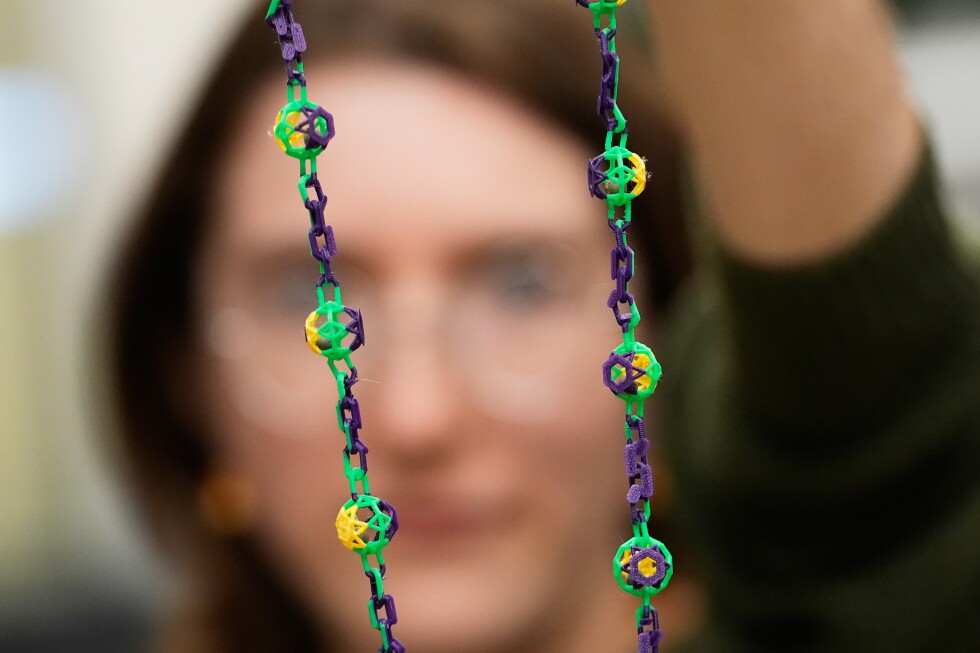
This year, beads are making a comeback in the Freret parade, but with a crucial difference. Freret is one of three krewes now throwing biodegradable beads developed at Louisiana State University. These innovative “PlantMe Beads” are 3D-printed from a starch-based material called polylactic acid (PLA).
LSU graduate student Alexis Strain described the beads as large hollow spheres containing okra seeds. The necklaces can actually be planted, with the okra attracting bacteria that help the beads decompose naturally.
The environmental toll of traditional Mardi Gras celebrations extends beyond aesthetics. Kristi Trail, executive director of the Pontchartrain Conservancy, points out the dual problem posed by plastic beads: “First, they clog the storm drains, leading to flooding. Then those that aren’t caught in the drains are washed directly into Lake Pontchartrain, where they can harm marine life.”
The conservancy is preparing to study microplastics in the lake, highlighting growing concerns about long-term environmental damage from Carnival festivities. While efforts toward a more sustainable Mardi Gras have been gaining momentum for years, Trail notes that comprehensive data on their impact remains limited. However, a recent grant should help researchers better assess these initiatives moving forward.
“Beads are obviously a problem, but we generate about 2.5 million pounds of trash from Mardi Gras,” Trail added, emphasizing the scale of the environmental challenge.
The biodegradable bead project began in 2013 when Professor Naohiro Kato, an associate professor of biology at LSU, spoke with locals concerned about Mardi Gras’ environmental footprint. As a plant biologist, Kato recognized that bioplastics could be produced from plants and began exploring possibilities.
The first prototype came in 2018 with beads made from microalgae-derived bioplastic. Though innovative, production costs proved prohibitively expensive compared to petroleum-based alternatives. The breakthrough came when Strain began experimenting with 3D printing, leading to the more economical PlantMe Beads.
For the 2026 Carnival season, LSU students have produced 3,000 PlantMe Bead necklaces for three krewes, offering them in exchange for design feedback and spectator reception reports.
Ironically, Kato noted that people have expressed a desire to keep the PlantMe Beads as souvenirs due to their uniqueness. “So wait a minute, if you want to keep it, the petroleum-plastic Mardi Gras bead is the best, because this won’t last,” he observed.
The LSU lab continues refining sustainable alternatives. Strain is testing different 3D printer materials that biodegrade quickly without needing to be planted, while Kato envisions turning bead production into educational community projects with local schools. Students could learn about bioplastics and plant biology while creating parade throws.
For Kato, the ultimate goal extends beyond simply replacing one type of bead with another. He hopes Mardi Gras will embrace a broader philosophy of waste reduction.
The Krewe of Freret appears aligned with this vision. “In 2025, we were the first major parading organization to say, ‘No more cheap beads. Let’s throw things that people value, that people appreciate, that can be used year-round,'” Rhoades said.
Among Freret’s most sought-after throws are baseball hats bearing the krewe’s logo, which Rhoades regularly spots being worn around the city. He believes their approach is influencing larger krewes, who also want their throws to become treasured keepsakes rather than temporary trinkets.
“They want people to take their stuff home, and use it, and talk about it, and post it on social media, and say, ‘Look what I just caught!'” Rhoades said, suggesting that the future of Mardi Gras traditions may be both more sustainable and more meaningful.
Fact Checker
Verify the accuracy of this article using The Disinformation Commission analysis and real-time sources.

6 Comments
Kudos to the Krewe of Freret for taking the lead on banning plastic beads. It’s great to see New Orleans Krewes embracing more sustainable options, even if it means breaking with long-standing traditions. Curious to see if other parades follow suit in the coming years.
I agree, the Krewe of Freret deserves recognition for their bold decision. Implementing sustainable changes can be challenging, especially for events steeped in tradition, so their leadership on this issue is commendable.
While it’s great to see progress on making Mardi Gras more sustainable, I wonder about the economic impacts on businesses that have relied on selling plastic beads over the years. Hopefully the transition can be managed in a way that supports local jobs and livelihoods.
The statistic about 46 tons of beads clogging storm drains is eye-opening. It really underscores the scale of the waste problem from the cheap, mass-produced Mardi Gras beads. Transitioning to biodegradable alternatives seems like a necessary and overdue step.
Interesting to see the shift towards more sustainable Mardi Gras traditions in New Orleans. The plastic bead waste issue seems quite severe, so finding eco-friendly alternatives is a smart move. I wonder how the public has responded to the changes so far.
I’m curious to learn more about the types of biodegradable bead materials being used as alternatives. Are they made from plant-based or recycled materials? It will be interesting to see how the durability and cost-effectiveness compare to traditional plastic beads.