


Listen to the article
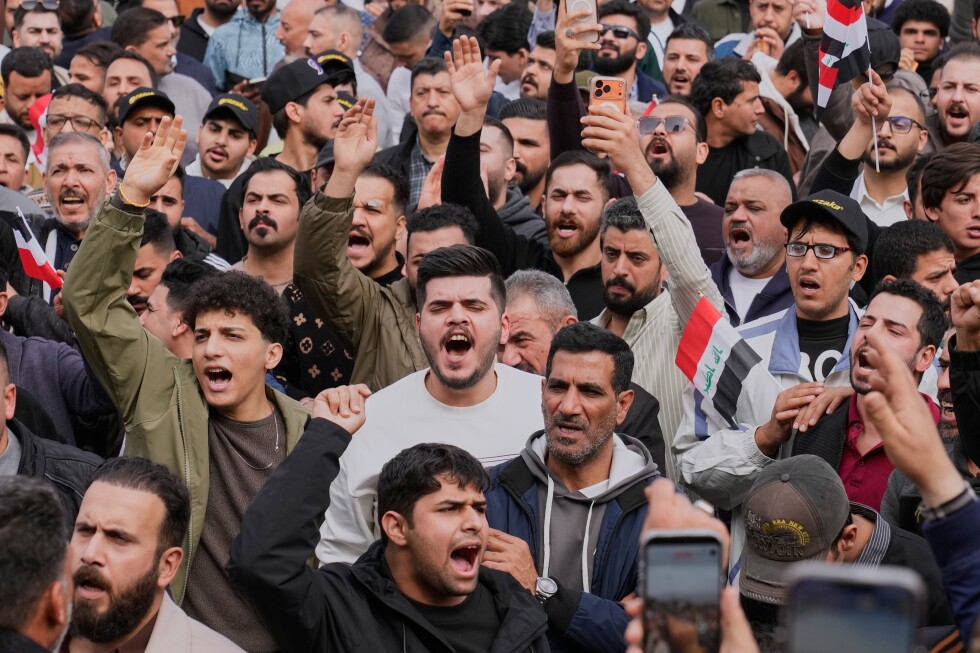
Hundreds of Iraqi traders and customs clearance company owners took to the streets of central Baghdad on Sunday to protest against new customs tariffs that have dramatically increased import costs and disrupted commerce throughout the country.
The controversial tariffs, which took effect on January 1, were implemented by the Iraqi government as part of broader fiscal reforms aimed at reducing the nation’s substantial debt burden and decreasing its heavy dependence on fluctuating oil revenues. Iraq currently faces a debt of more than 90 trillion Iraqi dinars ($69 billion) and relies on oil for approximately 90% of government revenues, a vulnerability exposed by recent oil price declines.
Demonstrators gathered outside the General Customs Directorate, voicing their opposition with chants against corruption and the new fee structure. Many carried banners highlighting the economic impact on everyday Iraqis, while simultaneously accusing the government of implementing policies that primarily harm small businesses and consumers.
“We used to pay about 3 million dinars per container, but now in some cases they ask for up to 14 million,” explained Haider al-Safi, owner of a transport and customs clearance company. “Even infant milk fees rose from about 495,000 dinars to nearly 3 million.”
The steep increases, which reach up to 30% on some goods, have created significant bottlenecks at key entry points like the Umm Qasr port in southern Iraq, the country’s primary gateway for imported goods. Al-Safi also noted that electric vehicles, previously exempt from customs duties in line with global green initiatives, now face a 15% import fee.
This policy shift comes at a particularly challenging economic moment for Iraq, where inflation and unemployment have already strained household budgets. The impact extends well beyond the import sector, with consequences rippling through retail markets as higher costs are passed on to consumers.
“The main victim is the citizen with limited income, and government employee whose salary barely covers his daily living, those who have to pay rent, and have children with school expenses — they all will be affected by the market,” said Mohammed Samir, a wholesale trader from Baghdad.
The protests coincided with a nationwide strike by shop owners, who closed markets and stores across several districts of Baghdad. Major commercial areas remained shuttered, with businesses displaying banners reading “Customs fees are killing citizens,” highlighting the unified opposition to the government’s fiscal policy.
Protesters also leveled serious allegations of corruption within the customs system, claiming that influential groups are facilitating the release of goods in exchange for unofficial payments that bypass the official tariff structure. This alleged parallel system not only undermines government revenue goals but also creates an uneven playing field for businesses without such connections.
In response to the increased costs at federal entry points, many traders are reportedly considering rerouting their imports through Iraq’s semi-autonomous Kurdistan region, where customs fees remain lower. This potential shift could further complicate the central government’s revenue collection efforts and create tensions between Baghdad and Erbil.
The controversy has reached Iraq’s judiciary, with opponents filing a legal challenge seeking to overturn or modify the tariff increases. The Federal Supreme Court is scheduled to rule on the matter this Wednesday, a decision that could have far-reaching implications for Iraq’s economic policy and governance.
Economists note that while Iraq’s need to diversify revenue sources is legitimate, the abrupt implementation of such significant tariff increases without adequate transition measures risks destabilizing markets and potentially driving more commerce into informal channels, ultimately reducing rather than increasing government revenue.
As the standoff continues, the Iraqi government faces the difficult task of balancing fiscal reform needs with the immediate economic realities facing its citizens and business community during an already challenging economic period.
Fact Checker
Verify the accuracy of this article using The Disinformation Commission analysis and real-time sources.

8 Comments
The protesters in Baghdad raise a valid point – these tariff hikes are significantly impacting everyday Iraqis and small businesses. While fiscal reform is needed, the government should carefully weigh the economic consequences before implementing such dramatic changes.
Absolutely. Gradual, well-considered reforms would likely be more effective than sudden, drastic measures that disrupt trade and harm consumers. Hopefully the government can find a more balanced approach.
The protests in Baghdad highlight the real-world impact of these new customs tariffs. While reducing Iraq’s debt burden is important, the government needs to be careful not to damage the domestic economy in the process. Striking the right balance will be critical going forward.
The new customs tariffs in Iraq seem like a double-edged sword. While the government is trying to reduce debt and dependence on oil, the higher costs are really hurting small businesses and consumers. It will be interesting to see how the government balances these competing priorities.
Interesting to see the protests in Baghdad over the new customs tariffs. Reducing Iraq’s reliance on oil revenues is understandable, but the government needs to carefully consider the economic impact on the ground. Hopefully they can find a middle ground that works for both the national budget and the local traders.
Agreed. The government needs to listen to the concerns of the local business community and find ways to implement reforms that don’t overly burden small enterprises. Getting the balance right will be crucial.
Iraq’s reliance on oil revenue is understandable given the country’s resources, but diversifying the economy is crucial. These new tariffs, however, seem to be creating more problems than solutions. The government needs to find a way to reduce debt without overburdening local businesses and traders.
Iraq’s heavy dependence on oil revenues is certainly a vulnerability, but these new tariffs seem to be causing real disruption to the local economy. I hope the government can find ways to shore up its finances without such steep increases in import costs.