


Listen to the article
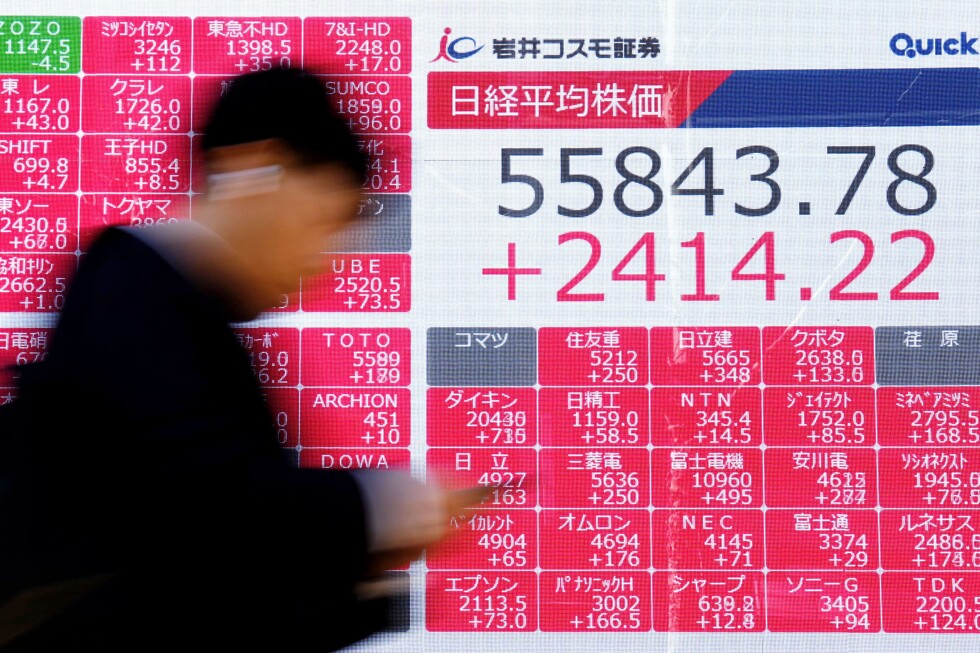
Asian markets surged Wednesday morning as a newly announced two-week ceasefire between the United States and Iran triggered a dramatic plunge in oil prices, relieving pressure on global markets that have been volatile since hostilities began in late February.
The agreement includes the reopening of the strategic Strait of Hormuz, a crucial maritime chokepoint through which approximately 20% of the world’s oil supply passes daily. The strait’s effective blockade during the conflict had sent energy prices soaring and rattled global markets.
Japan’s benchmark Nikkei 225 led the regional rally with a 5.0% gain to 56,106.18. South Korea’s Kospi posted an even more dramatic increase of 5.9% to 5,819.97, while Australia’s S&P/ASX 200 jumped 2.6% to 8,952.30. Chinese markets also participated in the upswing, with Hong Kong’s Hang Seng rising 2.6% to 25,767.42 and the Shanghai Composite adding 1.7% to reach 3,957.55.
The ceasefire announcement sent oil prices plummeting. Benchmark U.S. crude sank $16.84 to $96.11 a barrel, while Brent crude, the international standard, dropped $14.51 to $94.76 a barrel. These steep declines directly reflect the expected restoration of normal shipping through the Strait of Hormuz, particularly significant for resource-dependent economies like Japan.
“Yet the mood remains one of cautious optimism rather than outright celebration,” said Tim Waterer, chief market analyst at KCM Trade. “The ceasefire is only two weeks long, and markets will be watching closely to see whether shipping through the Strait of Hormuz normalizes as promised and whether the fragile truce can pave the way for a more durable peace agreement.”
The breakthrough came after President Trump announced late Tuesday he would temporarily suspend threatened attacks on Iranian civilian infrastructure, including bridges and power plants. In response, Iran’s foreign minister stated that passage through the strait would be permitted for the next two weeks under Iranian military management.
The timing proved critical, as Trump had established an 8 p.m. Eastern time deadline for Iran to open the waterway. Diplomatic efforts intensified in the final hours, with Pakistan’s prime minister urging Trump to extend his ultimatum by two weeks while simultaneously pressing Iran to reopen the strait.
The last-minute diplomatic resolution provided relief to Wall Street, where markets rallied in late trading. The S&P 500 erased earlier losses to finish with a modest 0.1% gain. The tech-heavy Nasdaq composite also added 0.1%, while the Dow Jones Industrial Average dipped slightly by 0.2%.
Bond markets similarly reflected the easing of geopolitical tensions, with the yield on the 10-year Treasury falling to 4.24% from 4.30% earlier Tuesday, indicating investors moving back toward government securities after fleeing to safer assets during the conflict’s escalation.
Currency traders also responded to the changing dynamics, with the U.S. dollar weakening to 158.54 Japanese yen from 159.52 yen. The euro strengthened against the dollar, rising to $1.1671 from $1.1597.
The temporary nature of the agreement keeps market participants vigilant, however. Analysts caution that sustainable recovery depends on whether the ceasefire holds and evolves into a more permanent resolution. The two-week window provides breathing room but leaves significant uncertainty about longer-term regional stability.
Energy markets will likely remain sensitive to developments in the Persian Gulf, with traders closely monitoring shipping volumes through the strait as a key indicator of whether the agreement is being implemented effectively. For oil-importing nations across Asia, the resumption of normal shipping operations represents a critical step toward economic stabilization after weeks of price volatility.
Fact Checker
Verify the accuracy of this article using The Disinformation Commission analysis and real-time sources.

10 Comments
Impressive gains across the major Asian indexes. The markets clearly see this ceasefire as a positive development for the economic outlook in the region.
I’m curious to see how long this ceasefire will hold and whether it leads to a more lasting peace agreement. Geopolitical tensions in the Middle East remain fragile.
That’s a good point. Even a temporary truce could provide some breathing room, but a durable diplomatic solution would be ideal for stabilizing the region.
The surge in Asian shares is an encouraging sign. This conflict had been weighing heavily on global markets, so the ceasefire is a much-needed de-escalation.
Lower oil prices will be a welcome relief for energy-intensive industries like mining. Hopefully this leads to more investment and job growth in the sector.
This ceasefire is very welcome news for the global economy. Restored oil shipments through the Strait of Hormuz should help stabilize energy markets and ease pressure on manufacturing and transportation.
With the ceasefire and plunging oil prices, this could be a good opportunity for companies to lock in more favorable fuel and transportation costs. Smart planning could pay dividends.
Glad to see the plunge in oil prices after the ceasefire announcement. This should provide some relief to businesses and consumers struggling with high energy costs.
Absolutely. Lower fuel prices will be a big boost, especially for energy-intensive industries like mining and commodities.
The restoration of the Strait of Hormuz for shipping is crucial for global commodities trade. This should help ease supply chain disruptions and price volatility.