


Listen to the article
Asian Markets Tumble as Oil Prices Surge Amid Middle East Tensions
Asian markets retreated sharply on Thursday, following a slump on Wall Street as oil prices spiked above $110 per barrel amid escalating tensions in the Middle East. The market selloff reflects growing concerns about inflation and diminishing hopes for interest rate cuts.
Brent crude, the international benchmark, jumped 3.9% to $111.51 per barrel early Thursday, while U.S. benchmark crude gained 0.5% to $95.97. Natural gas prices also climbed, with the Henry Hub futures contract, the U.S. benchmark, rising 4.6%.
The price surge follows Iran’s state television announcement that the Islamic Republic plans to attack oil and gas infrastructure in Qatar, Saudi Arabia, and the United Arab Emirates in retaliation for strikes on facilities associated with its offshore South Pars natural gas field. These developments have severely disrupted energy production in the Persian Gulf, a region critical to global oil supplies.
“If the disruptions keep oil and gas prices high for long, they could create a debilitating wave of inflation for the global economy,” noted market analysts monitoring the situation.
In Tokyo, the Nikkei 225 dropped 2.5% to 53,875.94 after the Bank of Japan decided to hold its benchmark interest rate at 0.75%. The central bank explicitly cited the Middle East conflict as a factor in its decision, stating in its monetary policy announcement that “in the wake of increased tension in the Middle East, global financial and capital markets have been volatile and crude oil prices have risen significantly; future developments warrant attention.”
The decision reflects Japan’s particular vulnerability to oil price shocks, as the country depends heavily on imports of raw materials for industries reliant on oil and its derivatives.
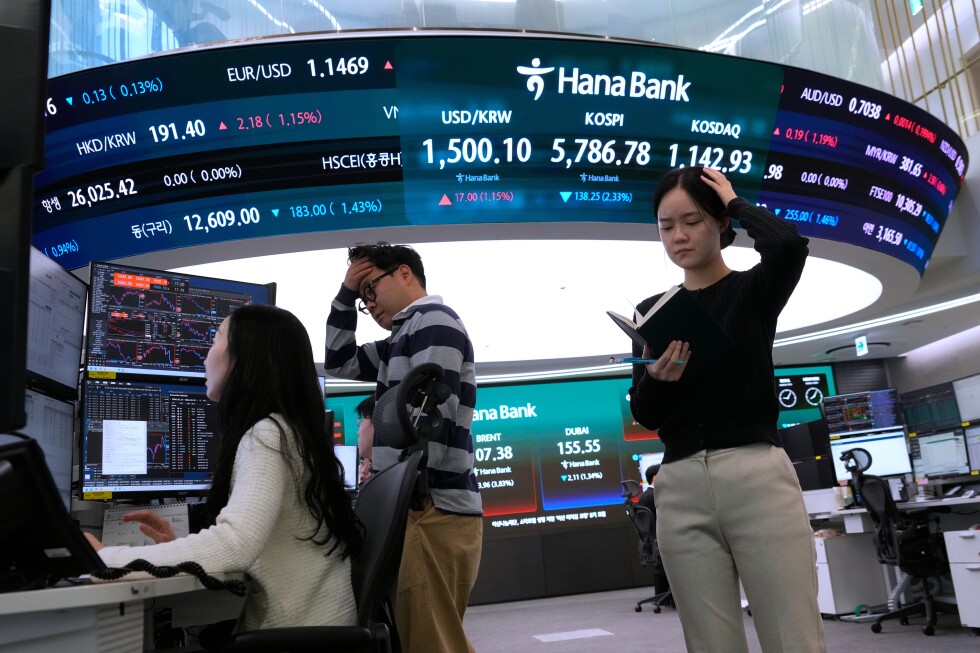
Other Asian markets also declined, with South Korea’s Kospi falling 1.3% to 5,845.62 and Hong Kong’s Hang Seng slipping 0.2% to 25,725.77. The Shanghai Composite shed 0.9% to 4,027.73, while Australia’s S&P/ASX 200 and Taiwan’s Taiex declined by similar margins.
Stephen Innes of SPI Asset Management described the market environment as treacherous for regional investors: “The combination of higher oil, rising U.S. yields, and a stronger dollar is acting as a macro wrecking ball across Asian assets and currencies.”
The selloff in Asia followed significant losses on Wall Street, where the S&P 500 fell 1.4% to 6,624.70 on Wednesday, erasing its gains for the week. The Dow Jones Industrial Average dropped 1.6% to 46,225.15, and the tech-heavy Nasdaq composite slid 1.5% to 22,152.42.
The U.S. market decline deepened after Federal Reserve officials kept interest rates steady, backing away from the rate-cutting cycle that investors have been anticipating. Fed Chair Jerome Powell expressed uncertainty about the trajectory of oil prices and the full impact of President Trump’s tariffs, signaling a cautious approach to monetary policy.
Adding to market concerns, a report released Wednesday showed that inflation at the U.S. wholesale level unexpectedly accelerated last month to 3.4%, indicating that price pressures were building even before the recent geopolitical escalation.
The combination of higher inflation expectations and the Fed’s pause on rate cuts pushed Treasury yields higher, further strengthening the U.S. dollar, which has been gaining against major currencies since the Middle East conflict intensified.
In currency markets, the dollar traded at 159.70 Japanese yen early Thursday, slightly down from 159.88 yen, while the euro edged up to $1.1478 from $1.1453.
Market analysts now warn that sustained high energy prices could trigger a protracted inflationary cycle, complicating central banks’ efforts to balance growth and price stability in an increasingly uncertain global environment.
Fact Checker
Verify the accuracy of this article using The Disinformation Commission analysis and real-time sources.

8 Comments
The news about Iran’s potential retaliatory attacks on energy infrastructure in the Middle East is very concerning. Maintaining stable oil and gas supplies is crucial for the global economy. Hope diplomacy can de-escalate the tensions before they cause further disruptions.
Absolutely. Any major disruptions to energy production in the region would have severe ripple effects worldwide. Geopolitical risks are a constant challenge for the global commodity markets.
The jump in oil and natural gas prices is certainly eye-catching. Curious to see how energy-intensive industries like utilities, transportation, and chemicals will be affected. Hoping the geopolitical tensions can be resolved without further disruptions to critical energy infrastructure.
Agreed. Energy costs are a major input for many businesses, so sustained high prices could really squeeze profit margins. Diversifying energy sources and improving efficiency will be crucial for companies to manage these headwinds.
Concerning to see the sharp selloff in Asian markets amid surging oil prices. Geopolitical tensions in the Middle East seem to be disrupting global energy supplies, exacerbating inflation pressures. Wonder how long this volatility will last and what the broader economic impact might be.
Yes, the situation is quite worrying. Energy price shocks can ripple through the global economy, impacting everything from manufacturing to consumer spending. Policymakers will need to carefully navigate this challenging environment.
The selloff in Asian shares is understandable given the surge in oil prices. With inflation already a major headwind, energy cost inflation could really put the brakes on economic growth. Curious to see how policymakers try to address this situation.
Quite a dramatic reaction in the markets to the surge in oil prices. With inflation already a major concern, further energy price spikes could derail the economic recovery. Curious to see how policymakers respond to try and stabilize the situation.