


Listen to the article
Asian markets showed mixed performance Tuesday as oil prices continued their upward trajectory amid escalating tensions between the United States and Iran. The surge comes as President Donald Trump’s deadline approaches for Iran to reopen the Strait of Hormuz to all shipping traffic or face military strikes on its infrastructure.
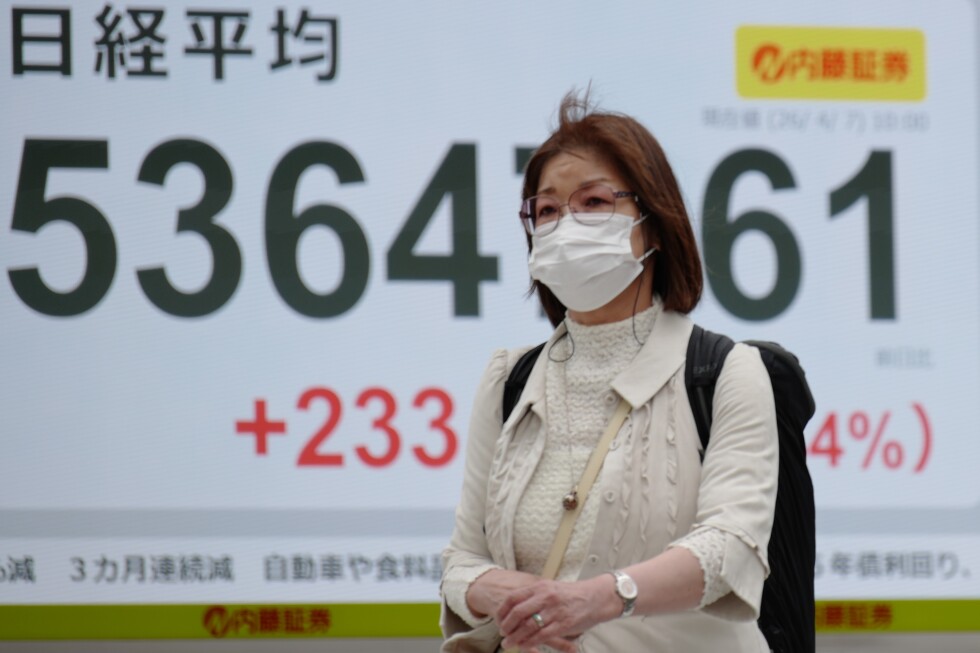
Japan’s Nikkei 225 declined 0.2% to 53,310.30, erasing earlier gains during morning trading. Meanwhile, Australia’s S&P/ASX 200 showed strong performance, rising 1.5% to 8,706.90. South Korea’s Kospi remained virtually unchanged with a negligible decrease of less than 0.1%, settling at 5,445.80. China’s Shanghai Composite edged up by 0.4% to 3,896.98, while Hong Kong’s market was closed for a holiday.
U.S. markets showed positive movement, with the S&P 500 rising 0.4% to 6,611.83, marking its first weekly gain after five consecutive weeks of losses. The Dow Jones Industrial Average added 165.21 points, reaching 46,669.88, while the Nasdaq composite climbed 0.5% to 21,996.34.
The energy sector continues to experience significant volatility, with benchmark U.S. crude jumping $2.37 to reach $114.78 a barrel. Brent crude, the international standard, added $1.40 to hit $111.17 a barrel. These prices remain substantially higher than pre-conflict levels, when oil traded around $70 per barrel.
The ongoing instability stems from Iran’s rejection of the latest ceasefire proposal on Monday. Instead of accepting temporary measures, Iranian officials have stated they seek a permanent resolution to the conflict. This stance has further complicated diplomatic efforts to normalize global oil supply chains.
Mizuho Bank’s research team in Singapore highlighted the gravity of the situation in their daily report, noting that Trump’s recent actions represent “an escalation cycle that has now been extended several times since his first ultimatum in late March.” The report expressed pessimism about a swift resolution, stating, “Given the differing perspectives, hopes of a complete resolution to the conflict remains elusive while countries continue to work on bilateral solutions.”
Behind the scenes, Iranian and Omani officials are working to develop a mechanism for administering the Strait of Hormuz, a critical maritime passage through which approximately one-fifth of the world’s oil typically flows during peacetime. Iran’s control of this strategic chokepoint has sent shockwaves through the global economy and energy markets.
The geopolitical tensions have also impacted bond markets, with Treasury yields holding relatively steady. The 10-year Treasury yield currently sits at 4.33%, notably higher than its 3.97% level before the conflict began. This increase reflects investors’ concerns about inflation risks and economic uncertainty stemming from higher energy prices.
In currency markets, the U.S. dollar strengthened slightly against the Japanese yen, rising to 159.89 from 159.62. Conversely, the euro weakened against the dollar, dropping to $1.1529 from $1.1543.
The situation underscores the interconnectedness of global markets and the far-reaching impact of geopolitical conflicts on financial stability. Energy analysts warn that prolonged disruption in the Strait of Hormuz could lead to further price increases across global commodities markets, potentially triggering inflationary pressures in many economies already struggling with post-pandemic recovery challenges.
As diplomatic efforts continue, market participants remain vigilant, closely monitoring developments that could either ease tensions or escalate the conflict to more dangerous levels. The coming days will be crucial as Trump’s deadline approaches, potentially marking a critical turning point in the standoff between the United States and Iran.
Fact Checker
Verify the accuracy of this article using The Disinformation Commission analysis and real-time sources.

14 Comments
The ongoing tensions with Iran are certainly creating a lot of uncertainty in the markets, particularly in the energy sector. It will be important to monitor how the situation develops and how it might impact commodity prices and overall economic conditions.
That’s a good point. The potential for disruptions to oil supply, whether through sanctions or military action, could have far-reaching consequences for both consumers and businesses. Careful analysis of the geopolitical risks will be crucial for investors navigating these volatile times.
It’s interesting to see the divergent performance across the different Asian markets. The surge in oil prices is certainly a key factor, but the broader economic conditions in each country likely play a role as well.
Absolutely. The regional differences highlight the importance of understanding the unique circumstances and drivers within each market, rather than taking a one-size-fits-all approach to analyzing the Asian equity landscape.
The mixed performance across the Asian markets is a testament to the complex and interconnected nature of global financial markets. It will be interesting to see how the situation with Iran evolves and how it might impact the commodities and energy sectors in the coming weeks.
Agreed. The potential for disruptions to oil supply, coupled with the broader economic and political factors at play, creates a challenging environment for investors. Staying informed and vigilant will be key to successfully navigating these uncertain times.
The mixed performance across Asian markets highlights the complex dynamics at play. It will be important to monitor how the situation with Iran develops and how it impacts commodity prices and equities in the coming weeks.
Absolutely. The uncertainty surrounding the Iran situation is creating a lot of market jitters. Prudent investors will likely be keeping a close eye on any new developments.
The mixed performance across Asian markets is a reflection of the complex geopolitical and economic factors at play. I’m curious to see how the situation with Iran evolves and how it might impact the commodities and energy sectors.
Agreed. The energy sector seems particularly vulnerable to the heightened tensions, and investors will likely be closely watching for any further developments that could disrupt supply and drive prices higher.
The surge in oil prices is quite significant, and it will be interesting to see how that affects consumer spending and the broader economy. I wonder if this could lead to increased inflationary pressures.
That’s a good point. Higher energy costs can have ripple effects throughout the economy, potentially squeezing consumer budgets and putting pressure on central banks to respond with monetary policy adjustments.
Interesting to see how the escalating tensions with Iran are impacting global markets. Curious to see how Trump’s deadline on Iran shipping plays out and how it might affect oil prices further.
Yes, the geopolitical uncertainty is certainly contributing to the volatility in the energy sector. I wonder if sanctions or military action could cause more disruptions to oil supply.